Ambrose of Milan
(339-397 AD)





Theology on the Web helps over 2.5 million people every year to find high quality theological resources that will help to equip them to serve God and to know Him better (2 Timothy 2:15). Like other websites that provide free services, it is dependent on donations to enable it to grow and develop and only 0.004% of visitors currently do so. If you would like to support this site, please use one of the options to the right of this message.
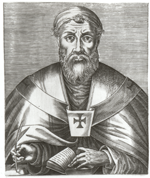
Ambrose of Milan (from
André Thevet)
Click on thumbnail for information on how
to
purchase a larger version of this image
(see copyright information)
Synopsis
Born the son of Aurelius Ambrosius, the imperial viceroy of Gaul,[1] Ambrose followed in his father's footsteps and became governor of Aemilia-Liguria (Northern Italy) in AD 370. He might well have remained in a political career had not dramatic events overtaken him. Ambrose had his official residence in Milan, where he was a catechumen in the church. When the bishop of the city, a pro-Arian named Auxentius died, the election of a new bishop was hotly contested by the Arian and Nicene parties within the church. The contest became so violent that Governor Ambrose was summoned to the church where the election was taking place because of reports of a riot. The story goes on to tell how someone shouted out "Bishop Ambrose!" a cry that was taken up and resulted in his being elected bishop.[2] Being only a catechumen he was hurriedly rushed through the various church orders and was ordained only eight days later, on 7th December 373.[3] Whatever the reasons for his election Ambrose proved his determination to succeed in his new position. His training and particularly his knowledge of Greek[4] set him in good stead. He devoted himself to prayer and to the study of both the Scriptures and pagan literature, rapidly becoming an accomplished preacher and writer.[5] His was able to read the works of the eastern writers in their original language and he made use of Philo, Origen, Athanasius, Didymus the Blind, Cyril of Jerusalem, Basil of Caesarea, Hippolytus of Rome and the Neoplatonist, Plotinus.[6] Ambrose is credited as being chiefly responsible for the final defeat of Arianism within the Western church.[7] Familiarity with Greek also enabled Ambrose to introduce allegorical interpretation to the western church.[8] He was deeply influenced by Philo and Origen, seeing in Scripture three levels of meaning: the literal, the moral and the allegorical, but also making use of typology.[9] His hermeneutic was of great help to Augustine, who refers to Ambrose in his Confessions, in removing his objections to the Old Testament Scriptures.[10]
Rob Bradshaw, Webmaster
References
[1] F. Homes Dudden, The Life and Times of St. Ambrose, Vol. 1. (Oxford: Clarendon Press, 1935), 2: "From his palace at Trier he administered a region roughly equivalent to the modern countries of France, Spain, Portugal, part of Germany, and Britain together with the islands of Sardinia, Corsica and Sicily."
[2] The story passed into the folklore of the early church and so may well have been embellished. See W.H.C. Frend, The Rise of Christianity. (Philadelphia: Fortress Press, 1984), 645, n.10 for references.
[3] Frend, Rise, 618; W.G. Rusch, The Later Christian Fathers. (London: Duckworth, 1977), 48.
[4] Which was becoming a rarity for western bishops by this time.
[5] Angelo Di Bernardino, ed. Patrology, Vol. 4. (Westminster, Maryland: Christian Classics, Inc., 1991), 145.
[6] Rusch, 49; Louis J. Swift, "Ambrose," Everett Ferguson, editor, Encylopedia of Early Christianity. (New York: Garland, 1990), 30.
[7] Rusch, 48.
[8] Hans von Campenhausen, The Fathers of the Latin Church, trans. Manfred Hoffman. (London: Adam & Charles Black, 1964), 94; Roland J. Teske, trans. Saint Augustine On Genesis. (Washington, D.C.: The Catholic University of America Press, 1991), 14-15.
[9] Swift, 30.
[10] Augustine, Confessions, 6.3.3-6.4.6 (NPNF, 1st series, Vol. 1, 91-92). For further details see next chapter.
Primary Sources
Secondary Sources
 |
Mary Charles-Murray, "They Speak to Us across the Centuries. 6. Ambrose," 109.8 Expository Times (1998): 228-231. |
|
R.H. Connolly, "Some Disputed Works of St. Ambrose," Downside Review 65 (1947): 7-20. |
|
George Demacopoulos, "Problematic Sources: A Survey of Recent Scholarship Concerning Ambrose of Milan and the Defeat of Western Homoianism," Greek Orthodox Theological Review 42.3-4 (1997): 359-373. |
|
Michael Gorman, "From Isidore to Claudius of Turin: The Works of Ambrose on Genesis in the Early Middle Ages," Revue des Etudes Augustiniennes 45.1 (1999): 121-138. |
 |
 R.P.C. Hanson, The Search for the
Christian Doctrine of God: The Arian Controversy 318-381. Edinburgh: T
& T Clark, 1988. ISBN: 0567094855. pp.954. R.P.C. Hanson, The Search for the
Christian Doctrine of God: The Arian Controversy 318-381. Edinburgh: T
& T Clark, 1988. ISBN: 0567094855. pp.954. |
|
John F. Johnson, "Creation and the Concept of Matter in the Theology of Ambrose," Concordia Journal 7. 3 (May 1981): 109–113. |
 |
![William Lefroy [1836-1909], ed., Church Leaders in Primitive Times](images/books3/church-leaders-in-primitive-times_lefroy-tb.jpg) Alfred Barry [1826-1910], "Life and Times of St. Ambrose," William Lefroy [1836-1909], ed., Church Leaders in Primitive Times. Lectures on Their Words and Works. Delivered in Norwich Cathedral by Eminent Anglican Devines, 2nd edn. London: Chas. J. Thynne, 1909. Hbk. pp.375-413. Alfred Barry [1826-1910], "Life and Times of St. Ambrose," William Lefroy [1836-1909], ed., Church Leaders in Primitive Times. Lectures on Their Words and Works. Delivered in Norwich Cathedral by Eminent Anglican Devines, 2nd edn. London: Chas. J. Thynne, 1909. Hbk. pp.375-413.  pdf [This material is in the Public Domain] pdf [This material is in the Public Domain] |
|
Andrew Lenox-Conyngham, "Natural and Positive Law in St. Ambrose of Milan," Colloquium 7.1 (Oct. 1974): 17–29. |
|
George E. Demacopoulos, "Problematic Survey: A Survey of Recent Scholarship Concerning Ambrose of Milan and the Defeat of Western Homoianism," The Greek Orthodox Theological Review 42. 3-4 (Fall 1997): 359-373. |
|
L.J. van der Lof, "The 'Prophet' Abraham in the writings of Irenaeus, Tertullian, Ambrose and Augustine," Augustiniana 44 (1994): 17-29. |
|
St. Ambrose (James F. Loughlin) |
|
Gerald A. Mccool, "The Ambrosian Origin of St. Augustine’s Theology of the Image of God in Man," Theological Studies 20.1 (March 1959): 62–81. |
|
M.P. McHugh, "Satan and St. Ambrose," Classical Folia 26 (1972): 94-106. |
|
M.P. McHugh, "The Demonology of St. Ambrose in the Light of the Tradition," Wiener Studien 12 (1978): 173-96. |
 |
 Neil B. McLynn, Ambrose of Milan: Church
and Court in a Christian Capital. Berkeley, California & London:
University of California Press, 1994. ISBN: 9780520914551. pp.436. [Sign-up to Perlego and access book instantly] Neil B. McLynn, Ambrose of Milan: Church
and Court in a Christian Capital. Berkeley, California & London:
University of California Press, 1994. ISBN: 9780520914551. pp.436. [Sign-up to Perlego and access book instantly] |
|
Richard Henry Malden [1879-1951], "St Ambrose as an Interpreter of Holy Scripture," Journal of Theological Studies 16 No 64 (July 1915): 509-522. pdf [This material is in the Public Domain] |
|
 John Moorhead, Ambrose. Church and Society in the Late Roman World. London: Routledge, 2014. ISBN: 9781317891017. pp.246. [Sign-up to Perlego and access book instantly] John Moorhead, Ambrose. Church and Society in the Late Roman World. London: Routledge, 2014. ISBN: 9781317891017. pp.246. [Sign-up to Perlego and access book instantly] |
|
C. Morino, Church and State in the Teaching of St. Ambrose. Washington, D.C.: Catholic University of Press, 1969. |
|
M. Poorthuis, "Who Is to Blame: Adam or Eve? A Possible Jewish Source for Ambrose's De Paradiso 12, 56," Vigiliae Christianae 50.2 (1996): 125-135. |
|
Kim E. Power, "Ambrose of Milan: Keeper of the Boundaries," Theology Today 53.1 (1998): 15-34. |
|
 Boniface Ramsey, Ambrose. London: Routledge, 2002. ISBN: 9781134815043. pp.251. [Sign-up to Perlego and access book instantly] Boniface Ramsey, Ambrose. London: Routledge, 2002. ISBN: 9781134815043. pp.251. [Sign-up to Perlego and access book instantly] |
|
Hugh M. Riley, Christian Initiation: A Comparative Study of the Interpretation of the Baptismal Liturgy in the Mystagogical Writings of Cyril of Jerusalem, John Chrysostom. Washington, D.C.: Catholic University of America Press, 1974. ISBN: 081320531X. |
|
George E. Saint-Laurent, "St. Ambrose of Milan and the Eastern Fathers," Diakonia 15.1 (1980): 23-31. |
|
George E. Saint-Laurent, "Augustine's Hero-Sage-Holy Man: Ambrose of Milan," Word and Spirit 9 (1987): 22-34. |
|
 Andrew Selby, Ambrose of Milan's On the Holy Spirit. Rhetoric, Theology, and Sources. Piscataway, NJ: Gorgias Press, 2020. ISBN: 9781463240868. pp.484. [Sign-up to Perlego and access book instantly] Andrew Selby, Ambrose of Milan's On the Holy Spirit. Rhetoric, Theology, and Sources. Piscataway, NJ: Gorgias Press, 2020. ISBN: 9781463240868. pp.484. [Sign-up to Perlego and access book instantly] |
|
J Warren Smith, "Justification and Merit before the Pelagian Controversy: The Case of Ambrose in Milan," Pro Ecclesia 16. 2 (Spring 2007): 195–217. |
|
L.J. Swift, "Saint Ambrose on Violence and War," Transactions of the American Philological Association 101 (1970): 533-43. |
|
L.J. Swift, "Justitia and ius privatum: Ambrose on Private Property," American Journal of Philology 100 (1979): 176-87. |
|
L.J. Swift, "Basil and Ambrose on the Six Days of Creation," Augustinianum 21 (1981): 317-28. |
|
W.S. Watt, "The Text of Ambrose's De officiis," Journal of Theological Studies 53.1 (2002): 112-118. |
|
Daniel H. Williams, Ambrose and the End of the Arian Nicene Conflicts. Oxford: Clarendon Press, 1995. Hbk. ISBN: 019826464X. pp.270. |
|
Michael Winterbottom, "The Text of Ambrose's De Officiis," Journal of Theological Studies 46.2 (1995): 559-566. |
Biographies
|
F. Homes Dudden [1874-1955], The Life and Times of St. Ambrose, 2 Vols. Oxford: Clarendon Press, 1935. (Out of print). |
|
![Frederic William Farrar [1831-1903], Lives of the Fathers. Sketches of Church History in Biography, 2 Vols](images/books3/lives-of-the-fathers_farrar-tb.jpg) Frederic William Farrar [1831-1903], Lives of the Fathers. Sketches of Church History in Biography, 2 Vols. London: Adam & Charles Black, 1907. Hbk. pp.781+737. pdf [This material is in the Public Domain] Frederic William Farrar [1831-1903], Lives of the Fathers. Sketches of Church History in Biography, 2 Vols. London: Adam & Charles Black, 1907. Hbk. pp.781+737. pdf [This material is in the Public Domain] |
|
A. Paredi, Saint Ambrose: His Life and Times. Notre Dame: University of Notre Dame Press, 1964. ISBN: 0268002398. pp.xii + 481. |
|
Robinson Thornton [1824-1906], St. Ambrose. his Life, Times and Teaching. The Fathers for English Readers. London: SPCK, 1879. Hbk. pp.215. pdf [This material is in the Public Domain] |
Related Subjects
 |
|
 |
|
 |
Alexander of Alexandria | Ambrose | Aristides | Arnobius | Athanasius | Athenagoras | Augustine | Basil | Boethius | John Cassian | Celsus | Clement of Alexandria | Clement of Rome | Constantine | Cyprian | Cyril of Alexandria | Cyril of Jerusalem | Ephraem the Syrian | Epiphanius | Eusebius of Caesarea | Gregory of Nazianzus | Gregory of Nyssa | Gregory Thaumaturgus | Hermas | Hilary of Poitiers | Hippolytus | Ignatius of Antioch | Irenaeus of Lyons | Julius Africanus | Jerome | John Chrysostom | Josephus | Justin Martyr | Justinian I | Lactantius | Leo the Great | Marcellus | Martin of Tours | Melito | Methodius | Minucius Felix | Novatian | Origen | Pachomius | Papias | Philo | Polycarp | Synesius of Cyrene | Tatian | Tertullian | Theodore of Mopsuestia | Theodoret | Theophilus | Tyconius | Ulfilas | Victorinus | Marius Victorinus
ABOUT | KEY | SITE MAP | INTRODUCTIONS | BIBLE | COUNCILS & CREEDS | DOCTRINE & PRACTICE | HERESIES & SECTS | HISTORY | MINISTRY | PEOPLE | PHILOSOPHY | WRITINGS | STUDY AIDS | BLOG | SUPPORT SITE | CONTACT