Jerome
(347 - 419/20)






Theology on the Web helps over 2.5 million people every year to find high quality theological resources that will help to equip them to serve God and to know Him better (2 Timothy 2:15). Like other websites that provide free services, it is dependent on donations to enable it to grow and develop and only 0.004% of visitors currently do so. If you would like to support this site, please use one of the options to the right of this message.
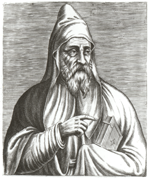
Jerome (from André
Thevet)
Click on thumbnail for information on how to
purchase a larger
version of this image
(see copyright
information)
Synopsis
Jerome, or Eusebius Hieronymus as he is sometimes known, was born at Stridon in Dalmatia. His home town was destroyed by the Goths in 379 and thereafter ceased to exist making it impossible to locate today.[1] We know few details about his parents, except that they were both Christians and that his father, Eusebius, was a well-to-do local landowner.[2] After completing his elementary education at a local school Jerome was sent to a school in Rome, where he received what at the time was considered an excellent classical education.[3] It is probable that by the time he left school he was fluent in Latin and knew a little Greek.[4] Jerome is remembered primarily for his translation of the Bible into Latin under the patronage of Damasus (304-384), the bishop of Rome (366-384). Jerome's knowledge of Hebrew and extensive classical education made him the ideal man for the task. His translation, which was in a Latin style used by the common people, became known as the Vulgate, the standard text of the Roman Catholic church until the Second Vatican Council (1962-65).[5] Jerome's version superseded the fragmentary and generally poorly translated Latin versions then available,[6] but was not without its own shortcomings.[7]
Jerome also wrote extensively, producing commentaries on most of the books of the Bible, as well as works on monasticism and treatises against various heresies. Although his background knowledge and linguistic ability were excellent, his method of exegesis swung wildly between that of rabbinic Judaism, the literalism of Antioch and the allegorical interpretation of Alexandria. While the literal reading tends to dominate Jerome nowhere rejects the other two.[8] J.N.D. Kelly comments that Jerome's hermeneutic worked "on the principle that this allegorical or spiritual interpretation should only be developed after the direct, literal sense of Scripture has been established."[9] At least one scholar recognises a development in Jerome's hermeneutic through his lifetime: At first the Alexandrian method attracted him, especially the translation of Hebrew names as a basis for the spiritual interpretation. Then the Origenist controversy warned him off an exaggerated use of allegory, and his own studies in Hebrew increased his interest in the letter. His last commentary, on Jeremias, is purely literal.[10] When he was in his forties Jerome spent two or three years as a hermit in the Syrian desert, at which time he learned Hebrew and a little Syraic.[11] His idealised picture of monasticism was shattered by the malicious behaviour of his neighbours, so Jerome left the desert and shortly afterwards was ordained as a priest in Antioch.[12]
These bad experiences did not prevent Jerome from continually exhorting others to embrace a monastic lifestyle, or from later establishing his own monasteries at Bethlehem.[13] Asceticism had become a subject of controversy in Jerome's day. There was a growing alarm among ordinary Western Christians that an ascetic lifestyle was becoming a requirement of true Christianity.[14] Some attempted to challenge the teachings of the church hierarchy, arguing from Scripture that marriage was instituted and blessed by God and was not defiling. The behaviour of many of the monks was ample proof to many that their lifestyle did not end their love of sinning (cf. Col. 2:20-23). Jerome's scathing responses resulted in him becoming extremely unpopular.[15] Nevertheless, his views became those of the Roman Catholic church down to the Renaissance.[16]
Rob Bradshaw, Webmaster
References
[1] J.N.D. Kelly, Jerome: His Life, Writings and Controversies. (London: Duckworth, 1975), 1-5.
[2] Kelly, Jerome, 5-6.
[3] Kelly, Jerome, 9-11.
[4] Kelly, Jerome, 14.
[5] Terrence G. Kardong, "Vulgate," Everett Ferguson, editor, Encylopedia of Early Christianity. (New York: Garland, 1990), 932-933.
[6] Bruce M. Metzger, "Old Latin Versions," Everett Ferguson, editor, Encylopedia of Early Christianity. (New York: Garland, 1990), 660-661.
[7] Kelly, Jerome, 86-87, 162-163.
[8] Rusch, 81.
[9] Kelly, Jerome, 60, cf. 151.
[10] Beryl Smalley, The Study of the Bible in the Middle Ages. (Oxford: The Clarendon Press, 1941), 8.
[11] See further Kelly, Jerome, 46-56.
[12] F.L. Cross & E.A. Livingstone, editors. The Oxford Dictionary of the Christian Church, 3rd edn. (Oxford: OUP, 1997), 731.
[13] Kelly, Jerome, 129-140.
[14] Kelly, Jerome, 104.
[15] Kelly, Jerome, 108-115.
[16] Kelly, Jerome, 106.
Bibliographies
 |
T.P. Halton & R.D. Sider, "A Decade of Patristic Scholarship 1970-1979," The Classical World, Vol. 76 (1982-1983): 353-356. |
Primary Sources
 Jerome, Letters [Letters 1-22], C.C. Mierow,
trans. Ancient Christian Writers., Vol. 33. New York: Newman, 1963. Hbk. ISBN:
0809100878.
Jerome, Letters [Letters 1-22], C.C. Mierow,
trans. Ancient Christian Writers., Vol. 33. New York: Newman, 1963. Hbk. ISBN:
0809100878.Secondary Sources
 |
Jeremy deQuesnay Adams, The "Populus" of Augustine and Jerome: A Study in the Patristic Sense of Community. New haven, 1971. ISBN: 0300014023. pp.278. |
|
Neil Adkin, "Some Notes on theDream of Saint Jerome," Philologus 128 (1984): 119-26. |
|
Neil Adkin, "Gregory of Nazianzenus and Jerome: Some Remarks," M.A. Flower & M. Toher, eds., Georgica, Greek Studies in Honour of George Cawkwell. London, 1991. pp.13-24. |
|
Neil Adkin, "Hierosolymam militaturus pergerem. A Note on the Location of Jerome's Dream," Koinonia 17 (1993): 81-3. |
|
Neil Adkin, "The Date of the Dream of Saint Jerome," Studi Classici e Orientali 43 (1993): 263-73. |
|
Neil Adkin, "Ambrose and Jerome: the Opening Shot," Mnemosyne 46 (1993): 364-300. |
|
Neil Adkin, "Jerome, Ambrose and Gregory Nazianzen," Vichiana 4 (1993): 294-300. |
|
Neil Adkin, "Juvenal and Jerome," CPb 89 (1994): 67-72. |
|
Neil Adkin, "Jerome's Use of Scripture Before and After hi s Dream," Illinois Classical Studies 20 (1995): 183-90. |
|
Neil Adkin, "Who is accusator meus at the Start of Jerome's Liber de optimo genere interpretandi (Epist. 57)?," Latomus 55 (1996): 876-7. |
|
Neil Adkin, "Pope Siricius' 'Simplicity' (Jerome , epist. 127, 9, 3)," Vetera Christianorum 33 (1996): 25-38. |
|
Neil Adkin, "Jerome on Ambrose. The Preface of the Translation of Origen's Homilies on Luke," Revue Benedictine 107 (1997): 5-14. |
|
Neil Adkin, "Jerome's Vow 'Never to Reread the Classics': Some Observations," Revue des Etudes Anciennes 101 (1999): 161-7. |
|
Neil Adkin, "Jerome on Marcella. Epist. 127, 10, 4," Bollettino di Studi Latini 29 (1999): 564-70. |
|
Neil Adkin, "Biblia pagana: Classical Echoes in the Vulgate," Augustinianum 40 (2000): 77-87. |
|
Neil Adkin, "Jerome, Seneca, Juvenal," Revue Belge de Philologie et d'histoire 78 (2000): 119-28. |
|
Neil Adkin, Jerome on Virginity: A Commentary on the Libellus De Virginitate Servanda (Letter 22). ARCA, Classical and Medieval Texts, Papers and Monographs, 42. Francis Cairns Publications, 2003. Hbk. ISBN: 0905205383. pp.480. |
|
M. Allen, "The Martyrdom of Jerome," Journal of Early Christian Studies 3 (1995): 211-13. |
|
Neil Adkin, "Cicero's Orator and Jerome," Vigiliae Christianae 51.1 (1997): 25-39. |
|
James Barr, "St. Jerome's Appreciation of Hebrew," Bulletin of the John Rylands Library 49 (1966): 280-302. |
|
James Barr, "St. Jerome and the Sounds of Hebrew," Journal of Semitic Studies 12.1 (1967): 1-36. |
|
A.D. Booth, "The Date of Jerome's Birth," Phoenix 33 (1979): 346-52. |
|
A.D. Booth, "The Chronology of Jerome's Early Years," Phoenix, Vol. 25 (1981): 237-259. |
|
Jay Braverman, Jerome's Commentary on Daniel: A Study of Comparative Jewish and Christian Interpretation of the Hebrew Bible. Catholic Biblical Quarterly Monograph Series 7. Washington, D.C., 1978. Pbk. ISBN: 091517006X. |
|
C. Brown Tkacz, "Ovid, Jerome and the Vulgate," Studia Patristica 33 (1997): 378-82. |
|
V. Burrus, "The Heretical Woman as Symbol in (bishop) Alexander, Athanasius, Epiphanius, and Jerome," Harvard Theological Review 84 (1991): 229-48. |
|
A. Ceresa-Gastoldo, "The Biographical Method of Jerome's De viris illustribus," Studia Patristica 15.1 (1984): 55-68. |
|
Elizabeth A. Clark, Jerome, Chrysostom, and Friends. Essays and Translations. Studies in Women and Religion, Vol. 2. New York / Toronto: Edwin Mellen Press, 1982. Hbk. ISBN: 088946541X. pp.254. |
|
Elizabeth A. Clark, "The Place of Jerome's Commentary on Ephesians in the Origenist Controversy: The Apokatastasis and Ascetic Ideals," Vigiliae Christianae, Vol. 41 (1987): 154-171. |
|
Elizabeth A. Clark, The Origenist Controversy: The Cultural Construction of an Early Christian Debate. Princeton University Press, 1993. Hbk. ISBN: 0691031738. pp.300. |
|
E. Coleiro, "St. Jerome's Lives of the Hermits," Vigiliae Christianae 11 (1957): 161-78. |
|
Marvin L. Colker, "Previously Unpublished Letters Ascribed to St. Jerome," Recherches de Theol et Phil Medievales 67.2 (2000): 195-217. |
|
T. Comerford Lawler, "Jerome's First Letter to Damascus," in Kyriakon Festschrift J. Quasten. Münster, 1970. pp.548-52. |
|
P. Courcelle, Late Latin Writers and Their Greek Sources. Cambridge: Harvard University Press, 1969. Hbk. ISBN: 0674511859. pp.48-127. |
|
P. Cox Miller, "The Blazing Body. Ascetic Desire in Jerome's Letter to Eustochium," Journal of Early Christian Studies 1 (1993): 21-45. |
|
J.T. Cummings, "St. Jerome as Translator and as Exegete," Studia Patristica 12 (1975): 279-82. |
|
John Curran, "Jerome and the Sham Christians of Rome," Journal of Ecclesiastical History 48.2 (1997): 213-229. |
|
John Curran, "Jerome and the Sham Christians of Rome," Journal of Ecclesiastical History 48.2 (1997): 213-229. |
|
W.J. Dalton, "St. Jerome on the INspiration and Inerrancy of the Scriptures," Australasian Catholic Report 33 (1956): 103-16. |
|
Harald Hagendahl, Latin Fathers and
the Classics: A Study on the Apologists, Jerome and Other Christian
Writers. Göteberg: Almqvist & Wiksell, 1958. pp.91-328. Updated version: "Jerome and the Latin Classics," Vigilae Christianae, Vol. 28 (1974): 216-227. |
|
C.T.R. Hayward, "Jewish traditions in Jerome's commentary on Jeremiah and the Targum of Jeremiah," Proceedings of the Irish Biblical Association 9 (1985): 100-20. |
|
Robert Hayward, "Saint Jerome and the Aramaic Targumim," Journal of Semitic Studies 32.1 (1987): 105-123. |
|
Robert Hayward, "Some Observations on St. Jerome's `Hebrew Questions on Genesis' and the Rabbinic Tradition," Proceedings of the Irish Biblical Association 13 (1990): 58-76. |
|
D.F. Heimann, "The Polemical Application of Scripture in St. Jerome," Studia Patristica 12 (1975): 309-16. |
|
Ronald E. Heine, "Recovering Origen's Commentary on Ephesians from Jerome," Journal of Theological Studies 51.2 (2000): 478-514. |
 |
Henry Hoyle Howorth [1842-1923], "The Influence of St Jerome on the Canon of the Western Church. I," Journal of Theological Studies 10 No 40 (July 1909): 481-496.  pdf [This material is in the Public Domain] pdf [This material is in the Public Domain] |
|
Ronald V. Huggins, "The 'Repentance of Jerome': How the Great Translator of the Latin Vulgate Bible Got His Priorities Turned Round," Midwestern Journal of Theology 10.1 (Spring 2011):
190-200. pdf [Reproduced by permission of the current copyright holder] |
|
David G. Hunter, "Resistance to the Virginal Ideal in Late-Fourth Century Rome: the Case of Jovinian," Theological Studies 48 (1987): 45-69. |
|
David G. Hunter, "Helvidius, Jovinian, and the Virginity of Mary in Late Fourt-Century Rome," Journal of Early Christian Studies 1 (1993): 47-71. |
|
David G. Hunter, "The Virgin, the Bride, and the Church: Reading Psalm 45 in Ambrose, Jerome, and Augustine," Church History 69.2 (2000): 281-303. |
|
R.G. Jenkins, "The Biblical Text of the Commentaries of Eusebius and Jerome on Isaiah," Abr-nahrain. Leiden, 22 (1983/84): 64-78. |
|
 Adam Kamesar, Jerome, the Hebrew Bible,
and Greek Scholarship. A Study of the Questiones Hebraicae in Genesim.
Oxford Classical Monographs. Oxford: Clarendon Press, 1993. Hbk. ISBN:
0198147279. pp.176. Adam Kamesar, Jerome, the Hebrew Bible,
and Greek Scholarship. A Study of the Questiones Hebraicae in Genesim.
Oxford Classical Monographs. Oxford: Clarendon Press, 1993. Hbk. ISBN:
0198147279. pp.176. |
|
A.F.J. Klijn, "Jerome's Quotations from a Nazoraean Interpretation of Isaiah," Recherches de science religieusse 60 (1972): 241-55. |
|
Matthew Kraus, "Christians, Jews, and Pagans in Dialogue: Jerome on Ecclesiastes 12:1-7," Hebrew Union College Annual 70-71 (2000): 183-231. |
|
![William Lefroy [1836-1909], ed., Church Leaders in Primitive Times](images/books3/church-leaders-in-primitive-times_lefroy-tb.jpg) Thomas Worthley Drury [1847-1926], "Jerome," William Lefroy [1836-1909], ed., Church Leaders in Primitive Times. Lectures on Their Words and Works. Delivered in Norwich Cathedral by Eminent Anglican Devines, 2nd edn. London: Chas. J. Thynne, 1909. Hbk. pp.447-477. pdf [This material is in the Public Domain] Thomas Worthley Drury [1847-1926], "Jerome," William Lefroy [1836-1909], ed., Church Leaders in Primitive Times. Lectures on Their Words and Works. Delivered in Norwich Cathedral by Eminent Anglican Devines, 2nd edn. London: Chas. J. Thynne, 1909. Hbk. pp.447-477. pdf [This material is in the Public Domain] |
|
R. Loewe, "Jerome's Treatment of an Anthropomorphism," Vetus Testamentum 2 (1952): 261-72. |
|
Josef Lössl, "Sature, Fiction and Reference to Reality in Jerome's Epistula," 117 Vigilae Christianae 52 (1998): 172-92. |
|
William C. McDermott, "Saint Jerome and Domitius Afer," Vigiliae Christianae 34.1 (1980): 19-23. |
|
William C. McDermott, "Saint Jerome and Pagan Greek Literature," Vigilae Christianae, 36.4 (1982): 372-382. |
|
P. Meyvaert, "Excerpts from an Unknown Treatise of Jerome to Gaudentius of Bescia," Revue Benedictine 96 (1986): 203-18. |
|
Patricia Cox Miller, "Jerome's Centaur: A Hyper-Icon of the Desert," Journal of Early Christian Studies 4.2 (1996): 209-233. |
|
F.X. Murphy, "The Problem of St. Jerome," American Economic Review 117 (1947): 102-7. |
|
F.X. Murphy, ed. A Monument to Saint Jerome: Essays on Some Aspects of His Life, Works and Influence. New York: Sheed and Ward, 1952. |
|
Hillel I. Newman, "Jerome's Judaizers," Journal of Early Christian Studies 9.4 (2001): 421-452. |
|
Robert J. O'Connell, "When Saintly Fathers Feuded: The Correspondence Between Augustine and Jerome," Thought, 54 (215) (1979): 344-364. |
|
W.A. Oldfather, Studies in the Text Tradition of St Jerome's Vitae Patrum. Urbana, 1943. |
|
John C. Olin, "Erasmus and St. Jerome," Thought: A Review of Culture and Idea 54 (215) (1979): 313-321. |
|
Rev. Samuel Osgood, "Jerome and His Times," Bibliotheca Sacra 5 No. 17 (1848): 117-147. pdf [This material is in the Public Domain] |
|
Arthur Stanley Pease, “Notes on St. Jerome’s Tractates on the Psalms,” Journal of Biblical Literature 26.2 (1907): 107-131. |
|
A. Penna, "The Vow of Jephthah in the Interpretation of St. Jerome," Studia Patristica 4 (1961): 162-70. |
|
D.E. Pilarczyk, "Jonah's Gourd: Augustine and Jerome on a New Translation of Sacred Scripture (Vg)," Bible Today 26 (1966): 1848-52. |
|
Stefan Rebenich,"Jerome: The 'Vir Trilinguis' and the 'Hebraica Veritas'," Vigiliae Christianae 47.1 (1993): 50-77. |
|
 Stefan Rebenich, Jerome. The Early Church
Fathers. London: Routledge, an imprint of Taylor & Francis Books Ltd.,
1996. Pbk. ISBN: 0415118387. pp.224. Stefan Rebenich, Jerome. The Early Church
Fathers. London: Routledge, an imprint of Taylor & Francis Books Ltd.,
1996. Pbk. ISBN: 0415118387. pp.224. |
|
 Eugene F. Rice, Jr., Saint
Jerome in the Renaissance. Johns Hopkins Symposia in Comparative History,
No 13. Baltimore: Johns Hopkins University Press, 1985. Pbk. ISBN: 0801837472.
pp.304. Eugene F. Rice, Jr., Saint
Jerome in the Renaissance. Johns Hopkins Symposia in Comparative History,
No 13. Baltimore: Johns Hopkins University Press, 1985. Pbk. ISBN: 0801837472.
pp.304. |
 |
 Philip Rousseau, Ascetics, Authority
and the Church in the Age of Jerome and Cassian, 2nd edn. Oxford & New York:
Oxford University Press, 1978. Hbk. ISBN: 0198218702. pp.169-234. [Sign-up to Perlego and access book instantly] Philip Rousseau, Ascetics, Authority
and the Church in the Age of Jerome and Cassian, 2nd edn. Oxford & New York:
Oxford University Press, 1978. Hbk. ISBN: 0198218702. pp.169-234. [Sign-up to Perlego and access book instantly] |
|
David Satran, "Fingernails and Hair: Anatomy and Exegesis in Tertullian," Journal of Theological Studies 40.1 (1989): 116-120. |
|
M.A. Schatkin, "The Influence of Origen Upon St. Jerome's Commentary on Galatians," Vigiliae Christianae 24 (1970): 49-58. |
|
J. Schwartz, "Jerome and the Jews of Judea," Zion 47.2 (1982): 186-191. |
|
J.H.D. Scourfield, "A Note on Jerome's Homily on the Rich Man and Lazarus," Journal of Theological Studies 48.2 (1997): 536-539. |
|
W.H. Semple, "St. Jerome as a Biblical Translator," Bulletin of the John Rylands Library 45 (1965s): 227-43. |
|
 H.F.D. Sparks, "Jerome as a Biblical
Scholar," P.R. Ackroyd & C.F. Evans, eds. The Cambridge History of the
Bible, Vol. 1. From Beginnings to Jerome. Cambridge: Cambridge
University Press, 1970. Hbk. ISBN: 0521074185. pp.510-541. H.F.D. Sparks, "Jerome as a Biblical
Scholar," P.R. Ackroyd & C.F. Evans, eds. The Cambridge History of the
Bible, Vol. 1. From Beginnings to Jerome. Cambridge: Cambridge
University Press, 1970. Hbk. ISBN: 0521074185. pp.510-541. |
|
E.F. Sutcliffe, "The Name Vulgate," Biblica 29 (1948): 345-52. |
|
J.J. Thierry, "Some Notes on Epistula XXII of Jerome," Vigiliae Christianae 21.2 (1967): 120-127. |
|
T.C.G. Thornton, "Jerome adn the 'Hebrew Gospel According to Matthew'," Studia Patristica 28 (1993): 118-22. |
|
M. Vessey, "Jerome's Origen: The Making of a Christian Literary Persona," Studia Patristica 28 (1993): 135-45. |
|
G. Vidén, "St. Jerome of Female Chastity: Subjugating the Elements of Desire," Symbolae Osloenses 73 (1998): 139-57. |
|
D.S. Weisen, St. Jerome as a Satirist: A Study in Christian Latin Thought and Letters. (Ithaca: Cornell University Press, 1964. |
|
C. White, The Correspondence (394-419) between Jerome and Augustine of Hippo. Lewiston, 1990. |
Biographies
![Edward Lewis Cutts [1824-1908], Saint Jerome](images/books3/saint-jerome_cutts-tb.jpg) Edward Lewis Cutts [1824-1908], Saint Jerome. The Fathers for English Readers. London: SPCK, n.d. Hbk. pp.230.
Edward Lewis Cutts [1824-1908], Saint Jerome. The Fathers for English Readers. London: SPCK, n.d. Hbk. pp.230. ![Frederic William Farrar [1831-1903], Lives of the Fathers. Sketches of Church History in Biography, 2 Vols](images/books3/lives-of-the-fathers_farrar-tb.jpg) Frederic William Farrar [1831-1903], Lives of the Fathers. Sketches of Church History in Biography, 2 Vols. London: Adam & Charles Black, 1907. Hbk. pp.781+737.
Frederic William Farrar [1831-1903], Lives of the Fathers. Sketches of Church History in Biography, 2 Vols. London: Adam & Charles Black, 1907. Hbk. pp.781+737.  J.N.D. Kelly, Jerome: His Life, Writings
and Controversies. Vendor: Hendrickson Publishers, 1998. Pbk. ISBN:
071561231X. pp.352.
J.N.D. Kelly, Jerome: His Life, Writings
and Controversies. Vendor: Hendrickson Publishers, 1998. Pbk. ISBN:
071561231X. pp.352.Related Subjects
 |
|
 |
|
 |
Alexander of Alexandria | Ambrose | Aristides | Arnobius | Athanasius | Athenagoras | Augustine | Basil | Boethius | John Cassian | Celsus | Clement of Alexandria | Clement of Rome | Constantine | Cyprian | Cyril of Alexandria | Cyril of Jerusalem | Ephraem the Syrian | Epiphanius | Eusebius of Caesarea | Gregory of Nazianzus | Gregory of Nyssa | Gregory Thaumaturgus | Hermas | Hilary of Poitiers | Hippolytus | Ignatius of Antioch | Irenaeus of Lyons | Julius Africanus | Jerome | John Chrysostom | Josephus | Justin Martyr | Justinian I | Lactantius | Leo the Great | Marcellus | Martin of Tours | Melito | Methodius | Minucius Felix | Novatian | Origen | Pachomius | Papias | Philo | Polycarp | Synesius of Cyrene | Tatian | Tertullian | Theodore of Mopsuestia | Theodoret | Theophilus | Tyconius | Ulfilas | Victorinus | Marius Victorinus
ABOUT | KEY | SITE MAP | INTRODUCTIONS | BIBLE | COUNCILS & CREEDS | DOCTRINE & PRACTICE | HERESIES & SECTS | HISTORY | MINISTRY | PEOPLE | PHILOSOPHY | WRITINGS | STUDY AIDS | BLOG | SUPPORT SITE | CONTACT