Tertullian of Carthage
(c. 160 - 225)






Theology on the Web helps over 2.5 million people every year to find high quality theological resources that will help to equip them to serve God and to know Him better (2 Timothy 2:15). Like other websites that provide free services, it is dependent on donations to enable it to grow and develop and only 0.004% of visitors currently do so. If you would like to support this site, please use one of the options to the right of this message.
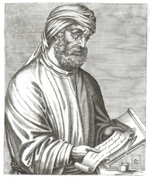
Tertullian of Carthage (from
André Thevet)
Click on thumbnail for information on how
to
purchase a larger version of this image
(see copyright information)
Synopsis
Quintus Septimus Florens Tertullianus was born in Carthage to pagan parents, but became a Christian at some point before AD 197. According to Jerome[1] and Eusebius[2] he was the son of a centurion and trained as a lawyer in Rome. Following his conversion he became a presbyter in the church at Carthage, but dissociated himself from the Church after the bishop of Rome rejected the ‘New Prophecy’ of the Montanist movement. However, "...neither Eusebius nor Jerome is in this matter a reliable witness, and what can be known about Tertullian’s life must be gathered from his own writings; unfortunately, their highly rhetorical character makes inference insecure."[3)] Very different conclusions may be reached from the fragmentary evidence available to us.[4]
Throughout church history Tertullian has received condemnation for two main reasons: his association with the Montanist movement[5] and because of his supposed anti-intellectualism. However, the vast majority of scholars now agree that the Montanists were doctrinally orthodox,[6] and so there are no grounds for rejecting Tertullian’s contribution to theology on the grounds of his association with them. Roger Forster & Paul Marston, for example, refer to Minucius Felix (late 2nd/3rd century), as Tertullian’s "more orthodox" contemporary.[7] However, it should be noted that in Minucius Felix’s work Octavius Christianity is treated from the standpoint of philosophy, Scripture is not cited, nor are major biblical teachings much discussed.[8] It is therefore difficult to accept Forster & Marston’s view on the basis of arguments from silence. There has been a long history of debate whether Tertullian used Octavius as a source for his Apology or vice versa. Current opinion favours the priority of the Apology.[9] This is not the first time that Tertullian’s orthodoxy has been attacked in order to undermine his credibility as a witness to the beliefs and practises of the church of his day. William Wall used the same ploy in the 1840’s to support his case for infant baptism. Wall wrote that Tertullian "...fell into the heresy of the Montanists, who blasphemously held that one Montanus was that Paraclete or Comforter which our Saviour promised to send: and that better and fuller discoveries of God’s will were made to him than to the Apostles, who prophesied only in part."[10] To which Paul K. Jewett responds: "But the noble African’s reputation as a Christian and theologian scarcely needs defence against such beggarly invective."[11]
Tertullian is the church father who more than any other has been taken to epitomise the anti-intellectualism of the early Church. Tertullian wrote:
For philosophy is the material of the world’s wisdom, the rash interpreter of the nature and dispensation of God. Indeed heresies are themselves instigated by philosophy… What indeed has Athens to do with Jerusalem? What has the Academy to do with the Church? What have heretics to do with Christians? Our instruction comes from the porch of Solomon, who had himself taught that the Lord should be sought in simplicity of heart. Away with all attempts to produce a Stoic, Platonic, and dialectic Christianity! We want no curious disputation after possessing Christ Jesus, no inquisition after receiving the gospel! When we believe, we desire no further belief. For this is our first article of faith, that there is nothing which we ought to believe besides.[12]
Three facts that lie behind Tertullian’s rhetoric that are seldom considered:
- Greek philosophy was "an amalgam of rival world-views, based on premises that are very different from the biblical revelation."[13] Their failure to establish any means of accountability to allow the resolution of disputes was already appreciated by Diodorus (c.90-21 BC), Galen (c.130-200 AD) and Claudius Ptolemy (2nd cent. AD) (and other leading thinkers of the 2nd century.[14]
- Tertullian believed that "heresies are themselves instigated by philosophy,"[15] Plato and Aristotle being responsible for Valentinian Gnosticism.[16] David Lindberg argues that "what he therefore opposed was not philosophy generally, but heresy or the philosophy that gave rise to it."[17]
- Tertullian himself made use of philosophical (particularly Stoic) ideas in his writings.[18] He agreed with Plato on the matter of the immortality of the soul.[19] He even claimed (as Philo and Justin Martyr had before him) that the philosophers borrowed from the Jewish Scriptures.[20] Like all writers, he assumed that he was able to write theology without incorporating his own presuppositions.[21]
The statement cited above must be viewed in the context of his other works:
Elsewhere Tertullian does not always speak in such robust terms of an unbridgeable chasm separating Athens and Jerusalem. He was as well educated as anyone of his time: a competent lawyer, able to publish his writings in both Latin and Greek with equal facility, acquainted with the current arguments of the Platonic, Stoic and Aristotelian schools and also possessing some knowledge of medicine.[22]
Finally, Tertullian’s argument "I believe it because it is absurd"[23] has been shown to be a misquotation, but more importantly it is an example of a standard Aristotelian argumentative form. Put simply what Tertullian is actually saying is that
...the more improbable an event, the less likely is anyone to believe, without compelling evidence, that it has occurred; therefore, the very improbability of an alleged event, such as Christ’s resurrection, is evidence in its favour. Thus far from seeking the abolition of reason, Tertullian must be seen as appropriating Aristotelian rational techniques and putting them to apologetic use.[24]
Indeed, in his Apology he demonstrated his familiarity with at least thirty literary authorities, which he probably had read first hand, rather than by referring to a handbook of quotations.[25]
Tertullian’s method of exegesis varied depending on the purpose of each of his works. When writing against the Gnostic Marcion (who rejected the Old Testament and all use of allegory) Tertullian defended its use, noting how even Paul had used allegory in his letters.[26] While he admitted that the use of allegory was sometimes legitimate he made it clear that he himself preferred the literal sense.[27] His principle for identifying the presence of allegory was that it was present if the literal sense resulted in nonsense; it is not present when the literal meaning makes sense.[28] In this he did not differ significantly from Origen’s principle.[29] In his other works Tertullian’s use of allegory is restrained.[30] Following other writers (such as Justin and Irenaeus) Tertullian used typology extensively to demonstrate the unity of the Testaments,[31] but the figures that he found in the Old Testament were based upon historical persons, places and events, and were used consistently.[32] As O’Malley points out: "He clearly does not feel able to allegorise generally, simply because Paul uses the words in Gal. 4:24."[33]
Rob Bradshaw, Webmaster
References
[1] Jerome, Lives, III, 53.
[2] Eusebius, History, 2.2.4 (NPNF, 2nd series, Vol. 1, 106).
[3] Robert D. Sider, "Tertullian," Everett Ferguson, ed. Encyclopedia of Early Christianity. New York & London: Garland Publishing, 1990. pp. 883.
[4] T. D. Barnes, Tertullian: A Historical and Literary Study. (Oxford: Clarendon Press, 1971).
[5] Sider, 883: "It is because of their opposition to the Montanists that neither Eusebius of Caesarea nor Jerome are regarded as reliable witnesses concerning Tertullian." Schaff comments that Jerome "...admired Tertullian for his powerful genius and vigorous style, though he could not forgive him his Montanism..." Philip Schaff, History of the Christian Church, Vol. 3. (Grand Rapids: Eerdmans, 1989 reprint), 969.
[6] Barnes, Tertullian, 42: "Historical interpretations of the rise of Montanism inevitably differ, according to the prejudices and preoccupations of the exegete. But the theological issue is clear. The orthodox dubbed the Montanists ‘Cataphygians’ or ‘the Phrygian Heresy’. Yet they had to confess that they were orthodox in all matters of Christian doctrine. Only in the fourth century could polemical writers accuse the Montanists of purely theological error, and then the accusation patently relied upon a perverse and anachronistic interpretation of an utterance of Montanus himself."
[7] Roger Forster, & Paul Marston, Reason & Faith. (Eastbourne: Monarch Publications, 1989), 260.
[8] Michael P. McHugh, "Minucius Felix," Everett Ferguson, ed. Encyclopedia of Early Christianity. New York & London: Garland Publishing, 1990. pp. 600. "Minucius Felix," F.L. Cross, & Livingstone, eds. The Oxford Dictionary Of The Christian Church Oxford: OUP, 1990. p.920.
[9] J. Stevenson, A New Eusebius: Documents Illustrating the History of the Church to AD 337. London: SPCK, 1987, 177.
[10] William Wall, The History of Infant Baptism. (London: Griffith, Farran, Okeden & Walsh, n.d.), 41.
[11] Paul K. Jewett, Infant Baptism & The Covenant of Grace. (Grand Rapids: Eerdmans, 1978), 21.
[12] Tertullian, Heretics, 7 (Stevenson, 166-167).
[13] Colin Brown, Christianity & Western Thought, Vol. 1. (Leicester: Apollos, 1990), 91.
[14] Christopher B. Kaiser, Creation & The History of Science. (London: Marshall Pickering, 1991), 4. Kaiser continues: "The long-range welfare of natural science depended on the development of an ecumenical community of scholars dedicated to the pursuit of truth. This ideal was appreciated by the leading thinkers of antiquity, but the needed substructure was not available… the ecumenical foundation of modern science was to be provided by the monastic movement of the Middle Ages, a movement based on the very discipline that was advocated by Irenaeus and Tertullian. Such are the ironies of history." See further 34-51.
[15] Tertullian, Heretics, 7 . Ante-Nicene Fathers, Vol. 3, 246).
[16] Brown, 91.
[17] David C. Lindberg, "Science and the Early Church," David C. Lindberg & Ronald L. Numbers, eds. God & Nature: Historical Essays on the Encounter Between Christianity and Science. (Berkeley & Los Angeles: University of California Press, 1986), 26.
[18] Brown, 91.
[19] Tertullian, Resurrection 3.2 Vol. 3, 547; Richard A. Norris, God and World in Early Christian Theology: A Study in Justin Martyr, Irenaeus, Tertullian and Origen. (London: Adam & Charles Black, 1966), 86.
[20] Tertullian, Apology 47.1; Flesh 9.2 Ante-Nicene Fathers, Vol. 3, 51-52, 531-532). Norris, 86.
[21] Stuart G. Hall, Doctrine and Practice in the Early Church. (London, SPCK, 1991), 69. For a full discussion of Tertullian’s use of Stoic arguments see: Jean Daniélou, The Origins Of Latin Christianity. (Philadelphia: Westminster Press, 1980), 209-223.
[22] Henry Chadwick, Early Christian Thought and the Classical Tradition. (Oxford: Clarendon Press, 1966), 2.
[23] Tertullian, Flesh, 5 Ante-Nicene Fathers, Vol. 3, 525. The same idea recurs several times in his writings.
[24] Lindberg, 26.
[25] T. D. Barnes, Tertullian: A Historical and Literary Study. (Oxford: Clarendon Press, 1971), 196-199. The full list of authorities used in Tertullian’s Apology is: "Pliny the Younger, Herodotus, Ctesias, Diodorus and Thallus, Cassius Severus and Cornelius Nepos, Pythagoras and Plato, Pindar, the Cynics Diogenes and Varro, Cornelius Tacitus, Aristeas, Manetho the Egyptian, Berossus the Chaldean, Hiram of Tyre, Ptolemy of Mende, Menander of Ephesus, Demetrius of Phalerum, King Juba of Mauretania, Apion and his adversary Josephus, the stoics Zeno and Cleanthes, Plato again and again, Epicurus, Hostilius, Laberius and Lentulus (three writers of mimes), Cicero and Seneca, Pyrrhon and Callincus."
[26] T.P. O’Malley, Tertullian and the Bible: Language - Imagery - Exegesis. Latinitas Christianorum Primaeva. (Utrecht: Dekker & Van De Vegt N.V. Nijmegen, 1967), 149.
[27] R.P.C. Hanson, "Notes on Tertullian’s Interpretation of Scripture," Journal of Theological Studies, n.s., Vol. 12 (1961): 274.
[28] O’Malley, 128, 157-158.
[29] Robert E. Roberts, The Theology of Tertullian (London: Epworth Press, 1924), 19: "Tertullian made use of the allegorical method of interpretation, but he does not emphasise the difference between the plain and the figurative sense of Scripture, and certainly is no supporter of the idea that there are different meanings of Scripture for different classes of people after the manner of the Gnostic and Alexandrian theologians. Whatever is plain narrative is such for all men, and where a figurative meaning is to be discovered it is open to all."
[30] Hanson, 274: "But though Tertullian is ready to acknowledge as legitimate the practice of allegorizing Scripture in the Church of his day, and will occasionally have recourse to it himself, he often rejects the practice and his writings leave a general impression that he was suspicious of allegory."
[31] O’Malley, 163.
[32] O’Malley, 172.
[33] O’Malley, 177.
Primary Sources
![Thomas Herbert Bindley [1861-1931], translator, Tertullian on the Testimony of the Soul and on the "Prescription" of Heretics](images/books3/tertullian_bindley_tb.jpg) Thomas Herbert Bindley [1861-1931], translator, Tertullian on the Testimony of the Soul and on the "Prescription" of Heretics. London: SPCK, 1914. Hbk. pp.96.
Thomas Herbert Bindley [1861-1931], translator, Tertullian on the Testimony of the Soul and on the "Prescription" of Heretics. London: SPCK, 1914. Hbk. pp.96.  Ernest Evans, Tertullian's Tract on the Prayer. Eugene, OR: Wipf & Stock, 2016. ISBN: 9781725255500. pp.88.
![Alexander Souter [1873-1949], Tertullian: Against Praxeas](images/books3/tertullian-against-praxeas_souter-tb.jpg) Alexander Souter [1873-1949], Tertullian: Against Praxeas. Translations of Christian Literature, Series II: Latin Texts. London: SPCK/New York: Macmillan, 1920. Hbk. pp.125.
Alexander Souter [1873-1949], Tertullian: Against Praxeas. Translations of Christian Literature, Series II: Latin Texts. London: SPCK/New York: Macmillan, 1920. Hbk. pp.125. ![Alexander Souter [1873-1949], Tertullian: Concerning the Resurrection of the Flesh. Translations of Christian Literature, Series II: Latin Text](images/books3/tertullian-concerning-the-resurrection_souter-tb.jpg) Alexander Souter [1873-1949], Tertullian: Concerning the Resurrection of the Flesh. Translations of Christian Literature, Series II: Latin Texts. London: SPCK/New York: Macmillan, 1922. Hbk. pp.205.
Alexander Souter [1873-1949], Tertullian: Concerning the Resurrection of the Flesh. Translations of Christian Literature, Series II: Latin Texts. London: SPCK/New York: Macmillan, 1922. Hbk. pp.205.  Tertullian, Treatise on Penance: On
Penitence & on Purity. T. C. Lawler, translator. Ancient Christian
Writters. New York: Paulist, 1959. Hbk. ISBN: 0809101505
Tertullian, Treatise on Penance: On
Penitence & on Purity. T. C. Lawler, translator. Ancient Christian
Writters. New York: Paulist, 1959. Hbk. ISBN: 0809101505Secondary Sources
 |
Robert H. Ayers, Language, Logic, and Reason in the Church Fathers: A Study of Tertullian, Augustine, and Aquinas. Altertumswissenschaftliche Texte Und Studien Series 6. Hildersheim: Olms Edition, 1979. Pbk. ISBN: 3487066297. pp.146. |
 |
 Julian Barr, Tertullian and the Unborn Child. Christian and Pagan Attitudes in Historical Perspective. London: Routledge, 2017. ISBN: 9781317045878. pp.194. [Sign-up to Perlego and access book instantly] Julian Barr, Tertullian and the Unborn Child. Christian and Pagan Attitudes in Historical Perspective. London: Routledge, 2017. ISBN: 9781317045878. pp.194. [Sign-up to Perlego and access book instantly] |
 |
Ian L.S. Balfour, "The fate of the soul in induced abortion in the writings of Tertullian," Patristica (1975/76): 127-31. |
|
Ian L.S. Balfour, "Tertullian On and Off the Internet," Journal of Early Christian Studies 8.4 (2000): 579-585. |
|
R.M. Barlow, "Biblical Inspiration in Tertullian," The Theologian 13.2 (1957): 40-44. |
|
Timothy David Barnes, Tertullian's Scorpiace," Journal of Theological Studies 19 (1968): 509-31. |
|
Timothy David Barnes, Tertullian: A Historical and Literary Study, 1971. Oxford: Clarendon Press, 1997. Hbk. .ISBN: 0198143621. pp.340. |
|
Timothy David Barnes, "Tertullian the Antiquarian," Early Christianity and the Roman Empire. London: Variorum Reprints, 1984. |
 |
James Franklin Bethune-Baker [1861-1951], "Tertullian's Use of Substantia, Natura and Persona," Journal of Theological Studies 4 No 15 (April 1903): 440-442.  pdf [This material is in the Public Domain] pdf [This material is in the Public Domain] |
|
R.F. Boughner, "Tertullian and the Satiric," Classical Folia 32 (1978): 21-28. |
|
Gerald L. Bray, "The Legal Concept of Ratio in Tertullian," Vigiliae Christianae 31.2 (1977): 94-116. |
|
Gerald L. Bray, Holiness and the Will of God. Perspectives on the Theology of Tertullian. Marshall, Morgan & Scott, 1979. Hbk. ISBN: 0551055936. pp.179. |
|
Gerald L. Bray, Holiness and the Will of God: Perspectives on the Theology of Tertullian. John Knox Press, 1980. Hbk. ISBN: 0804237050. |
|
Gerald L. Bray, "The Relationship Between Holiness and Chastity in Tertullian," E.A. Livingstone, ed., Studia Patristica xvi. Texte und Untersuchungen 129. Berlin, 1985. pp.132-5. |
 |
Tertullian and the Western Church (Gerald Bray) |
|
Mark S. Burrows, "Christianity in the Roman Forum: Tertullian and the Apologetic Use of History," Vigiliae Christianae 42.3 (1988): 209-235. |
|
F. Cardman, "Tertullian on Doctrine and the Development of Discipline," E.A. Livingstone, ed., Studia Patristica xvi. Texte und Untersuchungen 129. Berlin, 1985. pp.136-42. |
|
Elizabeth Carnelley, "Tertullian and Feminism," Theology 92(745) (1989): 31-34. |
|
F.F. Church, "Sex and Salvation in Tertullian," Harvard Theological Review 68 (1975): 83-101. |
|
L.W. Countryman, "Tertullian and the Regula Fidei," The Second Century 2.4 (1982): 208-227. |
|
F.L. Cross, The Early Christian Fathers. Studies in Theology 1. London: Gerald Duckworth & Co. Ltd., 1960. Hbk. pp.135-146. |
|
 C. Daniel-Hughes, The Salvation of the Flesh in Tertullian of Carthage: Dressing for the Resurrection. London: Palgrave Macmillan, 2011. ISBN: 9780230338074. [Sign-up to Perlego and access book instantly] C. Daniel-Hughes, The Salvation of the Flesh in Tertullian of Carthage: Dressing for the Resurrection. London: Palgrave Macmillan, 2011. ISBN: 9780230338074. [Sign-up to Perlego and access book instantly] |
|
Steven L. Davies, "Women, Tertullian, and the Acts of Paul," Semeia 38 (1986): 139-149. |
|
Geoffrey D. Dunn, "The Universal Spread of Christianity as a Rhetorical Argument in Tertullian's Adversus Iudaeos," Journal of Early Christian Studies 8.1 (2000): 1-19. |
|
Geoffrey D. Dunn, "Rhetorical Structure in Tertullian's Ad Scapulam," Vigiliae Christianae 56.1 (2002): 47-55. |
|
Geoffrey D. Dunn, "Tertullian and Daniel 9:24-27: A Patristic Interpretation of a Prophetic Time-Frame," Zeitschrift für Antikes Christentum / Journal of Ancient Christianity 6.2 (2002): 352-367. |
|
 Geoffrey
D. Dunn, Tertullian. London: Routledge, an imprint of Taylor &
Francis Books Ltd., 2004. Hbk. ISBN: 9781134459308. pp.208. [Sign-up to Perlego and access book instantly] Geoffrey
D. Dunn, Tertullian. London: Routledge, an imprint of Taylor &
Francis Books Ltd., 2004. Hbk. ISBN: 9781134459308. pp.208. [Sign-up to Perlego and access book instantly] |
|
Peter Ensor, "Tertullian and penal substitutionary atonement," Evangelical Quarterly 86.2 (April 2014): 130-142. pdf [Reproduced by permission of the current copyright holder] |
|
E. Evans, "Tertullian's Commentary on the Marcionite Gospel," Studia Evangelica (1959). |
|
E. Evans, Tertullian's Treatise on the Resurrection. London: SPCK, 1960. |
|
E. Evans, "Second Thoughts on Tertullian against Praxeas," Studia Patristica 3 (1961): 196-99. |
|
R. Evans, "On the Problem of Church and Empire in Tertullian's Apologeticum," Studia Patristica 14 (1976): 21-36. |
|
Church F. Forrester, "Sex and Salvation in Tertullian," Harvard Theological Review 68 (1975): 83-101. |
|
W.H.C. Frend, "Notes on Tertullian's Interpretation of Scripture," Journal of Theological Studies 12 (1961): 272-. |
|
W.H.C. Frend, "A Note on Jews and Christians in Third Century North Africa," Journal of Theological Studies 21 (1970): 92-96. |
|
W.H.C. Frend, "Their Word to Our Day. IX. Tertullian," Expository Times 81.5 (1970): 136-141. |
|
Stephen Gero, "Miles gloriosus: The Christian and Military Service According to Tertullian," Church History 39.3 (1970): 285-298. |
|
Justo L. Gonzalez, "Athens and Jerusalem Revisited: Reasons and Authority in Tertullian," Church History 43.1 (1974): 17-25. |
|
D.E. Groh, "Tertullian's Polemic Against Social Co-operation," Church History 40 (1971): 7-14. |
|
D.E. Groh, "Upper Class Christians in Tertullian's Africa: Some Observations," Studia Patristica 14 (1976): 41-47. |
|
R.P.C. Hanson, "Notes on Tertullians Interpretation of Scripture," Journal of Theological Studies, n.s. 12 (1961): 273-279. |
|
J.B. Higgins, "The Latin Text of Luke in Marcion and Tertullian," Vigiliae Christianae 5 (1951): 1-42. |
|
C.E. Hill, "Hades of Hippolytus or Tartarus of Tertullian, The Authorship of the Fragment De universo," Vigiliae Christianae 43.2 (1989): 105-126. |
|
O.W. Holmes, "Tertullian on Prayer," Tyndale Bulletin 5/6
(1960): 27-31. pdf |
|
W. Horbury, "Tertullian on the Jews in the Light of De Spectaculis XXX 5-6," Journal of Theological Studies 23 (1972): 455-59. |
|
![Fenton John Anthony Hort [1828–1892], Six Lectures on the Ante-Nicene Fathers](images/books3/ante-nicene-fathers_hort-tb.jpg) Fenton John Anthony Hort [1828–1892], Six Lectures on the Ante-Nicene Fathers. London & New York: MacMillan & Co., 1895. Hbk. pp.138. pdf [This material is in the Public Domain] Fenton John Anthony Hort [1828–1892], Six Lectures on the Ante-Nicene Fathers. London & New York: MacMillan & Co., 1895. Hbk. pp.138. pdf [This material is in the Public Domain] |
|
John F. Jansen, "Tertullian and the New Testament," Second Century 2.4 (1982): 191-207. |
|
Howard Jacobson, "Tertullian and Propagation," Vigiliae Christianae 43.4 (1989): 397. |
|
J.F. Jansen, "Tertullian and the New Testament," Second Century 2 (1982): 191-207. |
|
Peter Iver Kaufman, "Tertullian on Heresy, History, and the Reappropriation of Revelation," Church History 60.2 (1991): 167-179. |
|
G.D. Kilpatrick, "Acts 13:33 and Tertullian Adv. Marc. 4.22, 8," Journal of Theological Studies 10 (1960): 53. |
|
A. Kirkland, "Liturgical Time in Tertullian," Acta Patristica et Byzantina 6 (1995): 69-85. |
|
G.D. Kirkpatrick, "Acts 13:33 and Tertullian Adv. Marc. 4.22,8," Journal of Theological Studies 10 (1960): 53. |
|
L.S. Kirkpatrick, "Baptism, Scripture, and the Problem of the Christian Sinner in Tertullian's De Paenitentia and De Pudicitia," Irish Biblical Studies 17.2 (1995): 75-85. |
|
Petr Kitzler, "Tertullian and Ancient Embryology in De Carne Christi 4,1 and 19,3-4," Zeitschrift Für Antikes Christentum 18.2 (2014): 204-209. |
|
Arthur W. Klem, "Tertullian: Victim of
Caricature," Bulletin of the Evangelical Theological Society 5.4 (Fall
1962): 103-108. pdf |
|
Pierre de Labriolle, History and Literature of Christianity from Tertullian to Boethius. Tr. Herbert Wilson. London: Routledge & Kegan Paul (1924) pp. 55-105: Chapter II. The First Christian Writers in the Latin Tongue: Tertullian. |
|
William Lefroy [1836-1909], ed., Church Leaders in Primitive Times. Lectures on Their Words and Works. Delivered in Norwich Cathedral by Eminent Anglican Devines, 2nd edn. London: Chas. J. Thynne, 1909. Hbk. pp.181-254. pdf [This material is in the Public Domain] |
|
 Matthew Levering, Proofs of God. Classical Arguments from Tertullian to Barth. Grand Rapids: Baker, 2016. ISBN: 9781493403363. pp.256. [Sign-up to Perlego and access book instantly] Matthew Levering, Proofs of God. Classical Arguments from Tertullian to Barth. Grand Rapids: Baker, 2016. ISBN: 9781493403363. pp.256. [Sign-up to Perlego and access book instantly] |
|
L.J. van Lof, "The Plebs of the Psychici: are the Psychici of De Monogamia Fellow Catholics of Tertullian?" G.J.M. Bartelink et al, Eulogia. Mélanges à A.A.R. Bastiaensen. The Hague, 1991. pp.353-64. |
|
L.J. van Lof, "Tertullian and Augustine on Titus 3:10-11," Augustinus 38 (1993): 511-25. |
|
L.J. van der Lof, "The 'Prophet' Abraham in the writings of Irenaeus, Tertullian, Ambrose and Augustine," Augustiniana 44 (1994): 17-29. |
|
Kilian McDonnell, "Communion Ecclesiology and the Baptism in the Spirit: Tertullian and the Early Church," Theological Studies 49.4 (1988): 671-693. |
|
J. Ramsey Michaels, "Almsgiving and the Kingdom Within: Tertullian on Luke 17-21," Catholic Biblical Quarterly 60.3 (1998): 475-483. |
|
James Moffatt, "Aristotle and Tertullian," Journal of Theological Studies 17 (1916): 170-1. |
|
James Moffatt, "Tertullian on the Lord's Prayer," Expository Times 19 (1919): 24-41. |
|
T.P. O'Malley, Tertullian and the Bible: Language - Imagery - Exegesis. Latinitas Christianorum Primaeva. Utrecht: Dekker & Van De Vegt N.V. Nijmegen, 1967. |
|
Eric Osborn, "The Subtlety of Tertullian," Vigiliae Christianae 52.4 (1998): 361-370. |
|
Eric Osborn, "They Speak to Us across the Centuries: 8. Tertullian," Expository Times 109-12 (1998): 357-360. |
|
Eric Osborn, Tertullian, First Theologian of the West. Cambridge: Cambridge University Press, 2002. Pbk. ISBN: 0521524954. pp.307. |
|
Jaroslav Pelikan, "The Eschatology of Tertullian," Church History 21 (1952): 108-122. |
|
J.H. Petzer, "Tertullian's Text of Acts," Second Century 8.4 (1991): 201-15. |
|
Tertullianists and Cataphrygians (Douglas Powell) = Vigiliae Christianae 29 (1975); 33-54. |
|
J.D. Quinn, "Tertullian and 1 Timothy 5:22 on imposing hands; Paul Galtier revisited," Studia Patristica 21 (1989): 268-70. |
|
Gilles Quispel, "Hermes Trismegistus and Tertullian," Vigiliae Christianae 43.2 (1989): 188-190. |
|
David Rankin, "Tertullian's consistency of thought on ministry," Studia Patristica 21 (1989): 271-76. |
|
David Rankin, "Tertullian's Use of the Word Potestas," Journal of Religious History 19.1 (1995): 1-9. |
|
David Rankin, "Tertullian and the Crucified God," Pacifica 10.3 (1997): 298-309. |
|
Robert E. Roberts, The Theology of Tertullian. London: Epworth Press, 1924. |
|
 David Rankin, The Early Church and the Afterlife. Post-death existence in Athenagoras, Tertullian, Origen and the Letter to Rheginos. London: Routledge, 2017. ISBN: 9781351609180. pp.140. [Sign-up to Perlego and access book instantly] David Rankin, The Early Church and the Afterlife. Post-death existence in Athenagoras, Tertullian, Origen and the Letter to Rheginos. London: Routledge, 2017. ISBN: 9781351609180. pp.140. [Sign-up to Perlego and access book instantly] |
|
David Satran, "Fingernails and Hair: Anatomy and Exegesis in Tertullian," Journal of Theological Studies 40.1 (1989): 116-120. |
|
Robert Dick Sider, Ancient Rhetoric and Art in Tertullian. Oxford: Oxford University Press, 1971. ISBN: 0198267088. pp.142. |
|
Robert D. Sider, "On Symmetrical Composition in Tertullian," Journal of Theological Studies 24.2 (1973): 405-423. |
|
Robert D. Sider, "Tertullian, On the Shows: An Analysis," Journal of Theological Studies 29.2 (1978): 339-365. |
|
Robert D. Sider, "Approaches to Tertullian: A Study of Recent Scholarship," Second Century 2 (1982): 228-260. |
|
G.C. Stead, "Divine Substance in Tertullian," Journal of Theological Studies 14 (1963): 46-66. |
|
 Todd D. Still & David E. Wilhite, eds., Tertullian and Paul. London: T & T Clark, 2012. ISBN: 9780567554116. pp.224. [Sign-up to Perlego and access book instantly] Todd D. Still & David E. Wilhite, eds., Tertullian and Paul. London: T & T Clark, 2012. ISBN: 9780567554116. pp.224. [Sign-up to Perlego and access book instantly] |
|
Kenneth A. Strand, "Tertullian and the Sabbath," Andrews University Seminary Studies 9.2 (1971): 129-146. |
|
The Tertullian Project |
|
Tertullian, the Father of Latin Western Theology and an Advocate of "Freedom of Religion" (Johnson Thomaskutty, Faculty of New Testament, Union Biblical Seminary, Pune, India) |
|
C.N. Tsirpanlis, "The Antichrist and the End of the World in Irenaeus, Justin, Hippolytus and Tertullian," Patristic and Byzantine Review 9 (1990): 5-17. |
|
B.B. Warfield, "Tertullian and the Beginning of the Doctrine of the Trinity. Part 1," The Princeton Theological Review 3.4 (1905): 529-557. pdf [This material is in the Public Domain and can be freely distributed and copied] |
|
B.B. Warfield, "Tertullian and the Beginning of the Doctrine of the Trinity. Part 2," The Princeton Theological Review 4.1 (1906): 1-36. pdf [This material is in the Public Domain and can be freely distributed and copied] |
|
B.B. Warfield, "Tertullian and the Beginning of the Doctrine of the Trinity. Part 2," The Princeton Theological Review 4.2 (1906): 1-23. pdf [This material is in the Public Domain and can be freely distributed and copied] |
|
 B.B. Warfield, Studies in Tertullian and Augustine. New York: Oxford University Press, 1930. Hbk. pp.412. pdf [This material is in the Public Domain] B.B. Warfield, Studies in Tertullian and Augustine. New York: Oxford University Press, 1930. Hbk. pp.412. pdf [This material is in the Public Domain] |
|
Jan Hendrik Waszink, "Traces of Aristotle's lost dialogues in Tertullian," Vigiliae christianae 1.3 (July 1947): 137-149. |
|
Jan Hendrik Waszink, "Varro, Livy and Tertullian on the history of Roman dramatic art," Vigiliae christianae 2.4 (Oct. 1948): 224-242. |
|
J.H. Waszink, "Tertullian's Principles and Method sof Exegesis," W.R. Schoedel & R.L. Wilken, eds. Early Christian Literature and the Christian Intellectual Tradition: In Honorem Robert M.Grant. Paris: Beauchesne, 1979. pp.17-31. |
|
J.H. Waszink & J.C.M. Van Winden, "A Particular Kind of Idolatry: AN Exegesis of Tertullian, De Idolatoria Ch. 23," Vigiliae Christianae 36.1 (1982): 15-23. |
|
![Frederick Watson [1844-1906], The Defenders of the Faith; or, the Christian Apologists of the Second and Third Centuries](images/books3/defenders-of-the-faith_watson-tb.jpg) Frederick Watson [1844-1906], The Defenders of the Faith; or, the Christian Apologists of the Second and Third Centuries. The Fathers for English Readers, 4th edn. London: SPCK, 893. Hbk. pp.196. pdf [This material is in the Public Domain] Frederick Watson [1844-1906], The Defenders of the Faith; or, the Christian Apologists of the Second and Third Centuries. The Fathers for English Readers, 4th edn. London: SPCK, 893. Hbk. pp.196. pdf [This material is in the Public Domain] |
|
 David E. Wilhite, Tertullian the African. Berlin: De Gruyter, 2011. ISBN: 9783110926262. pp.244. [Sign-up to Perlego and access book instantly] David E. Wilhite, Tertullian the African. Berlin: De Gruyter, 2011. ISBN: 9783110926262. pp.244. [Sign-up to Perlego and access book instantly] |
|
Robert L. Wilken, "Tertullian and the Early Christian View of Tradition," Concordia Theological Monthly 38.4 (1967): 221-233. |
Biographies
![Frederic William Farrar [1831-1903], Lives of the Fathers. Sketches of Church History in Biography, 2 Vols](images/books3/lives-of-the-fathers_farrar-tb.jpg) Frederic William Farrar [1831-1903], Lives of the Fathers. Sketches of Church History in Biography, 2 Vols. London: Adam & Charles Black, 1907. Hbk. pp.781+737.
Frederic William Farrar [1831-1903], Lives of the Fathers. Sketches of Church History in Biography, 2 Vols. London: Adam & Charles Black, 1907. Hbk. pp.781+737. Related Subjects
Montanism
 |
|
 |
|
 |
Alexander of Alexandria | Ambrose | Aristides | Arnobius | Athanasius | Athenagoras | Augustine | Basil | Boethius | John Cassian | Celsus | Clement of Alexandria | Clement of Rome | Constantine | Cyprian | Cyril of Alexandria | Cyril of Jerusalem | Ephraem the Syrian | Epiphanius | Eusebius of Caesarea | Gregory of Nazianzus | Gregory of Nyssa | Gregory Thaumaturgus | Hermas | Hilary of Poitiers | Hippolytus | Ignatius of Antioch | Irenaeus of Lyons | Julius Africanus | Jerome | John Chrysostom | Josephus | Justin Martyr | Justinian I | Lactantius | Leo the Great | Marcellus | Martin of Tours | Melito | Methodius | Minucius Felix | Novatian | Origen | Pachomius | Papias | Philo | Polycarp | Synesius of Cyrene | Tatian | Tertullian | Theodore of Mopsuestia | Theodoret | Theophilus | Tyconius | Ulfilas | Victorinus | Marius Victorinus
ABOUT | KEY | SITE MAP | INTRODUCTIONS | BIBLE | COUNCILS & CREEDS | DOCTRINE & PRACTICE | HERESIES & SECTS | HISTORY | MINISTRY | PEOPLE | PHILOSOPHY | WRITINGS | STUDY AIDS | BLOG | SUPPORT SITE | CONTACT