Aristotle





Theology on the Web helps over 2.5 million people every year to find high quality theological resources that will help to equip them to serve God and to know Him better (2 Timothy 2:15). Like other websites that provide free services, it is dependent on donations to enable it to grow and develop and only 0.004% of visitors currently do so. If you would like to support this site, please use one of the options to the right of this message.
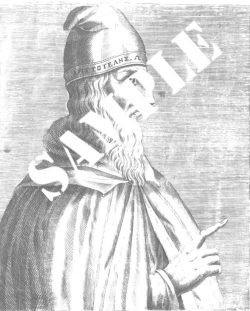
Aristotle (from André
Thevet)
Click on thumbnail to download larger image
(see copyright information)
Synopsis
Aristotle was born in Stagira (modern Staviro),[1] a small town in Northern Greece. He was a pupil of Plato, and for three years was tutor to the fourteen year old Alexander the Great (though his influence on Alexander was apparently negligible).[2] Aristotle used Plato’s ideas as his starting point for his own theories,[3] but rejected many of his views, including his Theory of Ideas.[4] For the purposes of our present study two aspects of his work are relevant: his idea of God, and his biological research. Charles Hummel provides an excellent summary of Aristotle’s cosmology:
Aristotle believed that the universe is finite and spherical, with the stationary earth at its center. The simplest entities in nature are the four elements of which the world is composed, earth, water, air and fire, each of which is an eternal substance. At the center of the universe is a motionless sphere composed of earth, forming the dry land. Over this is layer of water, comprising the ocean; next comes the atmosphere of air; then comes an outer coating of fire extending as far as the moon. Objects in our world are composed of one or more of these elements.[5]
Aristotle had the greatest influence of all the Greek philosophers on the development of mediaeval Christian and Islamic[6] doctrine.[7] While Plato’s Timaeus influenced much of the thinking of the early Church[8] it was not until the 11th century that translations of Aristotle’s works became widely available,[9] and their influence began to dominate.
Aristotle’s treatises on physics, metaphysics, logic, cosmology, the elements, epistemology, and nature of change furnished the Middle Ages with its conception of the structure and operation of the physical world. They assumed this fundamental role because their introduction into Western Europe coincided with, and probably contributed toward, the establishment of that uniquely medieval institution, the university. For approximately 450 years, from 1200 to 1650, the universities of Western Europe emphasised a philosophical and scientific curriculum based on the works of Aristotle, whose logic and natural philosophy were studied by all who received the master of arts degree. Since the latter was usually a prerequisite for entry into the higher faculty of theology, most theologians were well aquainted with contemporary science.[10]
Indeed, during this period the writings of Aristotle attained a "preeminent, if not infallible, authority",[11] but as Grant shows, Aristotle’s concept of God as the Unmoved Mover; the earth as without beginning, and the soul not surviving the death of the body[12][13] all led to tensions between science and theology.[14] Hilary Armstrong points out that Aristotle’s concept of God as
...the Eternal Mind enclosed in a sterile self-sufficiency, everlastingly contemplating its own thinking, neither knowing nor willing the universe and only affecting it through the ceaseless motion which desire for its unattainable perfection inspires in the First Heaven, it is not at all like anything we mean by the word ‘God' .It is simply the logical culmination of the hierarchy of substances and the ultimate explanation of motion and change. But it is not a person or power exercising providence, ordering all things by its will. Still less is it a Creator or the inexpressible Absolute. Aristotle’s thought is not really God-centred, but Cosmos-centred. It is the everlasting universe which is for him the Whole, the sum of being, the ultimate Reality. The First Mover or God is a part of that whole, not Absolute Being but the Supreme Being.[15]
The following reasons have been put forward to explain why Aristotle rose to pre-eminence in theological studies, despite resistance from the ecclesiastical authorities.[16]
- "...Aristotle was so ambiguous and provided
such a flexible battery of concepts that he could be understood in many ways,
and even the rejection of his position could be formulated in his own
terminology."[17]
- The ecclesiastical ban on Aristotle intensified the
interest in his works.[18]
- Mediaeval theologians could point to the favourable
attitude of many of the church fathers who had made use of Aristotle, such as
Leonidus of Byzantium (d.c.543), John of Damascus (650/675-749) and Gregory of
Nazianxus (329-390).[19]
Many would consider that Aristotle’s biological studies left a more beneficial legacy. His studies in this area marked a watershed in the history of Greek science.[20] In contrast to Plato, he placed the value of personal observation above abstract argument.[21] He was an expert logician (the founder of formal logic) and this led naturally to him being the originator of systematic biological classification.[22] Most scholars agree that this was his greatest contribution to science.
In his works[23] he referred to about 520 species of animals, and his descriptions of some have only been confirmed in the last 150 years.[24] With the benefit of specimens collected during Alexander’s conquests Aristotle was able to write his History of Animals, The Generation of Animals and The Parts of Animals, reputedly the first scientific treatises of this kind produced in Europe and unsurpassed in their detail until the sixteenth century.[25]
Aristotle rightly rejected the idea that the reproductive ‘seed’ is drawn from the whole body (known as ‘pangenesis’), and so denied that acquired characteristics could be inherited[26] as Lamarck (1744-1829) later maintained. He has been called the first evolutionist by some.[27]. Such a claim is totally unjustified because Aristotole taught the fixity of species[28] and attributed the driving force behind evolution to a guiding intelligence[29] rather than to a purely natural random process. Aristotle rejected the idea that men were spontaneously generated by the earth, and that water-animals had developed on dry land.[30] However, he did teach that spiders, locusts, cicadas, roundworms,[31] eels[32] barnacles[33] and certain fish,[34] are all spontaneously generated from mud and putrefying material.
By the sixteenth century Aristotelian philosophy had been harmonised with biblical revelation and biblical revelation with Aristotelian philosophy to such a degree that it became all but impossible to separate the two. The result was that when objections began to be raised against Aristotelian physics many felt that the Bible too was being challenged.[35]
Rob Bradshaw, Webmaster
References
[1] John Ferguson, Aristotle. (New York: Twayne Publishers, 1972), 13.
[2] G.E.R. Lloyd, Aristotle: The Growth And Structure of His Thought. (Cambridge: Cambridge University Press, 1968), 6 .
[3] Lloyd, 41.
[4] Lloyd, 42.
[5] Charles E. Hummel, The Galileo Connection: Resolving Conflicts Between Science & the Bible. (Downers Grove, Illinois: IVP, 1986), 27 .
[6] Ferguson, 167-169. Three stand out: Alkindi (d.873), Ibn Sina (980-1037), Ibn Roshd or Averroes (1126-1198) .
[7] Edward Grant, "Science and Theology in the Middle Ages," David C. Lindberg & Ronald L. Numbers, eds. God & Nature: Historical Essays on the Encounter Between Christianity and Science. (Berkeley & Los Angeles: University of California Press, 1986), 52
[8] Jean Daniélou, Gospel Message and Hellenistic Culture. (Philadelphia: Westminster Press, 1980), 130: "[Plato] was to keep this pre-eminence in Christian eyes throughout the patristic period. At the time Aristotle, who in the thirteenth century was to dethrone Plato, is no more than a poor relation, whom Tatian [2nd century], for example compares to Judas for betraying his master." Cf. Origen, Celsus, 2.1
[9] It was after the fall of Constantinople in 1204 that Latin versions of the Greek, without an Islamic intermediary became available in the West. Ferguson, 171
[10] Grant, 52
[11] Lloyd, 19
[12] Aristotle’s definition of soul is "the first actuality of a natural body potentially having life; that is organic": De Anima 412a27. Cited in Armstrong, 91
[13] Lloyd, 33, 38-39. Aristotle inherited this belief from the Pythagoreans and from Plato
[14] Grant, 52-53
[15] Armstrong, 90
[16] Rev. Anselm H. Amadio & Loren Minio-Paluello, "Aristotle & Aristotlianism," Encyclopedia Brtiannica Macrpoedia, Vol. 14, 15th edn. (London: Encyclopaedia Britannica Inc., 1992), 66-67: "The introduction of the new Aristotle met with difficulties in Paris. The impact of non-Christian Aristotelian and Arabic philosophy engendered fears, doubts and suspicions. Although the masters at Paris were free to teach Aristotle’s logic, which was value free, and although no obstacle was placed in the way of lecturing on any of Aristotle’s works at Oxford and Toulouse, in the first part of the 13th century the ecclesiastical authorities at Paris imposed a ban on lectures relating to the physics, the metaphysics and the psychology of Aristotle and his commentators.
[17] Arthur Hyman, & James J. Walsh, Philosophy In The Middle Ages: The Christian, Islamic And Jewish Traditions. (Indianapolis: Hackett Publishing Co., 1977), 412.
[18] Amadio, & Minio-Paluello, 67
[19] Lawrence P. Schrenk, "Aristotle," Everett Ferguson, ed. Encyclopedia of Early Christianity. (New York & London: Garland, 1990), 9.
[20] Lloyd, 72
[21] Lloyd, 79
[22] Eric Nordenskiold, The History of Biology: A Survey, trans. Leonard Bucknall Eyre. (New York: Tudor, 1928), 12. Ernest L. Abel, Ancient Views on the Origins of Life. (Rutherford, New Jersey: Fairleigh Dickinson University Press, 1973), 38 .
[23] Nordenskiold, 37: "Of his purely biological works the following are extant: ten books On the History of Animals; five books On the Reproduction of Animals; and three books On the Soul.
[24] Lloyd, 79-81
[25] Charles E. Raven, "Natural Religion And Christian Theology," The Gifford Lectures 1951. (Cambridge: Cambridge University Press, 1953), 41.
[26] Aristotle, Generation 769a5-25; Lloyd, 82, 83: However his own explanation "was equally in error in that he believed… that the semen of the male contributes no material to the embryo, but merely supplies the form and the efficient cause of generation"
[27] Nordenskiold, 37. Abel laments that Aristotle failed the grasp the concept of Evolution! Abel, 63
[28] Lloyd, 92; W.K.C. Guthrie, A History of Greek Philosophy, Vol. 6. (Cambridge: Cambridge University Press, 1981), 290: "It may seem surprising that with such science-based ideas he never entertained the possibility of temporal evolution instead of a static hierarchy, but it would have run counter to his deeply rooted, Platonically inspired conviction of the permanence of form and its priority to matter...
[29] Nordenskiold, 43
[30] Guthrie, Vol. 6, 290; Aristotle, De Resp. 477b5-7
[31] Aristotle, History 5.19 (550b30 - 551a10)
[32] Aristotle, History 6.16 (520a2-24); Generation 762b20-30
[33] Aristotle, Generation 763a25-35)
[34] Aristotle, History 6.15 (569b10-24)
[35] Hummel, 151.
Primary Sources
 J.L. Ackrill, editor. A New Aristotle
Reader. Oxford: Clarendon Press, 1987. Pbk. ISBN: 0198750617. pp.600.
J.L. Ackrill, editor. A New Aristotle
Reader. Oxford: Clarendon Press, 1987. Pbk. ISBN: 0198750617. pp.600. Aristotle, The Complete Works of Aristotle. Illustrated. Logic, Universal Physics, Human Physics, Animal Physics, Metaphysics, Ethics and Politics and others. Kyiv, Ukraine: Strelbytskyy Multimedia Publishing, 2021. ISBN: 9780880011280. pp.5,551.
 Jonathan Barnes, editor, The Complete Works of
Aristotle, revised. Vol. 1. Princeton University Press, 1998. Hbk. ISBN:
069101650X. pp.1264.
Jonathan Barnes, editor, The Complete Works of
Aristotle, revised. Vol. 1. Princeton University Press, 1998. Hbk. ISBN:
069101650X. pp.1264. Jonathan Barnes, editor, The Complete Works of
Aristotle, revised. Vol. 2. Princeton University Press, 1998. Hbk. ISBN:
0691016518. pp.1248.
Jonathan Barnes, editor, The Complete Works of
Aristotle, revised. Vol. 2. Princeton University Press, 1998. Hbk. ISBN:
0691016518. pp.1248.Secondary Sources
 |
 Mortimer J. Adler, Aristotle for Everybody. New York: Touchstone, 1997. ISBN: 9781439104910. pp.288. [Sign-up to Perlego and access book instantly] Mortimer J. Adler, Aristotle for Everybody. New York: Touchstone, 1997. ISBN: 9781439104910. pp.288. [Sign-up to Perlego and access book instantly] |
 |
A. Hilary Armstrong, ed. The Cambridge History of Later Greek And Early Medieval Philosophy. Cambridge: Cambridge University Press, 1970. Hbk. ISBN: 052104054X. pp.39-52. |
|
 Renford Bambrough, The Philosophy of Aristotle.
Penguin Putnam Inc., 1963. Pbk. ISBN: 0451627830. Renford Bambrough, The Philosophy of Aristotle.
Penguin Putnam Inc., 1963. Pbk. ISBN: 0451627830. |
|
 John M. Dillon, The Middle Platonists: 80
B.C. to A.D. 220. Ithaca: Cornell University Press, 1996. Pbk. ISBN:
0801483166. pp.457. John M. Dillon, The Middle Platonists: 80
B.C. to A.D. 220. Ithaca: Cornell University Press, 1996. Pbk. ISBN:
0801483166. pp.457. |
 |
John A.J. Dudley, "The Love of God in Aristotle’s Ethics," Neue Zeitschrift Fü̈r Systematische Theologie Und Religionsphilosophie 25.2 (1983): 126-137. |
|
 Mark Edwards, Aristotle and Early Christian Thought. London: Routledge, 2019. ISBN: 9781315520193. pp.226. [Sign-up to Perlego and access book instantly] Mark Edwards, Aristotle and Early Christian Thought. London: Routledge, 2019. ISBN: 9781315520193. pp.226. [Sign-up to Perlego and access book instantly] |
|
Ronald N. Frost, "'Scholasticism, Reformation, Orthodoxy, and the Persistence of Christian Aristotelianism': A Brief Rejoinder," Trinity Journal 19.1 (1998): 97-101. |
|
 Edward Halper, Aristotle's 'Metaphysics' A Reader's Guide. London: Contuinuum, 2012. ISBN: 9781441192752. pp.160. [Sign-up to Perlego and access book instantly] Edward Halper, Aristotle's 'Metaphysics' A Reader's Guide. London: Contuinuum, 2012. ISBN: 9781441192752. pp.160. [Sign-up to Perlego and access book instantly] |
|
David A. Horner, "What It Takes to Be Great: Aristotle and Aquinas on Magnanimity," Faith and Philosophy 15.4 (1998): 415-444. |
 |
Aristotle (384-322 BCE.) Overview (Internet Encyclopedia of Philosophy) |
|
Sonia Kamińska, "What Can Grow from the Divine Seed?: The Divinity of Human Beings According to Aristotle," Studia Religiologica 45.3 (2012): 173-182. |
|
 Thomas Kiernan, Aristotle Dictionary. New York: Philosophical Library/Open Road, 2018. ISBN: 9781504055048. pp.949. [Sign-up to Perlego and access book instantly] Thomas Kiernan, Aristotle Dictionary. New York: Philosophical Library/Open Road, 2018. ISBN: 9781504055048. pp.949. [Sign-up to Perlego and access book instantly] |
|
Petr Kitzler, "Tertullian and Ancient Embryology in De Carne Christi 4,1 and 19,3-4," Zeitschrift Für Antikes Christentum 18.2 (2014): 204-209. |
|
 G.E.R. Lloyd, ed., Aristotle: The Growth
And Structure of His Thought. Cambridge: Cambridge University Press, 1968.
Pbk. ISBN: 0521094569. pp.364. G.E.R. Lloyd, ed., Aristotle: The Growth
And Structure of His Thought. Cambridge: Cambridge University Press, 1968.
Pbk. ISBN: 0521094569. pp.364. |
|
John Patrick Lynch, Aristotle's School: Study of a Greek Educational Institution. Berkeley: University of California Press, 1973. Pbk. ISBN: 0520021940. |
|
 Richard McKeon, Introduction
to Aristotle, Vol. 1. Random House, Inc., 1992. Hbk. ISBN: 0679600272.
pp.712. Richard McKeon, Introduction
to Aristotle, Vol. 1. Random House, Inc., 1992. Hbk. ISBN: 0679600272.
pp.712. |
|
Roopen Majithia, "The Relation of Divine Thinking to Human Thought in Aristotle," American Catholic Philosophical Quarterly 73.3 (1999): 377-406. |
|
W.E. Mann, "Immutability and Predication: What Aristotle Taught Philo and Augustine," International Journal for Philosophy of Religion 22.1/2 (1987): 21-39. |
|
Sherryll Mleynek, "Abraham, Aristotle, and God: The Poetics of Sacrifice," Journal of American Academy of Religion 62.1 (1994): 107-121. |
|
Richard A. Muller, "Scholasticism, Reformation, Orthodoxy, and the Persistence of Christian Aristotelianism," Trinity Journal 19.1 (1998): 81-96. |
|
 Carlo Natali, D. Hutchinson.ed., Aristotle: His Life and School. Princeton, NJ: Princeton University Press, 2013. ISBN: 9781400846009. pp.240. [Sign-up to Perlego and access book instantly] Carlo Natali, D. Hutchinson.ed., Aristotle: His Life and School. Princeton, NJ: Princeton University Press, 2013. ISBN: 9781400846009. pp.240. [Sign-up to Perlego and access book instantly] |
|
Gayne Nerney, "Aristotle and Aquinas on Indignation: From Nemesis to Theodicy," Faith and Philosophy 8.1 (1991): 81-95. |
|
Maria Liza Ruth A. Ocampo, "Aristotle’s De Anima and Human Transcendence: Some Considerations from a Christian Perspective," Budhi 13.1–3 (2009): 221-235. |
|
E.A. Park, "Life of Aristotle," Bibliotheca Sacra 1 No. 1 (1844): 39-84. pdf [This material is in the Public Domain] pdf [This material is in the Public Domain] |
|
E.A. Park, "Life of Aristotle, Part 2" Bibliotheca Sacra 1 No. 2 (1844): 280-309. pdf [This material is in the Public Domain] |
|
F.E. Peters, Aristotle and the Arabs: The Aristotelian Traditon in Islam. New York: New York University Press, 1968. Hbk. ISBN: 0814703429. pp.303. |
|
 Vasilis Politis, Routledge Philosophy GuideBook to Aristotle and the Metaphysics. London: Routledge, 2004. ISBN: 9781134529797. pp.360. [Sign-up to Perlego and access book instantly] Vasilis Politis, Routledge Philosophy GuideBook to Aristotle and the Metaphysics. London: Routledge, 2004. ISBN: 9781134529797. pp.360. [Sign-up to Perlego and access book instantly] |
|
 David Ross, Aristotle, 6th edn. London:
Routledge, 1995, 2005. ISBN: 9781134809790. pp.336. [Sign-up to Perlego and access book instantly] David Ross, Aristotle, 6th edn. London:
Routledge, 1995, 2005. ISBN: 9781134809790. pp.336. [Sign-up to Perlego and access book instantly] |
|
David T. Runia, "Festugiere Revisited: Aristotle in the Greek Patres," Vigiliae Christianae 43.1 (1989): 1-34. |
|
F.H. Sandbach, Aristotle and the Stoics. Cambridge Philological Society, 1985. Hbk. ISBN: 0906014069. pp.88. |
|
Richard Sorabji, ed. Philoponus and the Rejection of Aristotelian Science. Cornell University Press / London: Duckworth, 1987. Hbk. ISBN: 0801420490. pp.253. |
|
Aristotle (William Turner) |
|
Steve Walton, "What Has Aristotle to Do with Paul? Rhetorical Criticism and 1 Thessalonians," Tyndale Bulletin 46.2 (Nov. 1995): 229-250. pdf |
|
Jan Hendrik Waszink, "Traces of Aristotle's lost dialogues in Tertullian," Vigiliae christianae 1.3 (July 1947): 137-149. |
|
Gerard Watson, "The Theology of Plato and Aristotle," Irish Theological Quarterly 37.1 (1970): 56-64. |
|
 Michael V. Wedin, Aristotle's Theory of Substance:
The "Categories" and "Metaphysics'" Zeta. Oxford Aristotle Studies. Oxford:
Oxford University Press, 2002. Pbk. ISBN: 0199253080. pp.496. Michael V. Wedin, Aristotle's Theory of Substance:
The "Categories" and "Metaphysics'" Zeta. Oxford Aristotle Studies. Oxford:
Oxford University Press, 2002. Pbk. ISBN: 0199253080. pp.496. |
|
R.E. Witt, Albinus and the History of Middle Platonism. Cambridge: Cambridge University Press, 1937. |
|
Timothy S. Yoder, "Aristotle and C. S. Lewis on the Moral Significance of Friendship," Bibliotheca Sacra 176, no. 702 (April 2019): 203-321. |
|
Hans Zorn, "The Confessors Meet Aristotle," Currents in Theology and Mission 9.5 (1982): 291-295. |
Biographies
|
John Fitzgerald, "The Ancient Lives of Aristotle and the Modern Debate About the Genre of the Gospels," Restoration Quarterly 36.4 (1994): 209-222. |
|
E.A. Park, "Life of Aristotle," Bibliotheca Sacra 1 No. 1 (1844): 39-84. pdf [This material is in the Public Domain] |
|
E.A. Park, "Life of Aristotle, Part 2" Bibliotheca Sacra 1 No. 2 (1844): 280-309. pdf [This material is in the Public Domain] |