Basil of Caesarea (c. 329-379)





Theology on the Web helps over 2.5 million people every year to find high quality theological resources that will help to equip them to serve God and to know Him better (2 Timothy 2:15). Like other websites that provide free services, it is dependent on donations to enable it to grow and develop and only 0.004% of visitors currently do so. If you would like to support this site, please use one of the options to the right of this message.
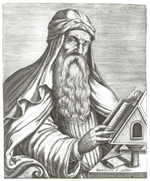
Basil of Caesarea (from
André Thevet)
Click on thumbnail for information on how
to
purchase a larger version of this image
(see copyright information)
Synopsis
Basil was born in Caesarea, the capital of Cappadocia,[1] one of nine children.[2] His grandmother, Macrina, was converted through the ministry of Gregory the Wonderworker (a disciple of Origen), and two of his brothers (Gregory of Nyssa and Peter of Sebaste) also became bishops, and his sister (Macrina) a nun.[3] He received a Greek education at Caesarea, Constantinople and Athens,[4] studying the classics, astronomy, geometry, mathematics and medicine. Medicine seems to have held a special fascination for him, which has led some writers to claim that he actually practised it.[5] Basil never learned Latin - a fact deduced from the lack of Latin sources quoted in his writings.[6] Basil initially intended to take up a career as a lawyer when he returned from five years at the university in Athens in 355. Instead he turned to a life of asceticism, and together with his friend, Gregory of Nazianxus, founded a small monastic community.[7] In 360 he was ordained as a reader, in 362 as a presbyter, and in 370 as bishop of Caesarea.[8]
Many of Basil's writings have survived. Of particular interest is his work Hexameron or On the Six Days of the Creation, which was originally delivered as a series of nine sermons during lent. Basil's deep love for nature of evident throughout this work. He drew extensively from the works of the classical writers.[9] The most significant influence on his thinking was probably that of Aristotle. Basil maintained that he interpreted the Bible literally, rather than allegorically as Origen had done. Concerning that he wrote:
I know the laws of allegory, though less by myself than from the works of others. There are those, truly, who do not admit the common sense of the Scriptures, for whom water is not water, but some other nature, who see in a plant, in a fish, what their fancy wishes, who change the nature of reptiles and of wild beasts to suit their allegories, like the interpreters of dreams who explain visions in sleep to make them serve their own end.[10]
A good example of Basil's literalism is he refutation of Origen's identification of the waters mentioned in Genesis 1 with spiritual and incorporeal powers. He declares: "Let us reject these theories as dreams and old wives tales. Let us understand that by water, water is meant; for the dividing of the waters by the firmament let us accept the reason that has been given to us."[11] He was also careful to distinguish between literal statements and poetic imagery, such as "the heavens declare the glory of God" (Psalm 19:1), which did not imply to Basil that the heavens could speak.[12] His interpretation of Genesis is illustrated by examples from contemporary 'science',[13] which while often being remarkably accurate from our modern perspective also contained elements of folklore. Basil mocks and rejects the theories of the Greek Atomists, arguing that the Greek philosophers were wrong because they did not know the Creator:[14] "...these men, I say, have discovered all except one thing: the fact that God is the Creator of the universe, and the just judge who rewards all the actions of life according to their merit."[15] The influence of Platonism is evident when Basil equates Yahweh with the Demiurge.[16] Matter is created, because if it were uncreated it would mean that the universe is the result of the action of two beings, the one who made the matter and the one who shaped it.[17] God is both the Creator and the Demiurge (shaper) of the universe.[18] Before the creation of this world there existed another world, the invisible and intellectual world equivalent to Plato's world of forms. Afterwards this world was made as a "school and training place where the souls of men should be taught and a home for beings destined to be born and to die."[19]
Rob Bradshaw, Webmaster
References
[1] Not to be confused with Caesarea the seaport in Palestine.
[2] Frederick W. Norris, "Basil of Caesarea," Everett Ferguson, editor, Encylopedia of Early Christianity. (New York: Garland, 1990), 139.
[3] F.L. Cross & E.A. Livingstone, editors. The Oxford Dictionary of the Christian Church, 3rd edn. (Oxford: OUP, 1997), 139.
[4] Cross & Livingstone, 139.
[5] Robert Travers Smith, St. Basil the Great. (London: SPCK, 1879), 17.
[6] Smith, Basil, 12, 199.
[7] W.H.C. Frend, The Rise of Christianity. (Philadelphia: Fortress Press, 1984), 630-631.
[8] Norris, "Basil," 140.
[9] Including Aristotle, Plotinus, Pericles, Plutarch, Pliny the Elder, Aelian, Theophrastus, Hippias, Plato, Protagorus, Thrasmachus, Hesiod, Homer, Solon, Socrates and Diogenes Laertus.
[10] Basil, Hexameron, 9.2 (NPNF, 2nd series, Vol. 8, 102); cf. Basil, Hexameron, 3.9 (NPNF, 2nd series, Vol. 8, 70-71).
[11] Basil, Hexameron, 3.9 (NPNF, 2nd series, Vol. 8, 71).
[12] Basil, Hexameron, 3.9 (NPNF, 2nd series, Vol. 8, 71).
[13] Sheldon-Williams, 432: "...he drew chiefly on the current cosmology, meteorology, botany, astronomy and natural history."
[14] Basil, Hexameron, 1.2 (NPNF, 2nd series, Vol. 8, 53).
[15] Basil, Hexameron, 1.4 (NPNF, 2nd series, Vol. 8, 54).
[16] Armstrong, 432.
[17] Basil, Hexameron, 2.2 (NPNF, 2nd series, Vol. 8, 59).
[18] Basil, Hexameron, 1.5; 2.2 (NPNF, 2nd series, Vol. 8, 54, 59).
[19] Basil, Hexameron, 1.5 (NPNF, 2nd series, Vol. 8, 54).
Primary Sources
Secondary Sources
 |
Mario Baghos, "St Basil’s Eschatological Vision: Aspects of the Recapitulation of History and the ‘Eighth Day," Phronema 25 (2010): 85-103. |
|
Demetrios J. Constantelos, "Basil the Great’s Social Thought and Involvement," The Greek Orthodox Theological Review 26.1–2 (Spr. 1981): 81-86. |
 |
W.L.K. Clarke, Basil the Great: A Study in Monasticism. London, 1913. |
|
Doru Costache, "Christian Worldview: Understandings from St Basil the Great," Phronema 25 (2010): 21-56. |
|
Mark DelCogliano, "Basil of Caesarea on Proverbs 8:22 and the Sources of pro-Nicene Theology," The Journal of Theological Studies 59.1 (April 2008): 183-190. |
|
Paul Jonathan Fedwick, St. Basil the Great and the Christian Ascetic Life. Rome: Basilian, 1978. |
|
Paul Jonathan Fedwick, Basil of Caesarea: Christian, Humanist, Ascetic: a Sixteen-Hundredth Anniversary Symposium, Part.1. Toronto : Pontifical Institute of Mediaeval Studies, 1981. pp. xliv + 436. |
|
 Paul Jonathan Fenwick, The
Church and the Charisma of Leadership in Basil of Caesarea. Toronto:
Pontifival Institute of Medieval Studies, 1979. Reprinted: Eugene, OR: Wipf
& Stock Publishers, 2001. Pbk. ISBN: 1579108237. pp.246. Paul Jonathan Fenwick, The
Church and the Charisma of Leadership in Basil of Caesarea. Toronto:
Pontifival Institute of Medieval Studies, 1979. Reprinted: Eugene, OR: Wipf
& Stock Publishers, 2001. Pbk. ISBN: 1579108237. pp.246. |
 |
Coleman M. Ford, "Striving for Glory with God’: Humility as the Good Life in Basil of Caesarea's Homily 20," Themelios 44.2 (August 2019): 278-390.  pdf pdf |
|
![Adrian Fortescue [1874-1923], The Greek Fathers](images/books3/greek-fathers_fortescue-tb.jpg) Adrian Fortescue [1874-1923], The Greek Fathers. London: The Catholic Truth Society, 1908. Hbk. pp.255. pdf [This material is in the Public Domain] Adrian Fortescue [1874-1923], The Greek Fathers. London: The Catholic Truth Society, 1908. Hbk. pp.255. pdf [This material is in the Public Domain] |
|
R.C. Gregg, Consolation Philosophy: Greek and Christian Paideia in Basil and the Two Gregories. Washington, DC: Paperback Publisher: Catholic University of America Press, 1975. Pbk. ISBN: 0813210003. |
|
R.P.C. Hanson, "Basil's Doctrine of Tradition in Relation to the Holy Spirit," Vigiliae Christianae 22 (1968): 241-255. |
|
Michael A.G. Haykin, "And Who Is the Spirit: Basil of Caesarea’s Letters to the Church at Tarsus," Vigiliae Christianae 41.4 (Dec, 1987): 377-385. |
|
Michael A.G. Haykin, "In the Cloud and in the Sea'; Basil of Caesarea and the Exegesis of 1 Cor. 10:2," Vigiliae Christianae 40 (1986): 135-44. |
|
Michael A.G. Haykin, "Defending the Holy Spirit’s Deity: Basil of Caesarea, Gregory of Nyssa, and the Pneumatomachian Controversy of the 4th Century," Southern Baptist Journal of Theology 7.3 (Autumn 2003): 74-79. |
 |
 Stephen Hildebrand, Basil of Caesarea. The Early Christian Fathers. London: Routledge, 2018. ISBN: 9781317525332. pp.pp.220. [Sign-up to Perlego and access book instantly] Stephen Hildebrand, Basil of Caesarea. The Early Christian Fathers. London: Routledge, 2018. ISBN: 9781317525332. pp.pp.220. [Sign-up to Perlego and access book instantly] |
|
John Jebaseelan, "Understanding St Basil of Caesarea’s Reference to Secret and Unwritten Apostolic Tradition in On the Holy Spirit," Phronema 33.1 (2018): 91-102. |
|
Philip Kariatlis, "St Basil’s Contribution to the Trinitarian Doctrine: A Synthesis of Greek Paideia and the Scriptural Worldview," Phronema 25 (2010): 57-83. |
|
John A.L. Lee, "Why Didn’t St Basil Write in New Testament Greek?" Phronema 25 (2010): 3-20. |
|
J.T. Leinhard, "Basil of Caesarea, Marcellus of Ancyra and "Sabellius'," Church History 58 (1990): 157-67. |
|
Richard Lim, "The Politics of Interpretation in Basil of Caesarea's Hexaemeron," Vigiliae Christianae 44.4 (1990): 351-370. |
|
 Timothy P. McConnell, Illumination in Basil of Caesarea's Doctrine of the Holy Spirit. Minneapolis, MN: Fortress Press, 2014. ISBN: 9781451484441. pp.250. [Sign-up to Perlego and access book instantly] Timothy P. McConnell, Illumination in Basil of Caesarea's Doctrine of the Holy Spirit. Minneapolis, MN: Fortress Press, 2014. ISBN: 9781451484441. pp.250. [Sign-up to Perlego and access book instantly] |
|
St. Basil the Great (Joseph McSorley) |
|
Rico Gabriel Monge, "Submission to One Head: Basil of Caesarea on Order and Authority in the Church.," St Vladimir’s Theological Quarterly 54.2 (2010): 219-243. |
|
M. Orphanos, Creation and Salvation According To Basil of Caesarea. Athens, 1975. |
|
George L. Prestige, St. Basil the Great and Apollonaris of Laodicea. Orthodoxies and Heresies in the Early Church. Henry Chadwick, ed. Ams Press, 1987. Hbk. ISBN: 0404623999. |
|
William M. Ramsay [1851-1939], Pauline and Other Studies in Other Studies in Early Christian History. London: Hodder & Stoughton, 1906. Hbk. pp.369-406. |
|
Adam Rasmussen, "Basil of Caesarea’s Uses of Origen in His Polemic against Astrology," Zeitschrift Für Antikes Christentum 18.3 (2014): 471-485. |
|
G.F. Reilly, Imperium and Sacerdotium According to St. Basil the Great. Washington, DC, 1945. |
|
David G. Robertson, "Stoic and Aristotelian Notions of Substance in Basil of Caesarea," Vigiliae Christianae 52.4 (1998): 393-417. |
|
George E. Saint-Laurent, "St. Basil of Caesarea and the Rule of St. Benedict," Diakonia 16.1 (1981): 71-79. |
|
Andrea Sterk, "On Basil, Moses, and the Model Bishop: The Cappadocian Legacy of Leadership," Church History 67.2 (1998): 227-253. |
|
L.J. Swift, "Basil and Ambrose on the Six Days of Creation," Augustinianum 21 (1981): 317-28. |
|
Donald A. Sykes, "Understandings of the Church in the Cappadocians," Horton Davies, ed., Studies of the Church in History. Essays Honoring Robert S. Paul on his Sixty-fifth Birthday. Allison Park, PA: Pickwick Publications, 1983. pp.73-83. pdf [Reproduced by permission of Wipf & Stock Publishers] For more information about the reprint of this title see here. |
|
Lucian Turcescu, "Prosopon and Hypostasis in Basil of Caesarea's Against Eunomius and the Epistles," Vigiliae Christianae 51.4 (1997): 374-395. |
|
James Alan Waddell, "Identifying Authorities and Pastoral Practice in the Early Church: Two Case Studies: Basil of Caesarea and Ephrem of Syria," Concordia Journal 31.1 (Jan. 2005): 48-59. |
|
N.G. Wilson, ed., Saint Basil on the Value of Greek Literature. London: Duckworth, 1975. Pbk. ISBN: 0715609246. pp.80. |
|
Harry A. Wolfson, "The Identification of Ex Nihilo With Emanation in Gregory of Nyssa," Harvard Theological Review, Vol. 63 (1970): 53-54. |
Biographies
|
![Frederic William Farrar [1831-1903], Lives of the Fathers. Sketches of Church History in Biography, 2 Vols](images/books3/lives-of-the-fathers_farrar-tb.jpg) Frederic William Farrar [1831-1903], Lives of the Fathers. Sketches of Church History in Biography, 2 Vols. London: Adam & Charles Black, 1907. Hbk. pp.781+737. pdf [This material is in the Public Domain] Frederic William Farrar [1831-1903], Lives of the Fathers. Sketches of Church History in Biography, 2 Vols. London: Adam & Charles Black, 1907. Hbk. pp.781+737. pdf [This material is in the Public Domain] |
|
M.M. Fox, The Life and Times of St. Basil as Revealed in His Works. Washington, D.C.: Catholic University of America Press, 1939. |
|
 Philip Rousseau, Basil of Caesarea, new edn.
University of California Press, 1998. Pbk. ISBN: 0520213815. pp.432. Philip Rousseau, Basil of Caesarea, new edn.
University of California Press, 1998. Pbk. ISBN: 0520213815. pp.432. |
|
Richard Travers Smith (1871-1905), St. Basil the Great. London: Society for the Promotion of Christian Knowledge, 1879. Hbk. pp.232. [This material is in the Public Domain] |
| Robert Louis Wilken, "The Spirit of Holiness: Basil of Caesarea and Early Christian Spirituality," Worship 42.2 (Feb. 1968): 77-87. |
Related Subjects
 |
|
 |
|
 |
Alexander of Alexandria | Ambrose | Aristides | Arnobius | Athanasius | Athenagoras | Augustine | Basil | Boethius | John Cassian | Celsus | Clement of Alexandria | Clement of Rome | Constantine | Cyprian | Cyril of Alexandria | Cyril of Jerusalem | Ephraem the Syrian | Epiphanius | Eusebius of Caesarea | Gregory of Nazianzus | Gregory of Nyssa | Gregory Thaumaturgus | Hermas | Hilary of Poitiers | Hippolytus | Ignatius of Antioch | Irenaeus of Lyons | Julius Africanus | Jerome | John Chrysostom | Josephus | Justin Martyr | Justinian I | Lactantius | Leo the Great | Marcellus | Martin of Tours | Melito | Methodius | Minucius Felix | Novatian | Origen | Pachomius | Papias | Philo | Polycarp | Synesius of Cyrene | Tatian | Tertullian | Theodore of Mopsuestia | Theodoret | Theophilus | Tyconius | Ulfilas | Victorinus | Marius Victorinus
ABOUT | KEY | SITE MAP | INTRODUCTIONS | BIBLE | COUNCILS & CREEDS | DOCTRINE & PRACTICE | HERESIES & SECTS | HISTORY | MINISTRY | PEOPLE | PHILOSOPHY | WRITINGS | STUDY AIDS | BLOG | SUPPORT SITE | CONTACT