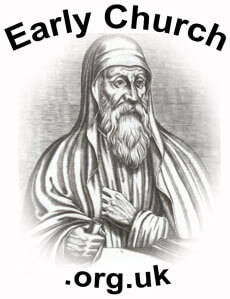
Hippolytus
(d. 240 AD)






Theology on the Web helps over 2.5 million people every year to find high quality theological resources that will help to equip them to serve God and to know Him better (2 Timothy 2:15). Like other websites that provide free services, it is dependent on donations to enable it to grow and develop and only 0.004% of visitors currently do so. If you would like to support this site, please use one of the options to the right of this message.
Synopsis
HIPPOLYTUS, a distinguished ecclesiastical writer; b. in the second half of the second century; d. about the year 240. Greek was his native tongue; and, although this may point to an Oriental birth, he was in Rome at an early age. He heard Irenæas lecture (Photius). The vivid minuteness with which he relates the fortunes of Callistus leads to the conclusion that he was in Rome under Victor (189-199). At the beginning of the third century he was a presbyter, conspicuous for learning, eloquence, zeal, and moral earnestness. He dissented, in matters of doctrine, from Victor’s successors (Zephyrinus and Callistus), holding the view that heretics should not be received back into the Church, and favoring the subordination theory of the Trinity; while they were inclined to Patripassianism. he seems to refer to himself as bishop, and stood at the head of a schismatic body in Rome (so also Prudeutius). Thus much is extracted from the author’s own work, the Philosophoumena. The other notices of his life are few. Eusebius (Hist., vi 20, 26) calls him bishop, and puts his life in the reign of Alexander Severus (222—285); and Prudentius (400) designates his bishopric as Portus, the port of Rome. Jerome (Cat. Vir. Illustr., 61) gives nothing more about him than a few of his writings. An ancient catalogue of Roman bishops, which Mommsen puts in 354, states that Yppolitus presbyter, with the Roman Bishop Pontianus, was banished by Severus to the unhealthy island of Sardinia (about 235). It does not say that he died there; and so the account of his death by Prudentius can be harmonized with this statement, but is not corroborated by any other testimony. He says Hippolytus was regarded as a martyr by the Roman Church, and suffered martyrdom at Portus, being torn to pieces by horses. The authenticity of this account is justly denied by Dollinger, on the ground that this mode of punishment was not practised by the Romans. In 1551 a marble statue was exhumed at Portus, which represents Hippolytus in a sitting posture, with beard and high forehead. On the chair are inscribed the titles of his works.
Writings. - In 1842 a learned Greek, Minoides Minas, employed by the French Government, found at Mount Athos, and brought to Paris, a number of manuscripts. Among these was one which E. Miller published at Oxford in 1851, under the title Origen’s Phliosophoumena; or, Refutation of all Heresies. The first book of this work was known before, and was generally ascribed to Origen. Of the original ten books, the second, third, and a part of the fourth, are still wanting. It is almost universally agreed by critics that this work is by the hand of Hippolytus, and not Origen. Baur (Theol. Jahrb., 1853) regarded the presbyter Caius as the author; but he has no followers in this opinion.
Hippolytus displays in this work wise judgment, large information, a wide acquaintance with the writings of philosophers, and acuteness in bringing out the relation of the ancient philosophies to the Christian heresies. He was as harsh and uncompromising a foe of philosophy as Tertullian. The Refutation of all Heresies … is a polemical work whose main object is to refute the doctrines (and especially the secret doctrines) of the Gnostics, and to abash heretics by showing that their views were taken from Pagan philosophy and Oriental theosophy. Book i. gives a summary of the Greek, Druid, and Indian philosophies. Books ii. and iii. are lost. Book iv. begins in the middle of an account of Chaldaean astrology, and gives an account of the magic practised at that time, etc. Books v.-x. contain the account of the heresies. In v. the Ophites (Naaseni, Peraticae, Sethites, Justinus) are treated; in vi., the followers of Simon Magus, and Valentinus and his disciples; in vii., Basilides (whose views appear to us in an altogether new phase) and Marcion; in viii., the Doketae, an Arabian Monoimos, the Quartodecimani, and the Montanists; in ix., Patripassianism, the author giving a valuable picture of the congregation in Rome at that time, and in x. he summarizes the contents of books i. and iv.-ix. It was from this summary that Theodoret drew. From the fact that Hippolytus looks back upon the administration of Callistus (217-222) as belonging to the past, the date of composition may be assigned pretty confidently to the year 234.
[996]
Other writings of Hippolytus are mentioned on the statue discovered at Pontus, to the number of thirteen. The greater number of these are entirely lost, and only fragments of others remain. Other works ascribed to him … are so different in style from the Refutation as hardly to be genuine. The same is true in regard to the exegetical works which are ascribed to him on the basis of notices in the fathers, manuscripts, etc. The fragments on Daniel, however, edited by Bardenhewer (D. heil. Hippol. Comnientar z. Buck Daniel, Freiburg, 1877), we may confidently regard as genuine.
Jacobi, "HIPPOLYTUS," Philip Schaff, ed., A Religious Encyclopaedia or Dictionary of Biblical, Historical, Doctrinal, and Practical Theology, 3rd edn., Vol. 2. Toronto, New York & London: Funk & Wagnalls Company, 1894. pp.995-996. [Greek titles of works omitted.]
Primary Sources
![Burton Scott Easton [1877-1950], translator, The Apostolic Tradition of Hippolytus](images/books3/apostolic-tradition-hippolytus-tb.jpg) Burton Scott Easton [1877-1950], translator, The Apostolic Tradition
of Hippolytus. Cambridge: Cambridge University Press, 1934. Hbk. pp.112.
Burton Scott Easton [1877-1950], translator, The Apostolic Tradition
of Hippolytus. Cambridge: Cambridge University Press, 1934. Hbk. pp.112. Secondary Sources
 |
C.P. Bammel, "The State of Play with Regard to Hippolytus and the Contra Noetum," Heythrop Journal 31 (1990): 195-199. |
|
Albert I. Baumgarten, "Josephus and Hippolytus on the Pharisees," Hebrew Union College Annual 55 (1984): 1-25. |
 |
Allen Brent, Hippolytus and the Roman Church in the Third Century: Communities in Tension Before the Emergence of a Monarch-bishop. Vigiliae Christianae, Supplements. Leiden: Brill, 1995. Hbk. ISBN: 9004102450. pp.600. |
|
Allen Brent, "Was Hippolytus a Schismatic?" Vigiliae Christianae 49.3 (1995): 215-244. |
|
J.A. Cerrato, "Hippolytus On the Song of Songs and the New Prophecy," Studia Patristica. Proceedings of the the 12th International Congress on Patristic Studies, Oxford 1995. Leuven: Peeters Press. |
|
J.A. Cerrato, Hippolytus Between East and West. Oxford University Press, 2001. Hbk. ISBN: 0199246963. pp.280. |
|
F.L. Cross, The Early Christian Fathers. Studies in Theology 1. London: Gerald Duckworth & Co. Ltd., 1960. Hbk. pp.94-96. |
|
R.H. Connolly, The So-Called Egyptian Church Order and Derived Documents. Cambridge: Cambridge University Press,1916. |
|
F.L. Cross, The Early Christian Fathers. Studies in Theology 1. London: Gerald Duckworth & Co. Ltd., 1960. Hbk. pp.155-167. |
|
J.J.I. von Dillinger, Hippolytus and Callistus. Edinburgh: T & T Clark, 1876. |
 |
David Dunbar, "The problem of Hippolytus of Rome: a study in historical-critical reconstruction," Journal of the Evangelical Theological Society 25.1 (March 1982): 63-74. pdf pdf |
|
David G. Dunbar, "Hippolytus of Rome and the Eschatological Exegesis of the Early Church," Westminster Theological Journal 45.2 (1983): 322-339. |
|
David G. Dunbar, "The Delay of the Parousia in Hippolytus," Vigiliae Christianae, Vol. 37 (1983): 313-327. |
|
C.M. Edsman, "A Typology of Baptism in Hippolytus Romanus," Studia Patristica 2 (1957): 35-40. |
|
Thomas M. Finn, "Ritual Process and the Survival of Early Christianity: A Study of the Apostolic Tradition of Hippolytus," Journal of Ritual Studies 3.1 (1989): 69-89. |
|
Hippolytus (Christian Classic Ethereal Library) |
|
![Fenton John Anthony Hort [1828–1892], Six Lectures on the Ante-Nicene Fathers](images/books3/ante-nicene-fathers_hort-tb.jpg) Fenton John Anthony Hort [1828–1892], Six Lectures on the Ante-Nicene Fathers. London & New York: MacMillan & Co., 1895. Hbk. pp.138. pdf [This material is in the Public Domain] Fenton John Anthony Hort [1828–1892], Six Lectures on the Ante-Nicene Fathers. London & New York: MacMillan & Co., 1895. Hbk. pp.138. pdf [This material is in the Public Domain] |
|
Frederick John Foakes Jackson [1855-1941], A History of Church History. Studies of Some Historians of the Christian Church. Cambridge: Heffer & Sons Ltd., 1939. Hbk. pp.194. pdf [This material is in the Public Domain] |
|
M. de Jonge, "Hippolytus' Benedictions of Isaac, Jacob and Moses' and the Testaments of the Twelve Patriarchs," Bijdragen 46.3 (1985): 245-60. |
|
Jaap J. Mansfeld, Heresiography in Context: Hippolytus' "Elenchos" as a Source for Greek Philosophy. Philosophia Antiqua Series. Leiden: Brill, 1992. Hbk. ISBN: 9004096167. pp.391. |
|
G. Ogg, "Hippolytus and the Introduction of the Christian Era," Vigiliae Christianae 16 (1962): 2-18. |
|
 Catherine Osborne, Rethinking Early Greek Philosophy: Hippolytus of Rome and the
Presocratics. London: Gerald Duckworth & Co. Ltd., 1987. Hbk. ISBN:
0715619756. pp.392. Catherine Osborne, Rethinking Early Greek Philosophy: Hippolytus of Rome and the
Presocratics. London: Gerald Duckworth & Co. Ltd., 1987. Hbk. ISBN:
0715619756. pp.392. |
|
Carroll D. Osburn, "The Test of the Pauline Epistles in Hippolytus of Rome," Second Century 2.2 (1982): 97-124. |
|
L. Edward Phillips, "Daily Prayer in the Apostolic Tradition of Hippolytus," Journal of Theological Studies 40.2 (1989): 389-400. |
|
D.L. Powell, "The Schism of Hippolytus," Vigiliae Christianae, Vol. 12 (Texte und Untersuchungen, 115). Berlin: Akademie, 1975. pp.449-456. |
|
E. Segelberg, "The Ordination Prayers in Hippolytus," Studia Patristica 13 (1975): 397-408. |
|
C.N. Tsirpanlis, "The Antichrist and the End of the World in Irenaeus, Justin, Hippolytus and Tertullian," Patristic and Byzantine Review 9 (1990): 5-17. |
 |
 Gerard
Vallée, A Study in Anti-Gnostic Polemics: Irenaeus, Hippolytus, and
Epiphanius. Studies in Christianity and Judaism, 1. Waterloo: Wilfred
Laurier University Press, 1981, 2006. ISBN: 9780889205741. pp.126. [Sign-up to Perlego and access book instantly] Gerard
Vallée, A Study in Anti-Gnostic Polemics: Irenaeus, Hippolytus, and
Epiphanius. Studies in Christianity and Judaism, 1. Waterloo: Wilfred
Laurier University Press, 1981, 2006. ISBN: 9780889205741. pp.126. [Sign-up to Perlego and access book instantly] |
|
A. Whealey, "Hippolytus' Lost De Universo and De resurrectione: Some New Hypotheses," Vigiliae Christianae 50.3 (1996): 244-256. |
|
A. Whealey, "Prologues on the Psalms. Origen, Hippolytus, Eusebius," Revue bénédictine de critique, d'histoire et de littérature religieuses 106 (1996): 234-45. |
|
 Chr. Wordsworth, Hippolytus and the Church of
Rome. London: Rivingtons, 1880. Reprinted: Eugene, OR: Wipf & Stock
Publishers, 2001. Pbk. ISBN: 157910763X. pp.328. Chr. Wordsworth, Hippolytus and the Church of
Rome. London: Rivingtons, 1880. Reprinted: Eugene, OR: Wipf & Stock
Publishers, 2001. Pbk. ISBN: 157910763X. pp.328. |
|
Benjamin G. Wright, "Cerinthus Apud Hippolytus: An Inquiry Into The Traditions About Cerinthus's Provenance," Second Century 4.2 (1984): 102-115. |
|
R.J. Zwi Werblowsky, "On the Baptismal Rite According to St. Hippolytus," Texte und Untersuchungen 64 (1957): 93-105. |
Biographies
Related Subjects
Montanism
 |
|
 |
|
 |
Alexander of Alexandria | Ambrose | Aristides | Arnobius | Athanasius | Athenagoras | Augustine | Basil | Boethius | John Cassian | Celsus | Clement of Alexandria | Clement of Rome | Constantine | Cyprian | Cyril of Alexandria | Cyril of Jerusalem | Ephraem the Syrian | Epiphanius | Eusebius of Caesarea | Gregory of Nazianzus | Gregory of Nyssa | Gregory Thaumaturgus | Hermas | Hilary of Poitiers | Hippolytus | Ignatius of Antioch | Irenaeus of Lyons | Julius Africanus | Jerome | John Chrysostom | Josephus | Justin Martyr | Justinian I | Lactantius | Leo the Great | Marcellus | Martin of Tours | Melito | Methodius | Minucius Felix | Novatian | Origen | Pachomius | Papias | Philo | Polycarp | Synesius of Cyrene | Tatian | Tertullian | Theodore of Mopsuestia | Theodoret | Theophilus | Tyconius | Ulfilas | Victorinus | Marius Victorinus
ABOUT | KEY | SITE MAP | INTRODUCTIONS | BIBLE | COUNCILS & CREEDS | DOCTRINE & PRACTICE | HERESIES & SECTS | HISTORY | MINISTRY | PEOPLE | PHILOSOPHY | WRITINGS | STUDY AIDS | BLOG | SUPPORT SITE | CONTACT