Clement of Alexandria
(c.150 - c.215)





Theology on the Web helps over 2.5 million people every year to find high quality theological resources that will help to equip them to serve God and to know Him better (2 Timothy 2:15). Like other websites that provide free services, it is dependent on donations to enable it to grow and develop and only 0.004% of visitors currently do so. If you would like to support this site, please use one of the options to the right of this message.
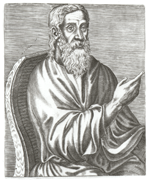
Clement of Alexandria (from
André Thevet)
Click on thumbnail for information on how
to
purchase a larger version of this image
(see copyright information)
Synopsis
Little is known about the life of Titus Flavius Clemens.[1] He succeeded the converted stoic philosopher Pantaenus[2] as head of the Christian Catechetical school in Alexandria, founded by the latter in the middle of the second century. He is regarded as an inferior theologian to his immediate successor to the post, Origen.[3]
Clement drew extensively on Philo,[4] and followed both Philo and Justin Martyr[5] in claiming that the Greek philosophers had plagiarised their teaching from Moses.[6] His reasons for doing this were twofold. First, he wished to counter the negative attitude that many uneducated Christians had towards Greek philosophy. That (in his opinion) would have greatly hindered its spread in the Hellenistic world. Secondly, he was faced with the attacks of educated Pagans, such as Celsus (late second century), who in his work True Doctrine[7] argued for the superiority of Greek culture, of which Judaism and Christianity were but shabby counterfeits.[8] On the contrary, Clement argued, Plato and the other philosophers had read the writings of Moses and the Prophets: whatever good could be found in their works was a result of divine inspiration and/or their use of biblical material.[9] This theory is often referred to as "the theft of the Greeks". Lilla points out that Clement and Celsus shared the common conviction that the Greeks had inherited, not invented their superior culture and philosophy from the ancient civilisations of India, Persia, Babylon and Egypt.[10]
In extolling the divine character of the philosophy of Plato, Clement claims several times that Plato was dependent on Scripture,[11] as was Pythagoras (who is also warmly praised).[12] This is amply demonstrated in the reading list of the Catechetical school in Alexandria, which included the works of all the philosophers (except those of the Epicureans, who denied the existence of God), and was clearly modelled on the Platonic schools of the time.[13] He interpreted Greek philosophy in a biblical sense[14] and maintained that it had prepared the Hellenistic world for the ‘true philosophy’: the Christian gospel.[15] Philosophy gave Clement an the means by which he could penetrate beyond the literal sense of Scripture to reveal the true meaning, namely allegory.
Rob Bradshaw, Webmaster
References
[1] Albert C. Outler, "The ‘Platonism’ of Clement of Alexandria," The Journal of Religion, Vol. 20, No. 3. (1940): 217.
[2] Eusebius, History 6.6 (NPNF, 2nd series, Vol. 1, 253-254). Henry Chadwick in A. Hilary Armstrong, ed. The Cambridge History of Later Greek And Early Medieval Philosophy. (Cambridge: CUP, 1970), 168.
[3] Outler, 217.
[4] Joseph W. Trigg, "Allegory," Everett Ferguson ed. EEC. (New York: Garland, 1990), 24.
[5] Though Clement nowhere gives Justin credit when he develops Justin’s ideas. Chadwick, Later Greek And Early Medieval Philosophy, 170.
[6] E.g. Clement, Strom. 1.20-29; 2.1.1; 4.1.2 (ANF, Vol. 2, 323-341). Salvatore R.C. Lilla., Clement of Alexandria, A Study in Christian Platonism and Gnosticism. (Oxford: OUP, 1971), 31-41.
[7] Written 178 AD.
[8] Lilla, 34-36.
[9] Clement of Alexandria, Exhortation 6; Strom. 1:15, 21; 2.5, 11, 14; 6.3 (ANF, Vol. 2, 316-317, 324; 351-353, 460, 465-476; 486-488).
[10] Lilla, 37-39.
[11] Clement, Strom. 1.25; 2.22; 5.14 (ANF, Vol. 2, 338, 375-376, 465-469). Lilla, 42, n.4.
[12] Lilla, 43.
[13] Gregory Thaumaturgus’ (or ‘the wonder-worker’) Thanksgiving to Origen is our source for details of the school’s curriculum. G.L. Prestige, Fathers And Heretics. (London: SCM, 1963), 49-52; Lilla, 55-56.
[14] Lilla, 43.
[15] Lilla, 56; Daniélou, Hellenistic, 109.
Primary Sources
 Denise Kimber Buell, Making Christians:
Clement of Alexandria and the Rhetoric of Legitimacy. Princeton, New
Jersey: Princeton University Press, 1999. Hbk. ISBN: 0691059802. pp.236.
Denise Kimber Buell, Making Christians:
Clement of Alexandria and the Rhetoric of Legitimacy. Princeton, New
Jersey: Princeton University Press, 1999. Hbk. ISBN: 0691059802. pp.236. G.W. Butterworth, trans., Clement of Alexandria:
Exhortation to the Greeks / Rich Man's Salvation / To the Newly Baptized,
Loeb Classical Library Cambridge: Harvard University Press, 1919. Hbk. ISBN:
0674991036. pp.432.
G.W. Butterworth, trans., Clement of Alexandria:
Exhortation to the Greeks / Rich Man's Salvation / To the Newly Baptized,
Loeb Classical Library Cambridge: Harvard University Press, 1919. Hbk. ISBN:
0674991036. pp.432.![Alexander Roberts [1826-1901] & James Donaldson [1831-1915], eds., The Ante-Nicene Fathers, Translations of the Fathers down to A.D. 325, Vol. 2](images/books3/ante-nicene-fathers_vol-02-tb.jpg) Alexander Roberts [1826-1901] & James Donaldson [1831-1915], eds., The Ante-Nicene Fathers, Translations of the Fathers down to A.D. 325, Vol. 2: Fathers of the Second Century: Hermas, Tatian, Athenagoras, Theophilus, and Clement of Alexandria (Entire). Buffalo, NY: The Christian Literature Publishing Company, 1887. Hbk. pp.626.
Alexander Roberts [1826-1901] & James Donaldson [1831-1915], eds., The Ante-Nicene Fathers, Translations of the Fathers down to A.D. 325, Vol. 2: Fathers of the Second Century: Hermas, Tatian, Athenagoras, Theophilus, and Clement of Alexandria (Entire). Buffalo, NY: The Christian Literature Publishing Company, 1887. Hbk. pp.626.  William
Wilson, trans. The Writings of Clement of Alexandria. Ante-Nicene Fathers, Vol. 4, 2 Vols. Edinburgh: T & T Clark, 1884. Hbk. pp.470+542.
William
Wilson, trans. The Writings of Clement of Alexandria. Ante-Nicene Fathers, Vol. 4, 2 Vols. Edinburgh: T & T Clark, 1884. Hbk. pp.470+542. Secondary Sources
 |
 Piotr Ashwin-Siejkowski, Clement of Alexandria. London: T & T Clark, 2008. ISBN: 9780567418128. pp.272. [Sign-up to Perlego and access book instantly] Piotr Ashwin-Siejkowski, Clement of Alexandria. London: T & T Clark, 2008. ISBN: 9780567418128. pp.272. [Sign-up to Perlego and access book instantly] |
 |
Richard Bauckham, "The Fall of the Angels as the Source of Philosophy In Hermias and Clement of Alexandria," Vigiliae Christianae 39.4 (1985): 313-330. |
 |
Charles Bigg [1840-1908], The Christian Platonists of Alexandria. Being the Bampton Lectures of the Year 1886. Oxford: Clarendon Press, 1913. Hbk. pp.386.  pdf [This material is in the Public Domain] pdf [This material is in the Public Domain] |
 |
 Charles Bigg [1840-1908], The Christian
Platonists of Alexandria. Eugene, OR: Wipf & Stock Publishers, 2000.
Pbk. ISBN: 1579103030. pp.332. Charles Bigg [1840-1908], The Christian
Platonists of Alexandria. Eugene, OR: Wipf & Stock Publishers, 2000.
Pbk. ISBN: 1579103030. pp.332. |
|
James A. Brooks, "Clement of Alexandria as a Witness to the Development of the New Testament Canon," Second Century 9.1 (1992): 41-55. |
|
B.G. Bucur, "The Other Clement of Alexandria: Cosmic Hierarchy and Interiorized Apocalypticism," Vigiliae Christianae 60.3 (2006): 251-268. |
|
 Denise Kimber Buell, Making Christians. Clement of Alexandria and the Rhetoric of Legitimacy. Princeton, NJ: Princeton University Press, 2020. ISBN: 9780691221526. [Sign-up to Perlego and access book instantly] Denise Kimber Buell, Making Christians. Clement of Alexandria and the Rhetoric of Legitimacy. Princeton, NJ: Princeton University Press, 2020. ISBN: 9780691221526. [Sign-up to Perlego and access book instantly] |
|
Aecio Cairus, "Clement of Alexandria and the Lord's Day," Andrews University Seminary Studies 40.2 (Autumn 2002): 273-276. pdf |
|
 H. von Campenhausen, Fathers of the Greek Church.
Hendrickson, 1998. Hbk. ISBN: 1565630955. pp.29-39. H. von Campenhausen, Fathers of the Greek Church.
Hendrickson, 1998. Hbk. ISBN: 1565630955. pp.29-39. |
|
Stephen C. Carlson, "Clement of Alexandria on the 'Order' of the Gospels," New Testament Studies 47.1 (2001): 118-125. |
|
Robert P.
Casey, "Clement of Alexandria and the Beginnings of Christian Platonism," Harvard Theological Review, Vol. 18, No. 1 (1925): 39-101. pdf |
|
 Robert Pierce Casey, Clement of Alexandria and the Beginnings of Christian Platonism. Piscataway, NJ: Gorgias Press, 2007. ISBN: 9781463214401. pp.67. [Sign-up to Perlego and access book instantly] Robert Pierce Casey, Clement of Alexandria and the Beginnings of Christian Platonism. Piscataway, NJ: Gorgias Press, 2007. ISBN: 9781463214401. pp.67. [Sign-up to Perlego and access book instantly] |
|
 Henry Chadwick, Early
Christian Thought and the Classical Tradition. Oxford: Clarendon, 1984.
Pbk. ISBN: 0198266731. pp.182. Henry Chadwick, Early
Christian Thought and the Classical Tradition. Oxford: Clarendon, 1984.
Pbk. ISBN: 0198266731. pp.182. |
|
Elizabeth A.Clark, Clement's Use of Aristotle: The Aristotelian to Clement of Alexandria's Refutation of Gnosticism. New York: Mellen, 1977. Hbk. ISBN: 0889469849. pp.182. |
|
F.L. Cross, The Early Christian Fathers. Studies in Theology 1. London: Gerald Duckworth & Co. Ltd., 1960. Hbk. pp.118-122. |
|
James Davison, "Structural Similarities and Dissimilarities in the Thought of Clement of Alexandria and the Valentinians," Second Century 3.4 (1983): 201-218. |
|
E. Draczkowski, "The educational function of the Old Testament in Clement of Alexandria's Conception. Written Kerygma in Theory and Practice," Roczniki teologisczno-kanonisczne 26.3 ((1979): 17-29. |
|
M.J. Edwards, "Clement of Alexandria and His Doctrine of the Logos," Vigiliae Christianae 54.2 (2000): 159-177. |
|
Peter Ensor, "Clement of Alexandria and penal substitutionary atonement," Evangelical Quarterly 85.1 (Jan. 2013): 19-35. pdf [Reproduced by permission of the current copyright holder] |
|
Denis Farkasfalvy, "The Presbyters' Witness on the Order of the Gospels as Reported by Clement of Alexandria," Catholic Biblical Quarterly 54.2 (1992): 260-270. |
|
John Ferguson, "The Achievement of Clement of Alexandria," Religious Studies 12.1 (1976): 59-80. |
|
John Ferguson, Clement of Alexandria. New York: Twayne, 1974. Hbk. ISBN: 0805722319. pp.210. |
|
Thomas Finan, "Hellenism and Judeo-Christian History in Clement of Alexandria," Irish Theological Quarterly 28 (1961): 83-114. |
|
W E Gregory Floyd, Clement of Alexandria's Treatment of the Problem of Evil. Oxford Theological Monographs. Oxford: Oxford University Press, 1971, Hbk. ISBN: 019826707X. pp.136. |
|
Tom Halton, "Clement of Alexandria and Athenaeus (Paed. III. 4,26)," Second Century 6.4 (1987/88): 193-202. |
|
Trevor A. Hart, "The Two Soteriological
Traditions of Alexandria," The Evangelical Quarterly 61.3 (1989):
239-259. pdf [Clement and
Athanasius] |
|
Clement of Alexandria (Francis P. Havey) |
|
A. van der Hoek, Clement of Alexandria and His Use of Philo in the Stromateis. Supplements to Vigiliae Christianae, 3. Leiden: Brill, 1988. Hbk. 9004087567. pp.261. |
|
A. Van Den Hoek, "How Alexandrian was Clement of Alexandria? Reflections on Clement and his Alexandrian Background," Heythrop Journal 31 (1990): 179-194. |
|
A. Van Den Hoek, "Divergent Traditions in Clement of Alexandria," and other Authors of the 2nd century," Apocrypha 7 (1996): 43-62. |
|
Annewies van den Hoek, "The Catechetical School of Early Christian Alexandria and its Philonic Heritage," Harvard Theological Review 90.1 (1997): 59-87. |
|
Annewies van den Hoek, "Techniques of Quotation in Clement of Alexandria: A View of Ancient Literary Working Methods," Vigiliae Christianae 50.3 (1996): 223-243. |
|
![Fenton John Anthony Hort [1828–1892], Six Lectures on the Ante-Nicene Fathers](images/books3/ante-nicene-fathers_hort-tb.jpg) Fenton John Anthony Hort [1828–1892], Six Lectures on the Ante-Nicene Fathers. London & New York: MacMillan & Co., 1895. Hbk. pp.138. pdf [This material is in the Public Domain] Fenton John Anthony Hort [1828–1892], Six Lectures on the Ante-Nicene Fathers. London & New York: MacMillan & Co., 1895. Hbk. pp.138. pdf [This material is in the Public Domain] |
|
Clayton N. Jefford, "Clement of Alexandria and Gnosis: A Dissertation in Review," Perspectives in Religious Studies 20.4 (1993): 381-396. |
|
Peter Karavites, Evil-Freedom and the Road to Perfection in Clement of Alexandria. Vigiliae Christianae Supplements Series. Leiden: Brill, 1998. Hbk. ISBN: 9004112383. pp.208. |
|
Donald Kinder, "Clement of Alexandria: Conflicting Views on Women," Second Century 7.4 (1989/90): 213-220. |
|
![William Lefroy [1836-1909], ed., Church Leaders in Primitive Times](images/books3/church-leaders-in-primitive-times_lefroy-tb.jpg) Frederic Henry Chase [1853-1925], "Clement of Alexandria,"
William Lefroy [1836-1909], ed., Church Leaders in Primitive Times. Lectures on Their Words and Works. Delivered in Norwich Cathedral by Eminent Anglican Devines, 2nd edn. London: Chas. J. Thynne, 1909. Hbk. pp.255-297. pdf [This material is in the Public Domain] Frederic Henry Chase [1853-1925], "Clement of Alexandria,"
William Lefroy [1836-1909], ed., Church Leaders in Primitive Times. Lectures on Their Words and Works. Delivered in Norwich Cathedral by Eminent Anglican Devines, 2nd edn. London: Chas. J. Thynne, 1909. Hbk. pp.255-297. pdf [This material is in the Public Domain] |
|
Blake Leyerle, "Clement of Alexandria on the Importance of Table Etiquette," Journal of Early Christian Studies 3.2 (1995): 123-141. |
|
Salvatore Romano Clemente Lilla, Clement of Alexandria, A Study in Christian Platonism and Gnosticism. Oxford Theological Monographs. Oxford: OUP, 1971. ISBN: 0198267061. pp.282. |
|
Joseph C McLelland, God the Anonymous: A Study in Alexandrian Philosophical Theology. Patristic Monograph series 4. Cambridge, MA: Philadelphia Patristic Foundation, 1976. ISBN: 091564603X. pp.209. |
|
Harry O. Maier, "Clement of Alexandria and the Care of the Self," Journal of American Academy of Religion 62.3 (1994): 719-745. |
|
Einar Molland, The Conception of the Gospel in the Alexandrian Theology. Oslo: I kommisjon hos J. Dybwad, 1938. pp. xi + 185. |
|
Raoul Mortley, "The Theme of Silence in Clement of Alexandria," Journal of Theological Studies 24.1 (1973): 197-202. |
|
Raoul Mortley, "The Mirror and I Cor. 13, 12 in the Epistemology of Clement of Alexandria," Vigiliae Christianae 30.2 (1976): 109-120. |
|
Eric Osborn, The Philosophy of Clement of Alexandria. Texts and Studies, new series, Vol. 3. Cambridge: Cambridge University Press, 1957. pp.xi + 205. |
|
Eric Osborn, Ethical Patterns in Early Christian Thought. Cambridge: Cambridge University Press, 1976. ISBN: 0521208351. pp. x + 252. |
|
Eric Osborn, "Clement of Alexandria: A Review of Research, 1958-1982," Second Century 3.4 (1983): 219-244. |
|
Eric Osborn, "Arguments for Faith in Clement of Alexandria," Vigiliae Christianae 48.1 (1994): 1-24. |
|
Albert C. Outler, "The Platonism of Clement of Alexandria," The Journal of Religion, Vol. 20, No. 3. (1940): 217-240. |
|
James Carlton Paget, "Clement of Alexandria and the Jews," Scottish Journal of Theology 59.1 (1998): 86-97. |
|
David Paulsen, "Ethical Individualism in Clement of ALexandria," Concordia Theological Monthly 43.1 (1972): 3-20. |
|
 David Ivan Rankin, From Clement to Origen. The Social and Historical Context of the Church Fathers. London: Routledge, 2016. ISBN: 9781317132424. pp.182. [Sign-up to Perlego and access book instantly] David Ivan Rankin, From Clement to Origen. The Social and Historical Context of the Church Fathers. London: Routledge, 2016. ISBN: 9781317132424. pp.182. [Sign-up to Perlego and access book instantly] |
|
David T. Runia, "Why Does Clement of Alexandria Call Philo The Pythagorean?" Vigiliae Christianae 49.1 (1995): 1-22. |
|
Alan.
P.F. Sell, "Theology and the Philosophical Climate: Case-Studies From the
Second Century AD (Part 2) Vox Evangelica 14 (1984): 53-64. pdf |
|
Morton Smith, Clement of Alexandria and a Secret Gospel of Mark. Cambridge, MA: Harvard University Press, 1973. Hbk. ISBN: 0674134907. pp.460. |
|
Morton Smith, "Clement of Alexandria and Secret Mark: The Score at the End of the First Decade," Harvard Theological Review 75.4 (1982): 449-461. |
|
![Robert Bertram Tollinton [1866-1932], Clement of Alexandria: A Study in Christian Liberalism, 2 Vols](images/books3/clement-of-alexandria_tollington-2-vols-tb.jpg) Robert Bertram Tollinton [1866-1932], Clement of
Alexandria: A Study in Christian Liberalism, 2 Vols. London: Williams and
Norgate, 1914. Hbk. pp.366+339. pdf [This material is in the Public Domain] Robert Bertram Tollinton [1866-1932], Clement of
Alexandria: A Study in Christian Liberalism, 2 Vols. London: Williams and
Norgate, 1914. Hbk. pp.366+339. pdf [This material is in the Public Domain] |
|
 Miriam Bergo Tremblay, Clement of Alexandria and the Sibylline Oracles. Chisinau, Republic of Moldova: LAP LAMBERT Academic Publishing, 2015. ISBN: 9783659694257. pp132. [Sign-up to Perlego and access book instantly] Miriam Bergo Tremblay, Clement of Alexandria and the Sibylline Oracles. Chisinau, Republic of Moldova: LAP LAMBERT Academic Publishing, 2015. ISBN: 9783659694257. pp132. [Sign-up to Perlego and access book instantly] |
|
Joseph W. Trigg, "Receiving the Alpha: Negative Theology in Clement of Alexandria and its Possible Implications," Studia Patristica 31 (1997): 540-45. |
|
A.H.C. Van Eijk, "The Gospel of Philip and Clement of Alexandria," Vigiliae Christianae 25.2 (1971): 94-120. |
|
J.G.M. Van Winden, "Quotations From Philo in Clement's Protepticus," Vigiliae Christianae 32.3 (1978): 208-213. |
|
W.H. Wagner, "Another Look at the Literary Problem in Clement of Alexandria's Major Writings," Church History, Vol. 37 (1968): 251-260. |
|
Robert L. Wilken, "Alexandria: A School for Training in Virtue," Patrick Henry, ed. Schools of Thought in the Christian Tradition. Philadelphia: Fortress Press, 1985. Pbk. ISBN: 0800607309. pp.15-30. |
|
J.C.M. van Winden, "Quotations from Philo in Clement of Alexandria's Protrepticus," Vigiliae Christianae 32 (1978): 208-213. |
|
H.A. Wolfson, "Clement of Alexandria on the Generation of the Logos," Church History 20.2 (1951): 72-81. |
|
Jan Zandee, "The Teachings of Silvanus" and Clement of Alexandria: a New Document of Alexandrian Theology. Mededelingen en Verhandelingen van het Vooraziatisch-Egyptisch Genootschap Ex Oriente Lux 19. Leiden: Ex Oriente Lux, 1977. pp. viii + 166. |
Biographies
|
J.G. Davies, "Clement of Alexandria (A.D. 155 - 215)," Expository Times 80.1 (1968): 18-20. |
|
![Frederic William Farrar [1831-1903], Lives of the Fathers. Sketches of Church History in Biography, 2 Vols](images/books3/lives-of-the-fathers_farrar-tb.jpg) Frederic William Farrar [1831-1903], Lives of the Fathers. Sketches of Church History in Biography, 2 Vols. London: Adam & Charles Black, 1907. Hbk. pp.781+737. pdf [This material is in the Public Domain] Frederic William Farrar [1831-1903], Lives of the Fathers. Sketches of Church History in Biography, 2 Vols. London: Adam & Charles Black, 1907. Hbk. pp.781+737. pdf [This material is in the Public Domain] |
Related Subjects
 |
|
 |
|
 |
Alexander of Alexandria | Ambrose | Aristides | Arnobius | Athanasius | Athenagoras | Augustine | Basil | Boethius | John Cassian | Celsus | Clement of Alexandria | Clement of Rome | Constantine | Cyprian | Cyril of Alexandria | Cyril of Jerusalem | Ephraem the Syrian | Epiphanius | Eusebius of Caesarea | Gregory of Nazianzus | Gregory of Nyssa | Gregory Thaumaturgus | Hermas | Hilary of Poitiers | Hippolytus | Ignatius of Antioch | Irenaeus of Lyons | Julius Africanus | Jerome | John Chrysostom | Josephus | Justin Martyr | Justinian I | Lactantius | Leo the Great | Marcellus | Martin of Tours | Melito | Methodius | Minucius Felix | Novatian | Origen | Pachomius | Papias | Philo | Polycarp | Synesius of Cyrene | Tatian | Tertullian | Theodore of Mopsuestia | Theodoret | Theophilus | Tyconius | Ulfilas | Victorinus | Marius Victorinus
ABOUT | KEY | SITE MAP | INTRODUCTIONS | BIBLE | COUNCILS & CREEDS | DOCTRINE & PRACTICE | HERESIES & SECTS | HISTORY | MINISTRY | PEOPLE | PHILOSOPHY | WRITINGS | STUDY AIDS | BLOG | SUPPORT SITE | CONTACT