Origen of Alexandria
(c.185 - c.254)






Theology on the Web helps over 2.5 million people every year to find high quality theological resources that will help to equip them to serve God and to know Him better (2 Timothy 2:15). Like other websites that provide free services, it is dependent on donations to enable it to grow and develop and only 0.004% of visitors currently do so. If you would like to support this site, please use one of the options to the right of this message.
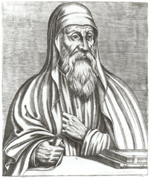
Origen of Alexandria (from
André Thevet)
Click on thumbnail for information on how
to
purchase a larger version of this image
(see copyright information)
Synopsis
Origen assumed the leadership of Alexandria's Catechetical School at the age of only eighteen, after an outbreak of persecution under the Roman Emperor Septimius Severus (146-211) in 203 forced the previous incumbent, Clement, to flee. He was undoubtedly one of the most brilliant of the church fathers, yet sadly, due to his more infamous interpretations he has (perhaps unfairly)[1] been the object of much ridicule over the centuries. Origen was the most prolific of the Christian writers of his time and his six-column arrangement of the Hebrew Old Testament text (known as the Hexapla)[2] was not surpassed for over a thousand years.[3] Much time has been wasted in discussions of Origen, arguing over whether he was orthodox or not. Rather than repeat these I will leave them to one side and attempt to explain the reasons behind his interpretation of Scripture and the creation account in particular. As with all the early Church fathers we must learn to sift out "the wheat of real wisdom from the tares of unfounded speculation."
Origen reasoned in the 4th book of his treatise On First Principles that, if the Bible is inspired by God, then it cannot be irrelevant, unworthy of God, or simply crude. If it ever appears to be in error then we have obviously missed its deeper meaning.[4] Origen wrote that the "literalists" of his day that "they attack allegorical interpretation and want to teach that divine Scripture has nothing deeper than the text allows".[5] "Literalists," he complained, "believe such things about [God] as would not be believed of the most savage and unjust of men".[6] These 'Literalists' misunderstood the meaning of poetry, metaphors, parables and figures of speech and had no concept of the need to understand what the original author of the text was seeking to express to his audience.[7] It is therefore not surprising that they arrived at interpretations that Origen found offensive and caused him react against their definition of the 'literal meaning' [8] .He was prepared to tolerate these unintellectual believers, though he did find them an embarrassment when explaining Christianity to sophisticated pagans. Nonetheless, he believed that if they were genuine in their simplicity then the literal meaning of the Gospels was sufficient for salvation.[9] There was a second group of 'literalists' whom Origen was much less tolerant towards: the Judaisers. By means of a more sophisticated literalism this group attempted to continue obedience to the Law within the Christian Church.[10]
Unlike the 'non-intellectual' believers of his day Origen believed that the Bible
...contains three levels of meaning, corresponding to the threefold Pauline (and Platonic) division of a person into body, soul and spirit. The bodily level of Scripture, the bare letter, is normally helpful as it stands to meet the needs of the more simple. The psychic level, corresponding to the soul, is for making progress in perfection.… [The] spiritual interpretation deals with 'unspeakable mysteries' so as to make humanity a "partaker of all the doctrines of the Spirit's counsel".[11]
It has often been pointed out that Origen was not consistent in the distinction he made between the three levels of Scripture. In reality he only discussed two levels - those of the letter and the spirit.[12] Most modern theologians and Bible students seek to identify the meaning God intended a biblical text to have to its original audience. From this they derive its contemporary application, which (to be considered valid) must be linked to the text's original meaning.[13] For Origen the universal application - what the text teaches about Christ and how the reader can become like Him - was the original meaning of the text.[14] If a text did not appear to be speaking about how you might advance towards perfection then you had misunderstood it. This was the key that showed Origen that he had interpreted a text correctly. To put it simply: if he could make a passage speak in this way then he was confident that he had uncovered its true 'spiritual' meaning. Some passages yielded such an application easily; others required more spiritual insight and, sometimes, the rejection of the historical meaning. It was this 'insight' that the 'literalists' (those who saw only the 'letter') lacked.
There are several specific reasons that we can deduce from Origen's writings that led him to the conclusion that the straightforward historical meaning of many passages of Scripture were simply not true.[15] Most can be found in Book 4 of On First Principles.
- Where a passage contradicts his eschatology. Origen's rejection of some passages, such as Zech. 9:10; Isa. 7:15; 11:6-7, 'obviously' which cannot be intended literally,16 seems to have been based upon his understanding of the end times (eschatology). Most early Christian writers were pre-millennialists and believed in a literal 1 000 year rule of Christ on earth.[17] Opposition to such an idea arose due to the excessive millennial claims of the Montanists in the second century, attempts to calculate the date of Christ's Return,[18] and in response to Gnostic ridicule of the doctrine.[19] Origen rejected such a carnal belief[20]: his views greatly influencing later writers, notably Eusebius of Caesarea.[21] We are faced with a 'chicken and the egg' scenario in attempting to decide if his eschatology influenced his choice of hermeneutic or vice versa.
- He used a defective translation in the Septuagint.[22] There are several examples of this in On First Principles 4.1.17. Origen argues that as there is no such thing as a 'goat-stag' (Deut. 14:5 LXX) and that a 'griffin' (Lev. 11:13; Deut. 14:12 LXX) cannot be subdued by man. The correct translations for these creatures are 'mountain goat' and 'vulture' respectively (see NIV). He argues that it is impossible to observe Exodus 16:29 literally, "...for no living being is able to sit throughout a whole day, and remain without moving from the sitting position".[23] The solution to this problem seems obvious to us, the correct reading being: "stay where he is" rather than "sit".
In his second Homily on Exodus Origen finds a problem with Exodus 1:21 which reads in his Bible: "Because the midwives feared God, they made houses for themselves." This leads him to comment:
This statement makes no sense according to the letter. For what is the relationship that the text should say, "Because the midwives feared God, they made houses for themselves."? It is as if a house is built because God is feared. If this be taken as it stands written, not only does it appear to lack logic, but also to be inane. But if you should see how the Scriptures of the Old and New Testaments, teaching the fear of God, make the houses of the Church and fill the whole earth with houses of prayer, then what is written will appear to have been written rationally."[24]
Of course the solution becomes obvious when one translates the Greek word oikias correctly in this context as "families" instead of "houses". The verse then reads: "And because the midwives feared God, he gave them families of their own." (NIV).
-
He failed to place himself in the literal context: literary, psychological or moral. (A relatively rare occurence[25] and in my own study of Origen I have found no clear examples.)
-
He considered the text useless, contrary to Christ's precepts or impossible.[26] Origen rejects Matthew 5:29 & 39 in On First Principles 4.1.18 because they seem to him impossible.[27] There he writes that the command that the right cheek should be struck is most incredible, because every one who strikes (unless he happens to have some bodily defect) strikes the left cheek with his right hand.
Likewise in his Commentary on Romans(2.9) Origen rejects the Mosaic command of circumcision (Lev. 12:3):
Now the law of nature can be in harmony with the law of Moses according to the spirit, not according to the letter. For what natural sense is there in, for example, the command to circumcise a child on the eighth day.[28]
There are, however, good medical reasons why circumcision was to be carried out on the eighth day that have only been recognised relatively recently with the discovery of blood clotting agents. In similar vein Origen argued "...what could be more irrational than (to take literally the injunction), "Salute no man by the way," which simple persons think the Saviour enjoined the apostles?"[29]
-
He has inadequate knowledge of Hebrew civilisation.[30]
-
He was too literal in his thinking and rejected what are obviously figures of speech, especially anthropomorphic language. For example:
When the psalmist declares that God's truth 'reaches to the clouds', Origen feels constrained to insist that clouds cannot be intended literally in such a saying; they must be interpreted spiritually of those who are obedient to the word of God. The literal interpretation of Zech. 4:10 would imply that God had seven bodily eyes.[31]
When discussing Exodus 21:22-25 where Origen is at a loss to explain how an unborn child can lose an eye or have his/her teeth knocked out. How, he asks, can a pregnant woman be burnt while witnessing a fight between two men.[32] His over-literal understanding does not consider that it is the principle of just - but not excessive punishment - that is being established here.
- Because Paul apparently rejected a text's 'literal' meaning.[33] Several instances in the New Testament are cited by Origen as precedents for rejecting a text's historical meaning, e.g. 1 Corinthians 9:9-10 (Deut. 25:4);[34] 1 Corinthians 10:4,11,[35] and Galatians 4:21-24.[36] In all these cases there are good reasons for arguing that Paul did not see the Old Testament references as having no historic meaning. Origen then extends this precedent to scriptures not mentioned by Paul, for example:
Do you think these are the only words related to wells? Jacob also goes to a well and finds Rachel there. There Rachel becomes known to him as "good in her eyes and beautiful in appearance." [Cf. Gen. 29:17] But Moses finds Sephora, the daughter of Raguel, at a well. [Cf. Exod. 2:15]
Are you not yet moved to understand that these words are spoken spiritually? Or do you think that it always happens by chance that the patriarchs go to wells and obtain their marriages at waters? He who thinks this way is "a sensual man" and "does not perceive these things which are of the spirit of God." [Cf. 1 Cor. 2:14] But let him who wishes remain in these understandings, let him remain "a sensual man." I, following Paul the apostle, say that these things are "allegories" [cf. Gal. 4:24] and I say that the marriages of the saints are the union of the soul with the word of God: "For he who joins himself to the Lord is one spirit."[37]
-
He had an inadequate grasp of God's progressive self-revelation. How, he argues, can even the simplest of believers explain literally the meaning of the account of Lot lying with his daughters?[38] How could Abraham have had two wives; two sisters be married to Jacob, and two handmaids be given to him by his wives?[39] Are not all these things forbidden in the Law?[40] Despite what Origen wrote these events are explicable as historical events, not condoned by God, which took place before the Law was given.
None of the errors listed above were restricted to Origen. Many other ancient, and indeed some modern writers have made the same mistakes. Despite his reservations regarding the historical meaning of a text, Origen was at times prepared even to defend the literal meaning, such as that of Noah's Ark[41] and the Flood.[42] However, he usually fails to connect the spiritual interpretation to the straightforward historical sense.[43] For him it was "almost accidental that the Bible contained much true history. The soul within the body of Scripture was the important thing."[44] The motivation behind Origen's exegesis was the desire that his audience see and hear Christ in the Scriptures and be transformed through that experience.[45] We might quibble with his methodology, but surely not with his intention. It is also worth noting that Origen believed that the passages of Scripture that are historically true far outnumbered those which have a purely spiritual meaning.[46]
Rob Bradshaw, Webmaster
References
[1] Moisés Silva, Has The Church Misread The Bible? Foundations of Contemporary Interpretation, Vol. 1. (Leicester: Apollos, 1987), 49. Silva attempts to redress the injustice done to Origen by explaining the reasoning behind his hermeneutic.
[2] Eusebius, History, 6.16.1-4 (NPNF, 2nd Series, Vol. 1, 262-263.
[3] W.H.C. Frend, The Rise of Christianity. (Philadelphia: Fortress Press, 1989), 375.
[4] Joseph W. Trigg, Origen. (London: SCM Press, 1983), 120; Bethune-Baker, 54.
[5] Origen, Matthew, Sermon 15.
[6] Origen, Principles 4.1.8 (ANF, Vol. 4, 357).
[7] Leslie W. Barnard, "To Allegorize or not to Allegorize?" Studia Theologica 36 (1982): 1-2.
[8] Maurice Wiles, "Origen As A Biblical Scholar," Cambridge History of the Bible, Vol. 1. (Cambridge: CUP, 1970), 472.
[9] Wiles, 424.
[10] Wiles, 424.
[11] Trigg, Origen, 120-121, 126
[12] Karen Jo Torjesen, Hermeneutical Procedure and Theological Method in Origen's Exegesis. (Berlin, New York: Walter De Gruyter, 1986), 41.
[13] See further: Gordon D. Fee & Douglas Stuart, How to Read the Bible For All Its Worth: A Guide to Understanding the Bible, 2nd edition. (Grand Rapids: Zondervan Publishing House, 1993); William W. Klein, Craig Blomberg & Robert L. Hubbard, Introduction to Biblical Interpretation. (London: Word Publishing, 1993).
[14] Torjesen, 125-126.
[15] Wiles, 470.
[16] Origen, Principles 4.1.8; (ANF, Vol. 4, 356).
[17] Including: Papias (see Irenaeus, Heresies, 5.33-35); Epistle of Barnabas (15:1-9), Justin Martyr (Dialogue, 80f.); Melito (see Polycrates in Eusebius' History, 5.1), Irenaeus (Heresies, 5.31.1); Hippolytus of Rome (Commentary on Daniel, 4.23), Julius 'Africanus', Tertullian (Against Marcion, 3; On the Resurrection of the Flesh), Cyprian and Lactantius (Divine Institutes, 6.14, 24, 26; 8.11ff. esp. 24). Bethune-Baker, 70; J.N.D. Kelly, Early Christian Doctrines, rev. edn., 1960. (San Francisco: Harper, 1978), 469; J.W. Montgomery, "Millennium," G.W. Bromiley, gen.ed., International Standard Bible Encyclopedia, rev., Vol. 3. (Grand Rapids: Eerdmans, 1986), 358.
[18] Montgomery, 358.
[19] The Gnostics, of course, rejected anything connected with the physical world. Bethune-Baker, 71.
[20] Origen, Principles 2.11.2; (ANF, Vol. 4, 297).
[21] Eusebius, History, 3.39.12-13 (NPNF, 2nd Series, Vol. 1, 172): "[Papias taught ] ...that there will be a period of some thousand years after the resurrection of the dead, and that the kingdom of Christ will be set up in material form on this very earth. I suppose he got these ideas through a misunderstanding of the apostolic accounts, not perceiving that the things said by them were spoken mystically in figures. For he appears to have been of very limited understanding, as one can see from his discourses. But it was due to him that so many of the Church Fathers after him adopted a like opinion, urging in their own support the antiquity of the man; as for instance Irenaeus and any one else that may have proclaimed similar views."
[22] Henri Crouzel, Origen. trans. A.S. Worral, (Edinburgh: T.& T. Clark, 1989), 62.
[23] Origen, Principles 4.1.17; (ANF, Vol. 4, 366).
[24] Origen, Homily on Exodus 2.2 (Origen, "Homilies on Genesis and Exodus," trans. Ronald E. Heine, The Fathers of the Church, Vol. 71. [Washington, D.C.: Catholic University of America Press, 1981], 242-243).
[25] Crouzel, 63.
[26] Crouzel, 63.
[27] Origen, Principles 4.1.18; (ANF, Vol. 4, 367). See further F.F. Bruce, The Hard Sayings of Jesus. (Leicester: IVP, 1983), 54-55.
[28] R. Laird Harris, "Leviticus," F.E. Gaebelein, gen.ed., Expositor's Bible Commentary, Vol. 2. (Grand Rapids: Zondervan, 1990), 573-574: "There may be more reasons than one for such a law. First, it would put the mother in sufficient isolation to assist in bringing her back to normal health. Being unclean she could not do the cooking or keep the house. Also, it is possible that such a provision would help to prevent the spread of childbed fever, which in former days took so many lives. If the mother was unclean, presumably any midwife would have to wash in water and be unclean until the evening, which would help prevent the direct transmission of the disease."
[29] Origen, Principles 4.1.18; (ANF, Vol. 4, 367). See further I.H. Marshall, "Commentary on Luke," New International Greek Testament Commentary. (Grand Rapids: Eerdmans, 1989) 418.
[30] Crouzel, 63.
[31] Wiles, 470; R.P.C. Hanson, Allegory And Event. (London: SCM, 1959), 151; Origen, Fragments on Genesis, PG. 12.93.
[32] Origen, Homily on Exodus 10.2 (Heine, 348).
[33] E.g. Origen, Homily Exodus 5.1 (Heine, 275-277); Celsus 4:49; Principles 4.1.13 (ANF, Vol. 4, 520, 361-362.)
[34] Origen, Homily on Joshua 9.8 & Principles 4.1.12; (ANF, Vol. 4, 360-361). Gordon D. Fee, "The First Epistle to the Corinthians," New International Commentary on the New Testament. (Grand Rapids: Eerdmans, 1989), 407, n.59: "To call this allegory is to push the term beyond its recognised boundaries. The OT text was chosen because in its original setting it meant precisely what Paul is arguing for here, the "worker" should reap material benefit from his labor. The meaning of the text is not allegorised; rather, it is given a new application."
[35] Fee, 458-459.
[36] Origen, Homily on Joshua 9.8. Paul is using the Hagar-Sarah not as part of his Scriptural argument for the superiority of the New Covenant, but rather is part of his exhortation to "become like me" (Gal. 4:12f.). Richard N. Longenecker, "Galatians," Word Biblical Commentary, Vol. 41 (Waco: Word, 1990), 199. It therefore wrong to claim that Paul based doctrine upon allegorical interpretation.
[37] Origen, Genesis 10.5 (Heine, 165-166). Squared brackets footnotes in original.
[38] Elsewhere Origen explains the account of Lot and his daughters defending the literal sense. See Origen, Homily on Genesis 5.1-5 (Heine, 112-117).
[39] Elsewhere Origen finds a suitable "spiritual" reason why Abraham could marry the handmaid Keturah. See Origen, Homily on Genesis 11.1-2 (Heine, 168-171).
[40] Origen, Principles 4.1.9; ANF, Vol. 4, 357.
[41] Origen, Homily on Genesis 2.2 (Heine, 75-77); Against Celsus 4.41; (ANF, Vol. 4, 516).
[42] Origen, Against Celsus, 4.41; (ANF, Vol. 4, 516).
[43] Wiles, 472.
[44] Henry Chadwick, The Early Church. (London: Penguin, 1990), 108.
[45] Torjesen, 44, 135-138.
[46] Origen, Principles, 4.1.19; (ANF, Vol. 4, 368): "...the truth of history may and ought to be preserved in the majority of instances."
Primary Sources
 Hans Urs von Balthashar, Origen: Spirit and Fire. A Thematic Anthology of His Writings.
Washington, D.C.: Catholic University of America Press, 2001. Hbk. ISBN:
0813210224. pp.416.
Hans Urs von Balthashar, Origen: Spirit and Fire. A Thematic Anthology of His Writings.
Washington, D.C.: Catholic University of America Press, 2001. Hbk. ISBN:
0813210224. pp.416. Origen, Commentary on the
Song of Songs and Homilies on the Song of Songs, R.P. Lawson, trans.
Ancient Christian Writers., Vol. 26. New York: Newman, 1957. Hbk. ISBN:
0809102617. pp.491.
Origen, Commentary on the
Song of Songs and Homilies on the Song of Songs, R.P. Lawson, trans.
Ancient Christian Writers., Vol. 26. New York: Newman, 1957. Hbk. ISBN:
0809102617. pp.491. Origen, Homilies on Jeremiah
and I Kings 28, Fathers of the Church, Vol. 97, trans. James Clark Smith.
Washington, DC: Catholic University of America Press, 1998. Hbk. ISBN:
0813200970. pp.312.
Origen, Homilies on Jeremiah
and I Kings 28, Fathers of the Church, Vol. 97, trans. James Clark Smith.
Washington, DC: Catholic University of America Press, 1998. Hbk. ISBN:
0813200970. pp.312. Origen, On Prayer,
Exhortation to Martyrdom, J.J. O'Meary, trans. Ancient Christian Writers,
Vol. 19. New York: Paulist Press, 1979. Pbk. ISBN: 0809121980. pp.293.
Origen, On Prayer,
Exhortation to Martyrdom, J.J. O'Meary, trans. Ancient Christian Writers,
Vol. 19. New York: Paulist Press, 1979. Pbk. ISBN: 0809121980. pp.293. Origen, The Song of Songs: Commentary &
Homilies, T. C. Lawler, trans. Ancient Christian Writers. New York: Paulist
Press. Hbk. ISBN: 0809102617. pp.491.
Origen, The Song of Songs: Commentary &
Homilies, T. C. Lawler, trans. Ancient Christian Writers. New York: Paulist
Press. Hbk. ISBN: 0809102617. pp.491. William Selwyn, Origen's Contra Celsum. Books 1–4. Eugene, OR: Wipf & Stock, 2007. ISBN: 9781725218109. pp.385.
Secondary Sources
 |
Khaled Anatolios, "Christ, Scripture, and the Christian Story of Meaning in Origen," Gregorianum 78.1 (1997): 55-77. |
|
Y.S. Andriópoulos, "The Incarnate Logos in the Hermeneutic of Origen," in Eisègèseis Prôtou Orthodoxou Hermèneutikou Synedriou. Athens, 1973. pp.193-217. |
|
C.P. Bammel, "Origen's Definitions of Prophecy and Gnosis," Journal of Theological Studies 40.2 (1989): 489-493. |
|
C.P. Bammel, "Adam in Origen," Rowan Williams, ed. The Making of Orthodoxy: Essays in Honour of Henry Chadwick. Cambridge: CUP, 1989. ISBN: 052135188X. |
|
C.P. Bammel, "Justification by Faith in Augustine and Origen," Journal of Ecclesiastical History 47.2 (1996): 223-235. |
|
J.R. Baskin, "Origen on Balaam: The Dilemma of the Unworthy Prophet," Vigiliae Christianae 37.1 (1983): 22-35. |
 |
The Platonist Christian cosmology of Origen, Augustine, and Eriugena (Wynand de Beer) pdf pdf |
 |
Robert M. Berchman, From Philo to Origen: Middle Platonism in Transition. Brown Judaic Studies 69. Chico: Scholars, 1984. Hbk. ISBN: 0891307508. pp.359. |
|
Silke-Petra Bergijan, "Celsus the Epicurean? The Interpretation of an Argument in Origen, Contra Celsum," Harvard Theological Review 94.2 (2001): 181-206. |
|
Charles Bigg [1840-1908], The Christian Platonists of Alexandria. Being the Bampton Lectures of the Year 1886. Oxford: Clarendon Press, 1913. Hbk. pp.386. pdf [This material is in the Public Domain] |
|
Gerald Bostock, "Allegory and the Interpretation of the Bible in Origen," Journal of Literature and Theology, 1.1 (1987): 39-53. |
|
W.J.P. Boyd, "Origen on Pharoah's Hardened Heart. A Study of Justification and Election in St. Paul and Origen," Studia Patristrica 7 (1966): 434-42. |
|
S.P. Brock, "Origen's Aims as a Textual Critic of the Old Testament," Studia Patristica 10 (1970): 215-18. |
|
Alan England Brooke [1863-1939], The Commentary of Origen on St. John's Gospel: the text revised with a critical introduction and indices. Cambridge, Cambridge University Press, 1896. [This material is in the Public Domain] |
|
G.T. Burke, "Celsus and the Old Testament," Vetus Testamentum 36 (1986): 241-45. |
|
Daniel F. Caner, "The Practice and Prohibition of Self-Castration in Early Christianity," Vigiliae Christianae 51.4 (1997): 396-415. |
|
 Henry Chadwick, Early
Christian Thought and the Classical Tradition. Oxford: Clarendon, 1984.
Pbk. ISBN: 0198266731. pp182. Henry Chadwick, Early
Christian Thought and the Classical Tradition. Oxford: Clarendon, 1984.
Pbk. ISBN: 0198266731. pp182. |
|
Steven L. Chase, "What Happens Next?: Biblical Exegesis and the Path of the Soul's Journey in Origen and Gregory of Nyssa," Patristic and Byzantine Review 10.1-2 (1991): 33-45. |
|
Elizabeth A. Clark, "From Origenism to Pelaganism; Elusive Issues in an Ancient Debate," Princeton Seminary Bulletin. Supplementary Texts 12 (1991): 283-303. |
 |
 Elizabeth
A. Clark, The Origenist Controversy: The Cultural Construction of an Early
Christian Debate. Princeton, NJ: PrincetonUniversity Press, 1993, 2014. ISBN: 9781400863112.
pp.300. [Sign-up to Perlego and access book instantly] Elizabeth
A. Clark, The Origenist Controversy: The Cultural Construction of an Early
Christian Debate. Princeton, NJ: PrincetonUniversity Press, 1993, 2014. ISBN: 9781400863112.
pp.300. [Sign-up to Perlego and access book instantly] |
|
Patricia Cox, "Origen and the Bestial Soul: A Poetics of Nature," Vigiliae Christianae 36.2 (1982): 115-140. |
|
Patricia Cox, "Origen and the Witch of Endor: Towards an Iconoclastic Typology," Anglican Theological Review 66 (1984): 137-147. |
|
J. Crehan, "The Dialektos of Origen," Theological Studies 11 (1950). |
|
F.L. Cross, The Early Christian Fathers. Studies in Theology 1. London: Gerald Duckworth & Co. Ltd., 1960. Hbk. pp.122-134. |
|
Henri Crouzel, "The Literature on Origen 1970-1988," Theological Studies 49.3 (1988): 499-516. |
|
Henri Crouzel, Origen. trans. A.S. Worral. Edinburgh: T.& T. Clark, 1998. Pbk. ISBN: 0567086399. pp.296. |
|
R.J. Daly, "Sacrifice in Origen," Studia Patristica 11 (1972): 125-29. |
|
R.J. Daly, "The Hermeneutics of Origen: Existential Interpretation in the Third Century," Richard J. Clifford & George W. MacRae, eds., The Word in the World: Essays in Honor of Frederick L. Moriarty. Cambridge, MA: Weston College Press, 1973. pp. 135-43. |
|
R.J. Daly, ed., Origeniana Quinta: Papers of the 5th International Origen Congress Boston College 14-18 August 1989. Bibliotheca Ephemeridum Theologicarum Lovaniensium 105. Leuven, 1992. ISBN: 9061865115. pp.635. |
|
D. Daube, "Origen and the Punishment of Adultery in Jewish Law," Texte und Untersuchungen 64 (1957): 109-13. |
|
Jean Daniélou, Origen. Orthodoxies and Heresies in the Early Church Series. New York: Sheed and Ward, 1955. Hbk. ISBN: 0404623816. |
|
Eugène De Faye [1860-1929], Origen and His Work. London: George Allen & Unwin Ltd., 1926. Hbk. pp.192. pdf [This material is in the Public Domain] |
|
J.F. Dechow, "Origen and early Christian pluralism: the context of his eschatology," in C. Kannengiesser & W.L. Petersen, eds. Origen of Alexandria: His World and his Legacy. Notre Dame, Indiana: Notre Dame University Press, 1988, Hbk. ISBN: 0268015015. pp.337-356. |
|
M. Demura, "The Resurrection of the Body and Soul in Origen's Contra Celsum," Studia Patristica 18.3 (1989): 385-92. |
|
J. Dillon, " 'Jesus Went Into His House': Origen's Exegesis of Matthew 13;38-52," Proceedings of the Irish Biblical Association 7 (1983): 24-43. |
|
Mark Julian Edwards, "Origen No Gnostic; or, On the Corporeality of Man," Journal of Theological Studies 43.1 (1992): 23-37. |
|
Mark Edwards, "Ammonius, Teacher of Origen," Journal of Ecclesiastical History 44.2 (1993): 169-181. |
|
Mark Julian Edwards, "Gnostics, Greeks, and Origen: The Interpretation of Interpretation," Journal of Theological Studies n.s. 44 (1993): 70-89. |
|
Mark Julian Edwards, "Did Origen Apply the Word Homoousios to the Son?" Journal of Theological Studies 49.2 (1998): 658-670. |
|
M.J. Edwards, "Origen's Two Resurrections," Journal of Theological Studies 46.2 (1995): 502-518. |
|
Mark Julian Edwards, "Did Origen Apply the Word Homoousios to the Son?" Journal of Theological Studies 49.2 (1998): 658-670. |
|
 Mark
Julian Edwards, Origen Against Plato. London: Routledge, 2017.
ISBN: 9781351738767. pp.198. [Sign-up to Perlego and access book instantly] Mark
Julian Edwards, Origen Against Plato. London: Routledge, 2017.
ISBN: 9781351738767. pp.198. [Sign-up to Perlego and access book instantly] |
|
Bart D. Ehrman, Gordon D. Fee & Michael W. HolmesThe Text of the Fourth Gospel in the Writings of Origen, Vol. 1. The New Testament in the Greek Fathers, No 3. Scholars Press, 1992. Pbk. ISBN: 1555407897. |
|
Bart D. Ehrman, "Heracleon, Origen, and the Text of the Fourth Gospel," Vigiliae Christianae 47.2 (1993): 105-118. |
|
Robert Wilson Evans [1789-1866], Biography of the Early Church, 2nd series. London: J.G. & F. Rivington, 1839. Hbk. pp.368. pdf [This material is in the Public Domain] |
|
![William Fairweather [1856-1942], Origen and Greek Patristic Theology](images/books3/origen_fairweather-tb.jpg) William Fairweather [1856-1942], Origen and Greek Patristic Theology. Edinburgh: T & T Clark, 1901. Hbk. pp.268. pdf [This material is in the Public Domain] William Fairweather [1856-1942], Origen and Greek Patristic Theology. Edinburgh: T & T Clark, 1901. Hbk. pp.268. pdf [This material is in the Public Domain] |
|
Douglas B. Farrow, "The Doctrine of the Ascension in Irenaeus and Origen," ARC: Journal of Faculty Religious Studies McGill University 26 (1998): 31-50. |
|
 Eugene De Faye, Origen and His Work. Eugene. OR: Wipf 7 Stock, 2008. ISBN: 9781725223875. pp.192. [Sign-up to Perlego and access book instantly] Eugene De Faye, Origen and His Work. Eugene. OR: Wipf 7 Stock, 2008. ISBN: 9781725223875. pp.192. [Sign-up to Perlego and access book instantly] |
|
Gordon D. Fee, "The Text of John in Origen and Cyril of Alexandria: A Contribution to Methodology in the Recovery and Analysis of Patristic Citations," Biblica 52.3 (1971): 357-394. |
|
Gordon D. Fee, "The Lemma of Origen's Commentary on John, Book X - An Independent Witness to the Egyptian Textual Tradition," New Testament Studies 20 (1973); 78-81. |
|
Louis H. Feldman, "Origen's Contra Celsus and Josephus' Contra Apionem: The Issue of Jewish Origins," Vigiliae Christianae 44.2 (1990): 105-135. |
|
Everett Ferguson, "Origen and the Election of Bishops," Church History 43.1 (1974): 26-33. |
|
George Florovsky, "Origen, Eusebius, and the Iconoclastic Controversy," Church History 19 (1950): 77-96. |
|
Alex Fogleman, "The Golden Thread of Charity: Love and the Formation of Character in Origen and Augustine," Journal of Spiritual Formation & Soul Care 13.2 (Nov. 2020): 246–261. |
|
John Foster, "Origen (185 - 254)," Expository Times 80.3 (1968): 72-76. |
|
Robert M. Grant, "New Fragments of the Homilies of Origen," Vigiliae Christianae 2 (1948): 160-161; 243-47. |
|
Robert McQueen Grant, "More fragments of Origen?" Vigiliae Christianae 2.4 (Oct. 1948): 243-247. |
|
 Christopher Haas, Alexandria
in Late Antiquity: Topography and Social Conflict. Baltimore: John Hopkins
University Press, 1997. Hbk. ISBN: 080185377X. pp.440. Christopher Haas, Alexandria
in Late Antiquity: Topography and Social Conflict. Baltimore: John Hopkins
University Press, 1997. Hbk. ISBN: 080185377X. pp.440. |
|
Gunnar af Haellstroem, Fides Simpliciorum According to Origen of Alexandria. Helsinki: Societas Scientiarum Fennica, 1984. ISBN: 9516531237. pp.111. |
|
Joseph M. Hallman, "Divine Suffering and Change in Origen and Ad Theopompum," Second Century 7.2 (1990): 85-98. |
|
David Halperin, "Oriegen, Ezekiel's Merkabah, and the Ascension of Moses," Church History 50.3 (1981): 261-275. |
|
Thomas Halton, "The New Origen, Peri Pascha," Greek Orthodox Theological Review 28.1 (1983): 73-80. |
|
C.P. Hammond, "Notes on the Manuscripts and Editions of Origen's Commentary on the Epistle to the Romans in the Latin Translation by Rufinus," Journal of Theological Studies 16 (1965): 338-57. |
|
C.P. Hammond, "Some Textual Points in Origen's Commentary on Matthew," Journal of Theological Studies 24 (1973): 386-404. |
|
Darrell D. Hannah, The Text of I Corinthians in the Writings of Origen .Brown Judaic Studies. Society of Biblical Literature, 1997. Hbk. ISBN: 0788503383. pp.318. |
|
R.P.C. Hanson, "Interpretations of Hebrew Names in Origen," Vigiliae Christianae 10 (1956): 103-23. |
|
 R.P.C. Hanson, Allegory and Event. A Study
of the Sources and Significance of Origen's Interpretation of Scripture.
Westminster John Knox Press, 2003. Pbk. ISBN: 066422444X. pp.432. R.P.C. Hanson, Allegory and Event. A Study
of the Sources and Significance of Origen's Interpretation of Scripture.
Westminster John Knox Press, 2003. Pbk. ISBN: 066422444X. pp.432. |
|
R P C Hanson, Origen's Doctrine of Tradition. London: SPCK, 1954. pp.214. |
|
Michael Haykin, "'The Spirit of God': The Exegesis of 1 Cor 2:10 - 12 by Origen and Athanasius," Scottish Journal of Theology 35.6 (1982): 513-528. |
|
 György Heidl, The Influence of Origen on the Young Augustine. A Chapter of the History of Origenism. Piscataway, NJ: Gorgias Press, 2009. ISBN: 9781463222031. pp.342. [Sign-up to Perlego and access book instantly] György Heidl, The Influence of Origen on the Young Augustine. A Chapter of the History of Origenism. Piscataway, NJ: Gorgias Press, 2009. ISBN: 9781463222031. pp.342. [Sign-up to Perlego and access book instantly] |
|
Ronald E. Heine, "Can the Catena Fragments of Origen's Commentary on John be Trusted," Vigiliae Christianae 40 (1986): 118-34. |
|
Ronald E. Heine, "A Note on the Text of Origen: Commentary on John, 19:III:16," Journal of Theological Studies 42.2 (1991): 596-598. |
|
Ronald E. Heine, "Stoic Logic as handmaid to Exegesis and Theology in Origen's Commentary on the Gospel of John," Journal of Theological Studies, n.s. 44.1 (1993): 90-117. |
|
 Ronald E. Heine, The
Commentaries of Origen and Jerome on St Paul's Epistle to the Ephesians. Oxford Early Christian Studies. Oxford: Oxford University Press, 2002. Hbk.
ISBN: 0199245517. pp.310. Ronald E. Heine, The
Commentaries of Origen and Jerome on St Paul's Epistle to the Ephesians. Oxford Early Christian Studies. Oxford: Oxford University Press, 2002. Hbk.
ISBN: 0199245517. pp.310. |
|
 Ronald E. Heine, Origen. An Introduction to His Life and Thought. Eugene, OR: Wipf & Stock, 2019. ISBN: 9781498288965. pp.182. [Sign-up to Perlego and access book instantly] Ronald E. Heine, Origen. An Introduction to His Life and Thought. Eugene, OR: Wipf & Stock, 2019. ISBN: 9781498288965. pp.182. [Sign-up to Perlego and access book instantly] |
|
T. Heither, "Origen's Exegesis and Gn. 24," Theology Digest 40.2 (1993): 141-46. |
|
Lawrence R. Hennessey, "Origen of Alexandria: The Fate of the Soul and the Body after Death," Second Century 8.3 (1991): 163-178. |
|
I.T. Holdcroft, "The Parable of the Pounds and Origen's Doctrine of Grace," Journal of Theological Studies 24.2 (1973): 503-04. |
|
Michael W. Holmes, "Origen and the inerrancy of scripture," Journal of the Evangelical Theological Society 24.3 (Sept. 1981): 221-231. pdf |
|
![Fenton John Anthony Hort [1828–1892], Six Lectures on the Ante-Nicene Fathers](images/books3/ante-nicene-fathers_hort-tb.jpg) Fenton John Anthony Hort [1828–1892], Six Lectures on the Ante-Nicene Fathers. London & New York: MacMillan & Co., 1895. Hbk. pp.138. pdf [This material is in the Public Domain] Fenton John Anthony Hort [1828–1892], Six Lectures on the Ante-Nicene Fathers. London & New York: MacMillan & Co., 1895. Hbk. pp.138. pdf [This material is in the Public Domain] |
|
Origen (182-251) (The Internet Encyclopecdia of Philosophy) |
|
Howard M. Jackson, "The Setting and Sectarian Provenance of the Fragment of the "Celestial Dialogue" Preserved by Origen from Celsus's," Harvard Theological Review 85.3 (1992): 273-305. |
|
Naomi Janowitz, "Theories of Divine Names in Origen and Pseudo-Dionysius," History of Religions 30.4 (1991): 359-372. |
|
P.E. Kahle, "The Greek Bible Manuscripts USed by Origen," Journal of Biblical Literature 79 (1960): 111-118. |
|
Charles Kannengeiser & William Lawrence Petersen, eds. Origen of Alexandria: His World and His Legacy. Notre Dame: Notre Dame University Press, 1989.Hbk. ISBN: 0268015015. pp.373. |
|
Graham Keith,
"Can Anything Good Come out of Allegory? The Cases of Origen and Augustine," The Evangelical Quarterly 70.1 (Jan.-Mar. 1998): 23-49. pdf [Reproduced by permission of the current copyright holder] |
|
Joseph F.T. Kelly, "Early Medieval Evidence for Twelve Homilies by Origen on the Apocalypse," Vigiliae Christianae 39.3 (1985): 273-279. |
|
K.W. Kim, "Commentary on Matthew: The Matthean Text Origen," Journal of Biblical Literature 68 (1949). |
|
K.W. Kim, "Origen's Text of John in his On Prayer, Commentary on Matthew, and Against Celsus," Journal of Theological Studies n.s. 1 (1950): 74-84. |
|
Reuven Kimelman, "Rabbi Yohanan and Origen on the Song of Songs: A Third-Century Jewish-Christian Disputation," Harvard Theological Review 73.3-4 (1980): 567-595. |
|
Ronald Kydd, "Origen and the Gifts of the Spirit," Eglise et Theologie 13.1 (1982): 111-116. |
|
Samuel Laeuchli, "The Polarity of the Gospels in the Exegesis of Origen," Church History 21 (1952): 215-224. |
|
Samuel Laeuchli, "Origen's Interpretation of Judas Iscariot," Church History 22 (1953): 259-68. |
|
N.R.M. de Lange, "Origen and Jewish Bible Exegesis," Journal of Jewish Studies 22 (1971): 31-52. |
|
N.R.M. de Lange, Origen and the Jews: Studies in Jewish-Christian Relations in Third Century Palestine. University of Cambridge Oriental Publications 25. Cambridge, 1976. Hbk. ISBN: 0521205425. pp. x + 240. |
|
N.R.M. de Lange, "Origen and the Rabbis on the Hebrew Bible," Studia Patristica 14 (1976): 117-21. |
|
N.R.M. de Lange, "Forgiveness of Sins in Origen," Worship 60 (1986): 520-527. |
|
N.R.M. de Lange, "Models from Philo in Origen's Teaching on Original Sin," Laval Théologique et Philosophique 44 (1988): 250-276. |
|
J. Laporte, "Models from Philo in Origen's Teaching on Original Sin," Laval théologique et philosophique 44.2 (1988): 191-203. |
|
 Elizabeth Ann Dively Lauro, The Soul and Spirit of Scripture Within Origen's Exegesis. Leiden:
Brill, 2005. Hbk. ISBN: 0391041991. pp.284. Elizabeth Ann Dively Lauro, The Soul and Spirit of Scripture Within Origen's Exegesis. Leiden:
Brill, 2005. Hbk. ISBN: 0391041991. pp.284. |
|
Richard A. Layton, "Recovering Origen's Pauline Exegesis: Exegesis and Eschatology in the Commentary on Ephesians," Journal of Early Christian Studies 8.2 (2000): 373-411. |
|
Richard A. Layton, "Propatheia: Origen and Didymus on the Origin of the Passions," Vigiliae Christianae 54.3 (2000): 262-282. |
|
![863-1939], "Origen," William Lefroy [1836-1909], ed., Church Leaders in Primitive Times](images/books3/church-leaders-in-primitive-times_lefroy-tb.jpg) Alan England Brooke [1863-1939], "Origen," William Lefroy [1836-1909], ed., Church Leaders in Primitive Times. Lectures on Their Words and Works. Delivered in Norwich Cathedral by Eminent Anglican Devines, 2nd edn. London: Chas. J. Thynne, 1909. Hbk. pp.299-. pdf [This material is in the Public Domain] Alan England Brooke [1863-1939], "Origen," William Lefroy [1836-1909], ed., Church Leaders in Primitive Times. Lectures on Their Words and Works. Delivered in Norwich Cathedral by Eminent Anglican Devines, 2nd edn. London: Chas. J. Thynne, 1909. Hbk. pp.299-. pdf [This material is in the Public Domain] |
|
J.T. Lienhard, "On 'Discernment of Spirits' in the Early Church (1 Cor 12:10 for Chrysostom, Origen, Athanasius; Cassian," Theological Studies 41 (1980): 505-29. |
|
Christopher Lewis, "Origen: Theologian or Philosopher?" Epiphany Journal 11.4 (1991): 13-28. |
|
Christopher Lewis, "Origen: Perennial Enigma," Epiphany Journal 11.2 (1991): 49-59. |
|
J.T. Lienhard, "Christology in Origen's Homilies on the Infancy Narratives in Luke," Studia Patristica 26 (1993): 287-91. |
|
Willamina M. Macauley, "The Nature of Christ in Origen's 'Commentary on John'," Scottish Journal of Theology 19.2 (1966): 176-87. |
|
C.W. Macleod, "Allegory and Mysticism in Origen and Gregory of Nyssa," Journal of Theological Studies 22.2 (1971): 362-379. |
|
C.W. Macleod, "Allegory and Mysticism in Origen and Gregory of Nyssa," Journal of Theological Studies 22 (1971): 362-79. |
|
C.W. Macleod, "Origen, Contra Celsum VII.42," Journal of Theological Studies 32.2 (1981): 447. |
|
R. Markus, "A Note on Origen, in Ev. Joannis XIX.5 (PG XIV, 568b-c)." Harvard Theological Review 47 (1954): 317-18. |
|
Dan G. McCartney, "Literal and Allegorical Interpretation in Origen's Contra Celsum," Westminster Theological Journal 48.2 (1986): 281-301. |
|
Kilian McDonnell, "Does Origen Have a Trinitarian Doctrine of the Holy Spirit?" Gregorianum 75.1 (1994): 5-35. |
|
K. McNamee, "Origen and the Papyri," Classical Folia 27 (1973): 28-51. |
|
W.W. Meissner, "Origen and the Analytic Psychology of Symbolism," Downside Review 79 (1961): 201-216. |
|
Fikry Meleka, "A Review of Origen's Commentary on the Song of Songs," Coptic Church Review 1 (Summer 1980): 73-77. |
|
Fikry Meleka, "A Review of Origen's Commentary on the Song of Songs," Coptic Church Review 1 (Fall 1980): 125-29. |
|
Anthony Meredith, "Origen's De Principiis and Gregory of Nyssa's Oratio Catechetica," Heythrop Journal 36.1 (1995): 1-14. |
|
Anthony Meredith, "Origen and Gregory of Nyssa on The Lord's Prayer," Heythrop Journal 43.3 (2002): 344-356. |
|
Patricia Cox Miller, "Pleasure of the Text, Text of Pleasure: Eros and Language in Origen's Commentary on the Song of Songs," Journal of the American Academy of Religion 54 (1986): 241-53. |
|
E. Narondi. "Origen's Concept of Biblical Inspiration," Second Century 4 (1984): 9-23. |
|
T. Odaka, "Among you stands one you do not know' (John 1:26). The Inseparable Relation Between Man and God According to Origen," Katorikku Kenkyu "Catholic Studies" 58.29.2 (1990): b1296-52. |
|
T. Odaka, "Origen's Understanding of St. Paul - The Idea of Predestination and Election in his Commentary on the Letter to the Romans," Katorikku Kenkyu "Catholic Studies" 22.43 (1983): 95-116. |
|
Eric F. Osborn, "Origen and Justification: The Good is One," Australian Biblical Review 24.1 (1976): 18-29. |
|
Albert C. Outler, "Origen and the Regulei Fidei," Second Century 4.3 (1984): 133-141. |
|
Alexandra Pâryan, "Genesis 1-3: Augustine and Origen on the Coats of Skins," Vigiliae Christianae 66.1 (2012): 56-92. |
|
Daniel T. Pekarske, "Origen on the Value of Temptation for the Spiritual Life," Studies in Formative Spirituality 12.2 (1991): 233-243. |
|
Lorenzo Perrone, "Prayer in Origen's Contra Celsum: The Knowledge of God and the Truth of Christianity," Vigiliae Christianae 55.1 (2001): 1-19. |
|
G.L.
Prestige, "Lecture 3: Origen: or, The Claims of Religious Intelligence," Fathers and Heretics. Bampton Lectures 1940. London: SPCK, 1940. Pbk.
pp.43-66. pdf |
|
Gilles Quispel, "Origen and the Valentinian Gnosis," Vigiliae Christianae 28.1 (1974): 29-42. |
|
Celia E. Rabinowitz, "Persona; and Cosmic Salvation in Origen," Vigiliae Christianae 38.4 (1984): 319-329. |
|
Ilaria Ramelli, "Origen in Augustine: A Paradoxical Reception," Numen 60. 2-3 (2013): 280-307. |
|
 David Ivan Rankin, From Clement to Origen. The Social and Historical Context of the Church Fathers. London: Routledge, 2016. ISBN: 9781317132424. pp.182. [Sign-up to Perlego and access book instantly] David Ivan Rankin, From Clement to Origen. The Social and Historical Context of the Church Fathers. London: Routledge, 2016. ISBN: 9781317132424. pp.182. [Sign-up to Perlego and access book instantly] |
|
 David Rankin, The Early Church and the Afterlife. Post-death existence in Athenagoras, Tertullian, Origen and the Letter to Rheginos. London: Routledge, 2017. ISBN: 9781351609180. pp.140. [Sign-up to Perlego and access book instantly] David Rankin, The Early Church and the Afterlife. Post-death existence in Athenagoras, Tertullian, Origen and the Letter to Rheginos. London: Routledge, 2017. ISBN: 9781351609180. pp.140. [Sign-up to Perlego and access book instantly] |
|
John M. Rist, Eros and Psyche: Studies in Plato, Plotinus and Origen. Toronto: University of Toronto Press, 1965. ISBN: 0802051448. pp.250. |
|
J.N. Rowe, "Origen's Conception of Christ as the Paschal Lamb," Studia Evangelica 6 (1968): 311-16. |
|
J.N. Rowe, "Origen's Subordination as Illustrated in His Commentary on St. John's Gospel," Studia Patristica 11 (1972): 222-28. |
|
 David Satran, In the Image of Origen. Eros, Virtue, and Constraint in the Early Christian Academy. Berkeley, CA: University of California Press, 2018. ISBN: 9780520965089. pp.248. [Sign-up to Perlego and access book instantly] David Satran, In the Image of Origen. Eros, Virtue, and Constraint in the Early Christian Academy. Berkeley, CA: University of California Press, 2018. ISBN: 9780520965089. pp.248. [Sign-up to Perlego and access book instantly] |
|
C.J. Scalise, "Allegorical flights of Fancy; the Problems of Origen's Exegesis," Greek Orthodox Theological Review 32 (1987): 69-88. |
|
 Thomas P. Scheck, Origen and the History of Justification. The Legacy of Origen's Commentary on Romans. Notre Dame, IN: University of Notre Dame Press, 2016. ISBN: 9780268093020. pp.312. [Sign-up to Perlego and access book instantly] Thomas P. Scheck, Origen and the History of Justification. The Legacy of Origen's Commentary on Romans. Notre Dame, IN: University of Notre Dame Press, 2016. ISBN: 9780268093020. pp.312. [Sign-up to Perlego and access book instantly] |
|
 Alan Scott, Origen and the
Life of the Stars. Oxford: Clarendon Press, 1994. Pbk. ISBN: 0198263619.
pp.205. Alan Scott, Origen and the
Life of the Stars. Oxford: Clarendon Press, 1994. Pbk. ISBN: 0198263619.
pp.205. |
|
Alan Scott, "Pseudo-Aristotle's Historia Animalium 9 in Origen," Harvard Theological Review 85.2 (1992): 235-239. |
|
Rev R. Sears, "Redepenning's Life of Origen," Bibliotheca Sacra 3 No. 10 (1846): 378-385. pdf [This material is in the Public Domain] |
|
John Clark Smith, "Conversion in Origen," Scottish Journal of Theology 32.3 (1979): 217-240. |
|
John Clark Smith, The Ancient Wisdom of Origen. Lewisburg & London, 1992. Hbk. ISBN: 0838752047. pp.372. |
|
Finian D. Taylor, "Origen of Alexandria: Christians and the State in the Third Century," American Benedictine Review 43.3 (1992): 250-261. |
|
Karen Jo Torjesen, "'Body,' 'Soul,' and 'Spirit' in Origen's Theory of Exegesis," Anglican Theological Review 67 (1985): 17-30. |
|
 Karen
Jo Torjesen, Hermeneutical Procedure and Theological Method in Origen's
Exegesis. Berlin: Walter De Gruyter, 1986, 2011. ISBN: 9783110881981.
pp.194. [Sign-up to Perlego and access book instantly] Karen
Jo Torjesen, Hermeneutical Procedure and Theological Method in Origen's
Exegesis. Berlin: Walter De Gruyter, 1986, 2011. ISBN: 9783110881981.
pp.194. [Sign-up to Perlego and access book instantly] |
|
Joseph W. Trigg, "The Charismatic Intellectual: Origen's Understanding of Religious Leadership," Church History 50 (1980): 5-19. |
|
Joseph W. Trigg, "The Angel of Great Counsel: Christ and the Angelic Hierarchy in Origen's Theology," Journal of Theological Studies n.s. 42 (1991): 35-51. |
|
Joseph W. Trigg, "Eustathius of Antioch's Attack on Origen: What Is at Issue in an Ancient Controversy," Journal of Religion 75.2 (1995): 219-238. |
|
 Joseph W. Trigg, Origen. London:
Routledge, 1998, 2012. ISBN: 9781134815258. pp.312. [Sign-up to Perlego and access book instantly] Joseph W. Trigg, Origen. London:
Routledge, 1998, 2012. ISBN: 9781134815258. pp.312. [Sign-up to Perlego and access book instantly] |
|
Cuthbert H. Turner [1860–1930], "Notes on the Text of Origen's Commentary On I Corinthians," Journal of Theological Studies 10 No 38 (Jan. 1909): 270-276. pdf [This material is in the Public Domain] |
|
 Panayiotis Tzamalikos, Anaxagoras, Origen, and Neoplatonism. Berlin: De Gruyter, 2016. ISBN: 9783110420104. pp.1822. [Sign-up to Perlego and access book instantly] Panayiotis Tzamalikos, Anaxagoras, Origen, and Neoplatonism. Berlin: De Gruyter, 2016. ISBN: 9783110420104. pp.1822. [Sign-up to Perlego and access book instantly] |
|
A. van de Beek, "Origen as a Theologian of the Will," Reformed Review 51.3 (1998): 242-254. |
|
A. Whealey, "Prologues on the Psalms. Origen, Hippolytus, Eusebius," Revue bénédictine de critique, d'histoire et de littérature religieuses 106 (1996): 234-45. |
|
J.D. Wilkinson, "A Defense of Origenist Allegory," Texte und Untersuchungen 81 (1962): 264-68. |
|
J.C.M. Van Winden, "Notes on Origen, Contra Celsum," Vigiliae Christianae 20.4 (1966): 201-203. |
|
 Maurice Wiles, "Origen As A Biblical Scholar," P.R. Ackroyd & C.F. Evans, eds. The Cambridge History of the Bible, Vol. 1. From Beginnings to Jerome. Cambridge: Cambridge University Press, 1970. Hbk. ISBN: 0521074185. pp.454-488. Maurice Wiles, "Origen As A Biblical Scholar," P.R. Ackroyd & C.F. Evans, eds. The Cambridge History of the Bible, Vol. 1. From Beginnings to Jerome. Cambridge: Cambridge University Press, 1970. Hbk. ISBN: 0521074185. pp.454-488. |
|
Robert L. Wilken, "Alexandria: A School for Training in Virtue," Patrick Henry, ed. Schools of Thought in the Christian Tradition. Philadelphia: Fortress Press, 1985. Pbk. ISBN: 0800607309. pp.15-30. |
Biographies
![Frederic William Farrar [1831-1903], Lives of the Fathers. Sketches of Church History in Biography, 2 Vols](images/books3/lives-of-the-fathers_farrar-tb.jpg) Frederic William Farrar [1831-1903], Lives of the Fathers. Sketches of Church History in Biography, 2 Vols. London: Adam & Charles Black, 1907. Hbk. pp.781+737.
Frederic William Farrar [1831-1903], Lives of the Fathers. Sketches of Church History in Biography, 2 Vols. London: Adam & Charles Black, 1907. Hbk. pp.781+737. Related Subjects
 |
|
 |
|
 |
Alexander of Alexandria | Ambrose | Aristides | Arnobius | Athanasius | Athenagoras | Augustine | Basil | Boethius | John Cassian | Celsus | Clement of Alexandria | Clement of Rome | Constantine | Cyprian | Cyril of Alexandria | Cyril of Jerusalem | Ephraem the Syrian | Epiphanius | Eusebius of Caesarea | Gregory of Nazianzus | Gregory of Nyssa | Gregory Thaumaturgus | Hermas | Hilary of Poitiers | Hippolytus | Ignatius of Antioch | Irenaeus of Lyons | Julius Africanus | Jerome | John Chrysostom | Josephus | Justin Martyr | Justinian I | Lactantius | Leo the Great | Marcellus | Martin of Tours | Melito | Methodius | Minucius Felix | Novatian | Origen | Pachomius | Papias | Philo | Polycarp | Synesius of Cyrene | Tatian | Tertullian | Theodore of Mopsuestia | Theodoret | Theophilus | Tyconius | Ulfilas | Victorinus | Marius Victorinus
ABOUT | KEY | SITE MAP | INTRODUCTIONS | BIBLE | COUNCILS & CREEDS | DOCTRINE & PRACTICE | HERESIES & SECTS | HISTORY | MINISTRY | PEOPLE | PHILOSOPHY | WRITINGS | STUDY AIDS | BLOG | SUPPORT SITE | CONTACT