Philo of Alexandria
(c.20 BC - c.AD 50)






Theology on the Web helps over 2.5 million people every year to find high quality theological resources that will help to equip them to serve God and to know Him better (2 Timothy 2:15). Like other websites that provide free services, it is dependent on donations to enable it to grow and develop and only 0.004% of visitors currently do so. If you would like to support this site, please use one of the options to the right of this message.
Synopsis
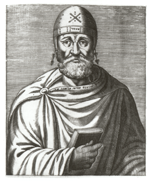
Philo of Alexandria (from
André Thevet)
Click on thumbnail for information on how
to
purchase a larger version of this image
(see copyright information)
The writings of Philo are the most important surviving documents from the world of Hellenistic Judaism.[1] They furnish us with a great deal of first hand information concerning the religion of the Jews outside of Israel, New Testament background and the interaction of Judaism within a Gentile culture.[2] Philo was deeply influenced by Middle Platonism,[3] Aristotle, the Neo-Pythagoreans, the Cynics and the Stoics. He stood at the end of a long Jewish tradition whose thoughts he developed, as evidenced by his references to the works of his predecessors.[4] Like them he attempted to interpret the Old Testament Scriptures in such as way as to bridge the gap between Judaism and intellectual paganism[5] rather than attempting to produce his own philosophical system.[6]
Philo made extensive use of allegory in his writings, but it would be a mistake to assume that he was the first of the Alexandrian Jews to allegorise Scripture. In fact, he stood almost at the end of a long tradition of men who wrote as Jews for Gentile ears.[7] Previous writers, however, had not thought of their interpretations as allegorical,[8] but rather as 'proper' or 'fitting' in that they corresponded with what the interpreter understood as the nature and character of God.[9] Philo recognised several levels of interpretation that he regarded as 'literal', ranging from the literalistic to sophisticated.[10] He claimed to find in the text itself indications that it was not intended literally. For example, the Trees of Life and of the Knowledge of Good and Evil are seen as being intended symbolically because no such plant have ever existed on earth.[11] For Philo a "literal or better, a literalistic interpretation is to be rejected when it is either blasphemous or ridiculous. The kind of literal interpretation that was rejected by Philo is the kind of interpretation that was rejected by Jewish interpreters as far back as Aristobulus."[12] Philo was, on the other hand, the first writer who attempted to maintain the validity of both the literal and allegorical interpretations of Scripture,[13] because he considered both to be divinely inspired.[14]
This appears most clearly in the Questions and Answers on Genesis and Exodus. In both of these works, literal and allegorical interpretations lie side by side. Philo is obviously more interested in the allegorical interpretation, but, for the most part, the literal interpretations are also considered valid and valuable. The same is true in... [On the Creation and Allegorical Interpretation]. Of the twenty seven times that allegorical terms appear, only five involve the rejection of a non-allegorical interpretation."[15]
Though they were not preserved by the Jews,[16] Philo's works were treasured by Christian writers[17] who seized upon his concept of the Logos, thinking that it was the same as the Logos of the prologue of John's Gospel.[18] To Philo the Logos was "the instrument by which God makes the world and the intermediary by which the human intelligence as it is purified ascends to God again"[19] .However, Philo's Logos is not Divine, nor is it a person and it has no existence apart from the role it performs.[20] Although it was once generally accepted among scholars that there was some dependence by John on Philo's concept of the Logos, it seems more likely that both were drawing on a common Jewish background, into which Philo imported Platonic concepts.[21] So important was Philo to the early church writers that some, such as Eusebius and Jerome even went so far as to claim that he was a Christian. Eusebius records a legendary meeting between Philo and Peter in Rome[22] and both writers argue that Philo's work concerning Jewish ascetics (On the Contemplative Life) is a first hand report of the church (and monasteries!) founded by Mark in Alexandria.[23] It is true to say that by the fourth century "Pious legend would allow no writer so influential on early Christian exegesis to remain unconverted."[24]
Rob Bradshaw, Webmaster
References
[1] "Philo," Encyclopedia Britannica Micropedia, 15th edn. (London: Encyclopaedia Britannica Inc., 1992), 385.
[2] R.M. Wilson, "Philo," G.W. Bromiley, gen.ed.International Standard Bible Encylopedia, rev., Vol. 3. (Grand Rapid: Eerdmans, 1986), 847.
[3] W.H.C. Frend, The Rise of Christianity. (Philadelphia: Fortress Press, 1989) 36: "To Philo even Plato has been anticipated by Moses." See Philo, Creation 8, 12, 131 (Yonge, 3, 4, 18-19).
[4] Wilson, "Philo," 847; F.F. Bruce, New Testament History, 1969. (New York: Doubleday, 1980) 54.
[5] "Philo," Encyclopedia Britannica Micropedia, 386: Philo was no plagiarist, for he adapted Plato's theories to his own ends. Frend, Rise, 36.
[6] Thomas H. Tobin, The Creation of Man: Philo And The History of Interpretation. The Catholic Biblical Quarterly Monograph Series 14. (Washington, DC: The Catholic Biblical Association of America, 1983), 2. "Philo," trans F.H. Colson & Rev. G.H. Whitaker, Loeb Classical Library, Vol. 1. (London: William Heinemann Ltd., 1929), xv-xvi: "His purpose was the same as Bunyan had in the Pilgrim's Progress and the Holy War, and Dante to some extent in his Divine Comedy namely, to set forth an allegory of the history of the human soul and its relations to God. But while Scripture to Bunyan and mediaeval eschatology for Dante were merely foundations on which they could rear the fabric which their own imagination created. Philo, entirely devoid of creative genius [when he attempts allegory of his own, as in De. Sac. 20-44 it is poor stuff], could never get away from the role of interpreter." Brackets were footnotes in original.
[7] R.P.C. Hanson, Allegory And Event. (London: SCM, 1959), 41.
[8] Tobin, 148. Their works contain "none of the technical vocabulary of allegory". Tobin, 98.
[9] Tobin, 42-43. Tobin, 43: "For example, in the interpretation of Gen. 1:26, an explanation of the verse must be given which shows that God is not in need of helpers in creating man, but that the use of such helpers is fitting and proper in order to prevent an improper attribution to God of responsibility for the creation of evil." i.e. evil is the fault of the helpers who created man's lower parts. See Philo, Creation, 72-75 (Yonge, 11); cf. Plato, Timaeus, 41.
[10] Tobin, 158. Tobin, 145: "Philo twice refers to these textual details as 'opportunities' or 'invitations'… to allegory." Planter, 36 (Yonge, 194); Confusion, 191 (Yonge, 194, 251).
[11] Philo, Creation, 154 (Yonge, 22).
[12] Tobin, 159.
[13] Tobin, 155.
[14] Tobin, 157.
[15] Tobin, 154; Philo, Creation, 154, 157, 164; AL 3.236, 238.
[16] Henry Chadwick, Later Greek and Early Medieval Philosophy. (Cambridge: CUP, 1970), 156-157: "The Judaism which established itself as normative was that of the rabbis.… The points of affinity between Philo and later rabbinic traditions turn out to be even less numerous than might be expected, and if later Jewish writings mention him, which is not certain, it is on terms of bitter disapproval."
[17] e.g. Justin Martyr, Clement of Alexandria, Origen, Ambrose, Jerome, Eusebius of Caesarea, Gregory of Nyssa, Cyril of Alexandria.
[18] Samuel Sandmel, Philo of Alexandria: An Introduction. (Oxford: OUP, 1979), 14.
[19] A. Hilary Armstrong, An Introduction to Ancient Philosophy. (London: Methuen & Co. Ltd., 1947), 162.
[20] Armstrong, Ancient Philosophy, 162.
[21] Stephen Smalley, John ~ Evangelist & Interpreter. (Exeter: Paternoster Press, 1983, 1992 reprint), 58; D.A. Carson. The Gospel According To John. (Leicester: IVP, 1991) 115; Guthrie, D. New Testament Theology. (Leicester: IVP, 1981) 322-323. Bruce, History, 54: "Although Philo does not appear to have exercised direct influence on New Testament thought, his writings present a number of striking points of contact with the Pauline Epistles, and some knowledge of his thought and method provides positive help for the understanding of the Fourth Gospel (although the Johannine Logos doctrine is essentially different from the Philonic) and of the Epistle to the Hebrews - the work of another Alexandrian who, however, prefers the typology of salvation-history to Philonic allegory as the key top unlock the meaning of the Old Testament." See further Henry Chadwick, "St .Paul and Philo of Alexandria", Bulletin of the John Rylands Library, 48. (1965-66) 286ff.; Lane, William L. "Hebrews 1-8," Word Biblical Commentary, Vol. 47A. (Waco: Word, 1991), civ, cvii-cviii.
[22] Eusebius, History, 2.17.1 (NPNF, Vol. 1, 117).
[23] Eusebius, History, 2.16.1-2 (NPNF, Vol. 1, 116); Jerome, Lives of Illustrius Men, 2.11 (NPNF, Vol. 3, 365).
[24] Tobin, 1.
Bibliographies
 |
R. Radice & David T. Runia, Philo of Alexandria: An Annotated Bibliography 1987-1996. Leiden: Brill, 2000. Hbk. ISBN: 9004116826. pp.412. |
Primary Sources
|
Fred. C. Conybeare, editor, Philo about the contemplative life: or the fourth book of the treatise concerning virtues, critically edited with a defence of its genuineness with a facsimile, 1895. Oxford: Clarendon Press, 1895. pp. xvi + 403. Reprinted: New York, 1987. |
|
 C.D.
Yonge, The Works of Philo. Peabody, Mass.: Hendrickson, 1993. Hbk. ISBN:
0943575931. pp.944. C.D.
Yonge, The Works of Philo. Peabody, Mass.: Hendrickson, 1993. Hbk. ISBN:
0943575931. pp.944. |
Secondary Sources
 |
A.W. Argyle, "Philo, the Man and His Work, Expository Times 85.4 (1974): 115-117. |
|
Bernard J. Bamberger, "Philo and the Aggadah," Hebrew Union College Annual 48 (1977): 153-185. |
|
John M.G. Barclay, "Paul and Philo on Circumcision: Romans 2:25-29 in Social and Cultural Context," New Testament Studies 44.4 (1998): 536-556. |
|
Jouette M. Bassler, "Philo on Joseph: The Basic Coherence of De Iosepho and De Somniis ii," Journal for the Study of Judaism 16.2 (1985): 240-255. |
|
Robert M. Berchman, From Philo to Origen: Middle Platonism in Transition. Brown Judaic Studies 69. Chico: Scholars, 1984. Hbk. ISBN: 0891307508. pp.359. |
 |
Charles Bigg [1840-1908], The Christian Platonists of Alexandria. Being the Bampton Lectures of the Year 1886. Oxford: Clarendon Press, 1913. Hbk. pp.386.  pdf [This material is in the Public Domain] pdf [This material is in the Public Domain] |
|
Thomas Henry Billings, The Platonism of Philo Judaeus, 1919. New York: Garland Publications, 1979. Hbk. ISBN: 0824096088. pp.viii + 105. |
|
Peder Borgen, Bread from Heaven: an Exegetical Study of the Concept of Manna in the Gospel of John and the Writings of Philo. Supplements to Novum Testamentum, 10. Leiden : E.J. Brill, 1981. Hbk. 9004064192. pp. x + 217. |
|
Peder Borgen, "Moses, Jesus, and the Roman Emperor Observations in Philo's Writings and the Revelation of John," Novum Testamentum 38.2 (1996): 145-159. |
|
 Peder Borgen, Philo of Alexandria: An
Exegete for His Time. Novum Testamentum, Supplements. Leiden: Brill, 1997.
Hbk. ISBN: 9004103880. pp.375. Peder Borgen, Philo of Alexandria: An
Exegete for His Time. Novum Testamentum, Supplements. Leiden: Brill, 1997.
Hbk. ISBN: 9004103880. pp.375. |
|
 Peder Borgen, Kare Fuglseth & Roald Skarsten, The
Philo Index: A Complete Greek Word Index to the Writings of Philo of
Alexandria. Grand Rapids: Eerdmans, 1999. Hbk. ISBN: 0802838839.
pp.383. Peder Borgen, Kare Fuglseth & Roald Skarsten, The
Philo Index: A Complete Greek Word Index to the Writings of Philo of
Alexandria. Grand Rapids: Eerdmans, 1999. Hbk. ISBN: 0802838839.
pp.383. |
|
David Bradshaw, "The Vision of God in Philo of Alexandria," American Catholic Philosophical Quarterly 72.4 (1998): 483-500. |
|
J. Edgar Bruns,"Philo Christianus: The Debris of a Legend," Harvard Theological Review 66.1 (1973): 141-145. |
|
Fred W. Burnett, "Philo on Immortality: A Thematic Study of Philo's Concept of Paliggenesia," Catholic Biblical Quarterly 46.3 (1984): 447-470. |
|
D.A. Carson, "Divine Sovereignty and Human Responsibility in Philo," Novum Testamentum 23.2 (1981): 148-164. |
|
Henry Chadwick, "St. Paul and Philo of Alexandria", Bulletin of the John Rylands Library, 48. (1965-66): 286-307. |
|
Naomi G. Cohen, "The Jewish Dimension of Philo's Judaism: An Elucidation of de Spec. Leg. IV 132-150," The Journal of Jewish Studies 38 (1987): 165-186. |
|
Naomi G. Cohen, "Philo and Midrash," Judaism 44.2 (1995): 196-207. |
|
Nils A. Dahl & Alan F. Segal, "Philo and the Rabbis on the Name sof God," Journal for the Study of Judaism 9.1 (1978): 1-28. |
|
Jean Daniélou, "The Philosophy of Philo: The Significance of Professor Harry A. Wolfson's New Study," Theological Studies 9 (1948): 578-589. |
|
Lala Kalyan Kumar Dey, The Intermediary World and Patterns of Perfection in Philo and Hebrews. Society of Biblical Literature Dissertation, 25. Missoula, MT: Scholars Press, 1975. ISBN: 0891300228. pp. xi + 239. |
|
J. Dillon, "The Transcendence of God in Philo," Colloquy, Vol. 16. Berkeley: Center for Hermeneutical Studies, 1975. |
|
J. Dillon, The Middle Platonists: 80 B.C. to A.D. 220. London: Gerald Duckworth & Co. Ltd., 1981. Pbk. ISBN: 0715616048. |
|
Sharyn Dowd, "The Theological Function of Petitionary Prayer in the Thought of Philo," Perspectives in Religious Studies 10.3 (1983): 241-254. |
|
F. Gerald Downing, "The Resurrection of the Dead: JEsus and Philo," Journal for the Study of the New Testament 15 (1982): 42-50. |
|
Francis T. Fallon, "The Law in Philo and Ptolemy: A Note on the Letter to Flora," Vigiliae Christianae 30.1 (1976): 45-51. |
|
Louis H. Feldman, "The Command, according to Philo, Pseudo-Philo, and Josephus, to annihilate the seven nations of Canaan," Andrews University Seminary Studies 41.1 (Spring 2003): 13-29. pdf |
|
L. Finkelstein, "Is Philo Mentioned in Rabbinic Literature?" Journal of Biblical Literature 53 (1934): 142-149. |
|
Erwin Ramsdell Goodenough, Politics of Philo Judaeus. Elliots Books, 1938. Hbk. ISBN: 068569822X. |
|
Erwin Ramsdell Goodenough, The Politics of Philo Judaeus: Practice and Theory, 1938. Hildesheim: Olms, 1967. pp. xii + 348. |
|
Erwin Ramsdell Goodenough, An Introduction to Philo Judaeus, 2nd edn. Brown Classics in Judaica. University Press of America, 1986. Pbk. ISBN: 0819153354. pp.194. |
|
Lester L. Grabbe, Etymology in Early Jewish Onterpretation: the Hebrew Names in Philo. Brown Judaic Studies 115. Atlanta, GA: Scholars Press, 1988. Hbk. ISBN: 1555400809. pp.268. |
|
Leonard Greenspoon, "THe Pronouncement Story in Philo and Josephus," Semeia 20 (1981): 73-80. |
|
Donald A. Hagner, "The vision of God in Philo and John: a comparative study," Journal of the Evangelical Theological Society 14.2 (Spring 1971): 81-93. pdf |
|
D.M. Hay, "Philo's References to Other Allegorists," Studia Philonica 6 (1979-80): 41-75. |
|
D.M. Hay, "Defining Allegory in Philo's Exegetical World," Society of Biblical Literature Seminar Papers 33 (1994): 55-68. |
|
A. Hilhorst, "Was Philo Read By Pagans? The Statement on Heliodorus in Socrates Hist. Eccl. 5.22," The Studia Philonica Annual 4 (1992): 75-77. |
|
A. van der Hoek, Clement of Alexandria and His Use of Philo in the Stromateis. Supplements to Vigiliae Christianae, 3. Leiden: Brill, 1988. Hbk. 9004087567. pp.261. |
|
Richard A. Horsley, "The Law of Nature in Philo and Cicero," Harvard Theological Review 71.1-2 (1978): 35-59. |
|
Pieter W. van der Horst, Philo's "Flaccus": The First Pogrom. Philo of Alexandria Commentary Series. Leiden: Brill, 2003. Hbk. ISBN: 9004131183. pp.290. |
|
G.E. Howard, "The 'Aberrant' TExt of Philo's Quotations Reconsidered," Hebrew Union College Annual 44 (1973): 197-209. |
| Frederick John Foakes Jackson [1855-1941], A History of Church History. Studies of Some Historians of the Christian Church. Cambridge: Heffer & Sons Ltd., 1939. Hbk. pp.194. pdf [This material is in the Public Domain] |
|
|
D.N. Jastram, "Philo's Concept of Generic Virtue," Society of Biblical Literature Seminar Papers 30 (1991): 323-347. |
|
Jean-Georges Kahn, "Did Philo Know Hebrew? The Testimony of the 'Etymologies'," Tarbiz 34 (1965): 33-45. |
|
Adam Kamesar, "Philo and the Literary Quality of the Bible: A Theoretical Aspect of the Problem," Journal of Jewish Studies 46.1-2 (1995): 55-68. |
|
Adam Kamesar, "Ambrose, Philo, and the Presence of Art in the Bible," Journal of Early Christian Studies 9.1 (2001): 73-103. |
|
Pinchas Karni, "Biblical Egypt in the Exegetical Concept of Philo," Shnaton 5/6 (1978; 1979): 197-204. |
|
Peter Katz, Philo's Bible: the Aberrant Text of Bible Quotations in Some Philonic Writings and its Place in the Textual History of the Greek Bible. Cambridge: Cambridge: University Press, 1950. pp. xii + 160. |
|
R.S. Kraemer, "Monastic Jewish Women in Graeco-Roman Egypt: Philo Judaeus on the Therapeutrides," Signs (Chicago) 14 (1989): 342-370. |
|
N.R.M. de Lange, "Models from Philo in Origen's Teaching on Original Sin," Laval Théologique et Philosophique 44 (1988): 250-276. |
|
J. Laporte, "Philo in the Tradition of Wisdom," Robert L. Wilken, ed. Aspects of Wisdom in Judaism and Early Christianity. Notre Dame: Notre Dame University Press, 1975. ISBN: 026800577X. |
|
John R. Levison, "Inspiration and the Divine Spirit in the Writings of Philo Judaeus," Journal for the Study of Judaism 26.3 (1995): 271-323. |
|
Robert K. McIver, "'Cosmology' as a Key to the Thought-World of Philo of Alexandria," Andrews University Seminary Studies 26.3 (1988): 267-279. |
|
B.L. Mack, "Exegetical Traditions in Alexandrian Judaism: A Program for the Analysis of the Philonic Corpus," Studia Philonica, Vol. 3 (1974-1975): 71-112. |
|
W.E. Mann, "Immutability and Predication: What Aristotle Taught Philo and Augustine," International for Philosophy of Religion 22.1/2 (1987): 21-39. |
|
R. Marcus, "A 16th Century Hebrew Critique of Philo (Azariah dei Rossi's Meor Eynayim, Pt. I, cc. 3-6," Hebrew Union College Annual 21 (1948): 2-71. |
|
John W. Martens, "Unwritten Law in Philo: A Response to Naomi G. Cohen," Journal of Jewish Studies 43.1 (1992): 38-45. |
|
M.J. Martin, "Philo's Interest in the Synagogue," Ancient Near Eastern Studies 37 (2000): 215-223. |
|
H.R. Moehring, "Arithmology as an Exegetical Tool in the Writings of Philo of Alexandria," Society of Biblical Literature Seminar Papers 1 (1978): 191-228. |
|
Jerome Murphy-O'Connor, "Philo and 2 Cor. 6:14-7:1," Revue Biblique 95.1 (1988): 55-69. |
|
Michael Neary, "Philo of Alexandria," Irish Theological Quarterly 54.1 (1988): 41-49. |
|
A.D. Nock, "Philo and HEllenistic Philosophy," Classical Review 57 (1943): 77-81. |
|
Thomas E. Phillips, "Revisiting Philo: Discussions of Wealth and Poverty in Philo's Ethical Discourse," Journal for the Study of the New Testament 83 (2001): 111-121. |
|
F.E. Robbins, "Arithmatic in Philo Judaeus," Classical Philology 26 (1931). |
|
Clare Komotoske Rothschild, "Creation of the Cosmos in Philo of Alexandria and the Wisdom of Solomon: The Metaphysical-Ontological Interpretation as Metaphor," Criterion 38.3 (1999): 14-19, 26. |
|
James R. Royse, "The Original Structure of Philo's Quaestiones," Studia Philonica 4 (1976-77): 41-78. |
|
James R. Royse, "The Oxyrhyncus Papyrus of Philo," Bulletin of the American Society of Papyrologists 17 (1980): 15-165. |
|
James R. Royse, "Philo and the Immortality of the Race," Journal for the Study of Judaism 11.1 (1980): 33-37. |
|
James R. Royse, "Cain's Expulsion from Paradise: the Text of Philo's Congr. 171," Jewish Quarterly Review 79 (1989): 219-225. |
|
James Ronald Royse, The Spurious Texts of Philo of Alexandria: a study of Textual Transmission and Corruption with Indexes to the Major Collections of Greek Fragments. Arbeiten zur Literatur und Geschichte des hellenistischen Judentums 22. Leiden: Brill, 1991. Hbk. ISBN: 900409511X. pp.252. |
|
David T. Runia, "How to read Philo," Exegesis and Philosophy: Exegesis and Philosophy: Studies on Philo of Alexandria. Variorum Collected Studies. Aldershot: Variorum, 1991. Hbk. ISBN: 0860782875. pp.185-198. |
|
David T. Runia, "Mosaic and Platonist Exegesis, Philo on `Finding' and `Refinding'," Vigiliae Christianae 40.3 (1986): 209-217. |
|
David T. Runia, Philo of Alexandria and the "Timaeus" of Plato. Leiden: Brill, 1986. Hbk. ISBN: 9004074775. pp.617. |
|
David T. Runia, "God and Man in Philo of Alexandria," Journal of Theological Studies 39 (1988): 48-75. |
|
David T. Runia, "polis and Megalopolis: Philo and the Founding of Alexandria," Mnemosyne 42 (1989): 398-412. |
|
David T. Runia & C.J. de Vogel, Exegesis and Philosophy: Studies on Philo of Alexandria. Variorum Collected Studies. Aldershot: Variorum, 1991. Hbk. ISBN: 0860782875. pp.320. |
|
David T. Runia, D.M. Hays & D. Winston, eds., Heirs of the Septuagint : Philo, Festschrift for Earle Hilgert. Brown Judaic Studies 230 = The Studia Phillonica Annual 3. Atlanta: Scholars Press, 1991. ISBN: 1555406254. pp.405. |
|
David T. Runia, "A Note on Philo and Christian Heresy," The Studia Philonica Annual 4 (1992): 65-74. |
|
 David T. Runia, Philo in
Early Christian Literature. A Survey (Compendia Rerum Iudaicarum Ad Novum
Testamentum. Section 3, Jewish Traditions in Early Christian Lite).
Augsburg / Fortress, 1993. Hbk. ISBN: 0800628284. pp.418. David T. Runia, Philo in
Early Christian Literature. A Survey (Compendia Rerum Iudaicarum Ad Novum
Testamentum. Section 3, Jewish Traditions in Early Christian Lite).
Augsburg / Fortress, 1993. Hbk. ISBN: 0800628284. pp.418. |
|
David T. Runia, "References to Philo from Josephus up to 1000 AD," Studia Philonica 6 (1994): 111-121. |
|
David T. Runia, Philo of Alexandria and the Church Fathers. Supplements to Vigiliae Christianae, Vol 32. Leiden: Brill, 1995. Hbk. ISBN: 9004103554. pp.300. |
|
David T. Runia, "Philo of Alexandria and the Beginnings of Christian Thought, Alexandrian and Jew," Studia Philonica Annual 7 (1995): 143-160. |
|
David T. Runia, Philo of Alexandria and the Church Fathers: A Collection of Papers. Vigiliae Christianae Supplements Series, Vol. 32. Leiden: Brill, 1995. Hbk. ISBN: 9004103554. pp.300. |
|
David T. Runia, "Why Does Clement of Alexandria Call Philo The Pythagorean?," Vigiliae Christianae 49.1 (1995): 1-22. |
|
David T. Runia, "Philo of Alexandria and the Greek Hairesis-Model," Vigiliae Christianae 53.2 (1999): 117-147. |
|
 David T. Runia, Philo of
Alexandria, On the Creation of the Cosmos According to Moses. Philo of
Alexandria Series. Leiden: Brill, 2002. Hbk. ISBN: 9004121692. pp.440. David T. Runia, Philo of
Alexandria, On the Creation of the Cosmos According to Moses. Philo of
Alexandria Series. Leiden: Brill, 2002. Hbk. ISBN: 9004121692. pp.440. |
|
 David T. Runia, On the Creation of the
Cosmos According to Moses. Philo of Alexandria Commentary. Atlanta: Society
of Biblical Literature, 2005. Pbk. ISBN: 1589831608. pp.464. David T. Runia, On the Creation of the
Cosmos According to Moses. Philo of Alexandria Commentary. Atlanta: Society
of Biblical Literature, 2005. Pbk. ISBN: 1589831608. pp.464. |
|
Samuel Sandmel, Philo's place in Judaism: a Study of Conceptions of Abraham in Jewish Literature, 1956. Augmented edn. New York: Ktav Publishing House, 1971. ISBN: 0870681354. pp.xxix + 232. |
|
Samuel Sandmel, Philo of Alexandria: An Introduction. Oxford: Oxford Univesity Press, 1985. Pbk. ISBN: 0195025156. |
|
D.R. Schwartz, "Josephus and Philo on Pontius Pilate," The Jerusalem Cathedra 3 (1983): 26-45. |
|
Matthew B. Schwartz, "Greek and Jew: Philo and the Alexandrian Riots of 38-41 CE." Judaism 49.2 (2000): 206-216. |
|
 Kenneth Schenck, A Brief Guide to
Philo. Westminster / John Knox Press, 2005. Pbk. ISBN: 066422735X.
pp.184. Kenneth Schenck, A Brief Guide to
Philo. Westminster / John Knox Press, 2005. Pbk. ISBN: 066422735X.
pp.184. |
|
A.F. Segal & N.A. Dahl, "Philo and the Rabbis on the Names of God," Journal for the Study of Judaism 9, 1-28. |
|
Torrey Seland, "The Common Priesthood of Philo and 1 Peter: A Philonic Reading of 1 Peter 2.5, 9," Journal for the Study of the New Testament 57 (1995): 87-119. |
|
J.R. Sharp, "Philonism and the Eschatology of Hebrews: another Look," East Asia Journal of Theology 2 (1984): 289-298. |
|
P. Shuler, "Philo's Moses and Matthew's Jesus: A Comparative Study in Ancient Literature," The Studia Philonica Annual 2 (1990): 86-103. |
|
Dorothy I. Sly, "1 Peter 3:6b in the Light of Philo and Josephus," Journal of Biblical Literature 110.1 (1991): 126-129. |
|
P. Smulders, "A Quotation of Philo in Irenaeus," Vigiliae Christianae 12 (1958): 154-156. |
|
Sidney G. Sowers, The Hermeneutics of Philo and Hebrews: a Companion of the Interpretation of the Old Testament in Philo Judaeus and the Epistle to the Hebrews. Basel Studies of Theology 1. Richmond, VA: John Knox Press, 1965. pp.154. |
|
Gregory E. Sterling, "The School of Sacred Laws: The Social Setting of Philo's Treatises," Vigiliae Christianae 53.2 (1999): 148-164. |
|
Joan E. Taylor, "Virgin Mothers: Philo on the Women Therapeutae," Journal for the Study of Pseudepigrapha 12.1 (2001): 37-53. |
|
Abraham Terian, "Had the Works of Philo Been Newly Discovered," Biblical Archaeologist 57.2 (1994): 86-97. |
|
Tom Thatcher, "Philo on Pilate: Rhetoric or Reality," Restoration Quarterly 37.4 (1995): 215-218. |
|
Robert W. Thurston, "Philo and the Epistle to the Hebrews," The
Evangelical Quarterly 58.2 (Apr.-June 1986): 133-143. pdf [All reasonable efforts have been made to contact the copyright holder of this article without success. If you hold the rights, please contact me] |
|
Thomas H. Tobin, The Creation of Man: Philo And The History of Interpretation. The Catholic Biblical Quarterly Monograph Series 14. Washington, DC: The Catholic Biblical Association of America, 1983. Pbk. ISBN: 0915170132. |
|
Thomas H. Tobin, "The Prologue of John and Hellenistic Jewish Speculation," Catholic Biblical Quarterly 52 (1990): 252-269. |
|
L. Urban, "'Before Abraham was I am': Does Philo Explain John 8: 56-58?" Studia Philonica 6 (1979-80): 157-195. |
|
A.J.M. Wedderburn, "Philo's HEavenly Man," Novum Testamentum 15 (1972): 301-326. |
|
J.C.M. Van Winden, "The World of Ideas in Philo of ALexandria: An Interpretation of De Orpificio Mundi 24 - 25," Vigiliae Christianae 37.3 (1983): 209-217. |
|
J. Whitaker, "God, Time and Being in Philo of Alexandria," Symbolae Osloenses, Vol. 23 (1971): 33-57. |
|
Ronald Williamson, Philo and the Epistle to the Hebrews. Leiden: Brill , 1970. ISBN: 9004001182. |
|
Ronald Williamson, "Philo and New Testament Christology," Expository Times 90.12 (1979): 361-365. |
|
R. McL. Wilson, "Philo and the Fourth Gospel," Expository Times 65 (1953): 47-49. |
|
J.C.M. van Winden, "Quotations from Philo in Clement of Alexandria's Protrepticus," Vigiliae Christianae 32 (1978): 208-213. |
|
David Winston & J. Dillon, Two Treatises of Philo of Alexandria: A Commentary on De Gigantibus and Quod Deus Sit Immutabilis. Brown Judaic Studies 25. Chico, CA: Scholars Press, 1983. Pbk. ISBN: 0891305637. pp.416. |
|
David Winston, Logos and Mystical Theology in Philo of Alexandria. Cincinatti: Hebrew Union College Press, 1985. Hbk. ISBN: 0878200509. pp.84. |
|
David Winston, "Two Types of Mosaic Prophecy According to Philo," Journal for the Study of Pseudepigrapha 4 (1989): 49-67. |
|
David Winston, "Judaism and Hellenism: Hidden Tensions in Philo's Thought," The Studia Philonica Annual 2 (1990): 1-19. |
|
 Bruce W. Winter, Philo and
Paul Among the Sophists: Alexandrian and Corinthian Responses to a
Julio-Claudian Movement. Grand Rapids: Eerdmans, 2001. Pbk. ISBN:
0802839770. pp.302. Bruce W. Winter, Philo and
Paul Among the Sophists: Alexandrian and Corinthian Responses to a
Julio-Claudian Movement. Grand Rapids: Eerdmans, 2001. Pbk. ISBN:
0802839770. pp.302. |
|
David Winston & J. Dillon, eds. Two Treatises of Philo of Alexandria. Brown Judaic Studies, 1984. Pbk. ISBN: 0891305637. pp.416. |
|
David Winston, Logos and Mystical Theology in Philo of Alexandria. Cincinnati: Hebrew Union College of America Press, 1985. Hbk. ISBN: 0878200509. |
|
Harry Austryn Wolfson, Philo: Foundations of Religious Philosophy in Judaism, Christianity and Islam, 2 Vols, revised edn. Cambridge: Harvard University Press, 1976. Hbk. ISBN: 0674664507. pp.1962. |
|
Harry Austryn Wolfson, Religious Philosophy: A Group of Essays. Cambridge: Harvard University Press, 1961. Hbk. ISBN: 0674759001. |
Related Subjects
 |
|
 |
|
 |
Alexander of Alexandria | Ambrose | Aristides | Arnobius | Athanasius | Athenagoras | Augustine | Basil | Boethius | John Cassian | Celsus | Clement of Alexandria | Clement of Rome | Constantine | Cyprian | Cyril of Alexandria | Cyril of Jerusalem | Ephraem the Syrian | Epiphanius | Eusebius of Caesarea | Gregory of Nazianzus | Gregory of Nyssa | Gregory Thaumaturgus | Hermas | Hilary of Poitiers | Hippolytus | Ignatius of Antioch | Irenaeus of Lyons | Julius Africanus | Jerome | John Chrysostom | Josephus | Justin Martyr | Justinian I | Lactantius | Leo the Great | Marcellus | Martin of Tours | Melito | Methodius | Minucius Felix | Novatian | Origen | Pachomius | Papias | Philo | Polycarp | Synesius of Cyrene | Tatian | Tertullian | Theodore of Mopsuestia | Theodoret | Theophilus | Tyconius | Ulfilas | Victorinus | Marius Victorinus
ABOUT | KEY | SITE MAP | INTRODUCTIONS | BIBLE | COUNCILS & CREEDS | DOCTRINE & PRACTICE | HERESIES & SECTS | HISTORY | MINISTRY | PEOPLE | PHILOSOPHY | WRITINGS | STUDY AIDS | BLOG | SUPPORT SITE | CONTACT